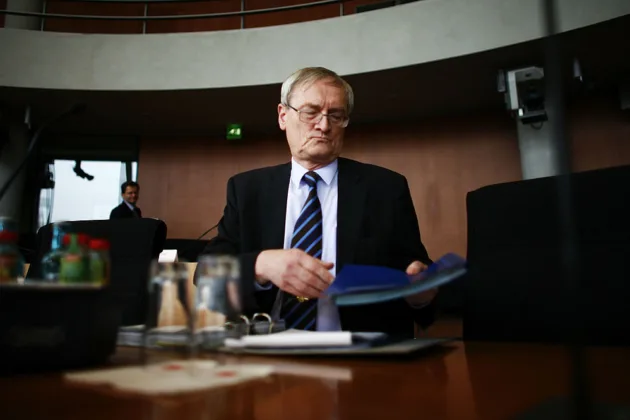












Germany’s former Federal Intelligence Service (BND) president August Hanning has been arrested on suspicion of treasonous espionage, spying out state secrets, attempted treason and intelligence-agent activity.
The 80-year-old former intelligence chief was detained by officers from the Federal Criminal Police Office (BKA) at his home near Münster, western Germany, on the morning of October 6, while investigators also arrested his former chief of staff, identified as Manfred D., in the Bad Tölz-Wolfratshausen district of Bavaria, southern Germany.
The two men are suspected of having been involved in a years-long operation in which highly classified BND material was allegedly passed to Hanning after he had left government service. Prosecutors are investigating whether he used the intelligence for private consulting work and to prepare information for foreign intelligence services.
The first detailed public report came from a joint investigation by NDR, WDR and Süddeutsche Zeitung, published on October 6, 2026.
The federal prosecutor general’s office formally confirmed the arrests shortly afterwards, stating that warrants issued by an investigating judge of the Federal Court of Justice had been executed by the BKA.
According to the warrants, Hanning and Manfred D. are suspected of agreeing in the spring of 2010 that D. would provide Hanning with intelligence from the BND in exchange for money.
The alleged arrangement continued for years, with investigators believing that D. supplied Hanning with almost 2,000 documents by June 2022, many of them classified and intended for internal use by the BND’s senior leadership.
Hanning allegedly used the material in connection with his private security and intelligence consultancy activities.
The investigation goes beyond the alleged unauthorised possession of classified material. Prosecutors are examining whether Hanning used information from BND documents to prepare an intelligence analysis for an employee of a foreign intelligence service.
Investigators also believe he maintained an informal exchange of political information with an official from another foreign intelligence service over a period of years.
German authorities have not identified the foreign services allegedly involved and there is currently no indication that the case is connected to Russia. One of the services has been described by investigators as hostile to German interests.
It also remains unclear whether all the information allegedly prepared for foreign intelligence actually reached its intended recipient.
Born in 1946, Hanning is a lawyer who spent decades at the centre of Germany’s security and intelligence apparatus. Before becoming BND president, he held senior positions in the Federal Chancellery and was responsible for coordinating Germany’s federal intelligence services.
He became president of the BND in December 1998, succeeding Hansjörg Geiger, and remained in charge until November 2005.
The BND, or Bundesnachrichtendienst, is Germany’s foreign intelligence service, broadly comparable to the Central Intelligence Agency (CIA) in the United States or MI6 in the United Kingdom. Its task is to collect and analyse intelligence concerning foreign countries and threats to Germany’s national security.
In December 2005, Hanning became a state secretary at the Federal Ministry of the Interior, where he was responsible for major areas of domestic security. He remained in the position until November 2009 before moving into the private sector.
After leaving government, Hanning established himself as a security and intelligence consultant, advising private and institutional clients on security, intelligence and geopolitical matters.
Hanning allegedly had access to sensitive intelligence even after he had formally left the BND, not because he retained an official position, but because a former senior colleague is accused of continuing to provide him with internal documents.
The second suspect, identified by German authorities only as Manfred D., was a long-serving senior BND official and Hanning’s former chief of staff.
According to investigators, D. allegedly became the source through which Hanning obtained the classified material. He went on to serve as chief of staff to several BND presidents between March 2012 and March 2026, giving him continuing access to sensitive information at the highest levels of the organisation.
Prosecutors accuse D. of aiding attempted treason and treasonous espionage. Hanning is suspected of paying for access to information, while D. is suspected of abusing his position to obtain and transfer it.
German investigators were initially looking into a separate matter involving the alleged abduction of the children of Hamburg entrepreneur Christina Block. In September 2025, investigators searched Hanning’s home and offices as part of that investigation.
During the examination of material seized in those searches, investigators reportedly found an electronic storage device containing highly sensitive information.
According to NDR, WDR and Süddeutsche Zeitung, the material indicated that Hanning possessed recent BND documents that he should not have had access to after leaving the agency in 2005. Investigators began examining how he had obtained the material and allegedly traced the documents back to Manfred D.
The arrests have prompted calls for a full account before the Bundestag. Marc Henrichmann, the Christian Democratic Union (CDU) chairman of the parliamentary panel that oversees Germany’s intelligence services, called the detention an important signal, while his Green deputy on the panel, Konstantin von Notz, demanded swift and complete clarification.
At this stage, these remain allegations under investigation, not convictions.
Both suspects are due to appear before an investigating judge at the Federal Court of Justice, who will examine the arrest warrants and decide whether they should remain in pre-trial detention while the investigation continues.
Investigators are also expected to continue analysing seized electronic devices and documents.
The key questions will be how much classified information Hanning received, what he did with it, whether any material reached foreign intelligence services, which services may have been involved and how much Manfred D. knew about its ultimate use.
A decision to keep the suspects in custody would not mean that they have been found guilty. Prosecutors would still have to complete their investigation and, if the evidence meets the required threshold, bring formal charges before a court.