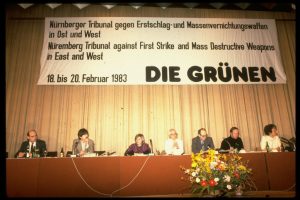







Were Petra Kelly, a founding “Fundamentalist” of the German Greens, to return and take a look around her country, at first glance she could well conclude that her party had triumphed. Consider the Greens’ foundational objectives when the party emerged in the early 1980s: Denuclearisation is now complete, with the complete shutdown of Germany’s nuclear power industry. Disarmament reduced Germany’s 5,000 main battle tanks to 320, and the once-mighty Bundeswehr to a NATO weakling. Deindustrialisation is replacing heavy industry and manufacturing with sunshine and windmills.
Kelly might be well satisfied at the accomplishments of her party, at least until she took a longer look at the world Germany now inhabits. The end of the Cold War did not lead to an era of “Third Way” pacifism, but a snarling Russian empire requiring a military response. The Energiewende (energy transition) did not generate employment for laid-off autoworkers, but drove factories to China, where coal-fired power is cheap and labour rights are non-existent. To the extent that the goals of the early Green fundamentalists have been achieved, they have beggared Germany and rendered her incapable of effective deterrence.
To their credit, the Greens have matured far beyond their otherworldly origins. The party is now a vociferous supporter of war against the Kremlin. Leaders once devoted to the gospel of arms control and treaties now doubt their efficacy in taming Putin’s designs on Ukraine. Green parliamentarians previously dubious of the military voted to exempt defence spending from Germany’s constitutional debt brake. The embrace of armed force as a potential force for good became Green dogma once the first Green foreign minister and determined “Realist” Joschka Fischer unleashed the German Luftwaffe on Serbia as part of NATO’s 1999 campaign to compel Belgrade to disgorge its province of Kosovo. The pacifist dreams of the founding Greens have succumbed to the realities of a violent world.
What remains of the Greens’ original programme is environmentalism du jour. Now that acid rain and ozone layer depletion no longer justify complete political control of the economy, the eco-left raises consciousness and funds off the threat of carbon emissions. A contrived panic over the looming demise of humankind served to jam Net Zero mandates into EU law, orchestrated in large part by the German Greens. Environmentalism is a passion in prosperous societies that have already made the long climb from subsistence agriculture to consumer prosperity. The fossil fuels burned to accomplish this are now the Greens’ original environmental sin, requiring massive, taxpayer-subsidised penance and stern lectures on sustainability to the developing world. Only the global dictates of environmental experts can prevent the great engines of prosperity from boiling the oceans. The transcendent creed of holy eco-activism echoes the party’s original quest for a spiritual alternative to corrupt power politics.
Petra Kelly’s Greens incubated in European affluence, far removed from the mines, oil wells and factory floors that created it. The young students who embraced the Greens were latter-day Wandervögel (the romantic youth movement of the early 20th century), seeking that ineffable German soulfulness and an escape from materialism, social hierarchies and technology. Today’s Greens may take a sterner view toward Russia, but are equally distant from the means of production, neither toiling on factory floors nor managing their output. They are instead heavily concentrated in western Germany’s laptop class: Academics, journalists, NGO administrators and Beamte, those tenured civil servants blessed with private health care and complete job security. They constitute a left-wing party devoid of class consciousness. Their preferred policies suggest a deep disdain for German workers and their regrettable affection for fast cars, cheap schnitzel and budget flights to Málaga.
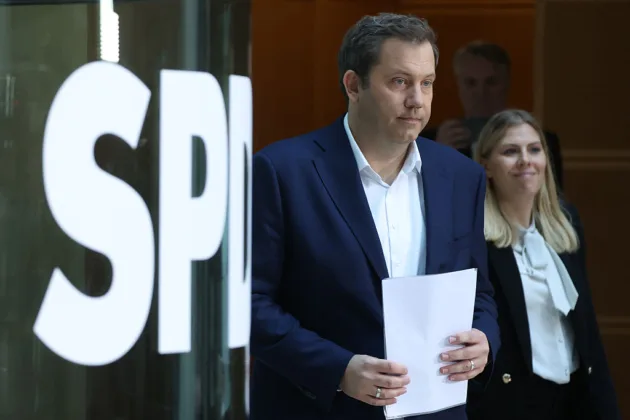
The Social Democrats, for all their recent affinity for outré cultural issues, remain ballasted by labour unions with a strong interest in keeping assembly lines humming and pension plans funded. Even the most Bolshie of autoworkers in Wolfsburg knows that if Volkswagen cannot sell cars, it cannot pay him either. The Greens, by contrast, lack a grassroots constituency dedicated to increasing material wealth, as most of them enjoy affluent lives and paychecks that materialise in their bank accounts as if by magic rather than from meeting monthly sales and production targets. Legitimacy for the Greens derives not from the laboring classes below, but from adherence to the great European project above national politics and tawdry patriotism. No party in Germany is more committed to European federalism, which has replaced the woolly globalism of the early Greens with devotion to the arbitrary dictates of the European Commission.
This distance from the industrial sources of German prosperity allows contemporary Greens to espouse policies comfortably detached from their consequences, but pleasantly adorned with an EU endorsement. Loyalty to Brussels explains the Green passion for policies that make no sense to average Germans. Cheap gas is the best available substitute for Germany’s dirty brown coal, but accessing it will require either an unlikely European mastery of the spot market in liquefied natural gas or an accommodation with Russia. Wind and solar power require massive taxpayer subsidies and expensive (gas or coal-fired) backup generation. High energy costs cause a wave of career-killing layoffs in Ludwigshafen, southwest Germany, but a small ripple in the household budget of a credentialed Green administrator. The EU’s Net Zero mandates will not alter the fact that fossil fuels will remain a stubborn majority of the energy mix in every industrial economy for decades to come. “Let them drive Teslas” is not a persuasive argument to unemployed machine tool operators.
The economist Thomas Sowell once observed that there are no solutions, only trade-offs. The Green Party’s embrace of Net Zero mandates, its opposition to any peace deal that leaves Putin in power, and its support for ruinously expensive wind and solar leave Germany with costly energy, factories unable to compete globally, and the deindustrialisation of Germany as business flees to low cost jurisdictions overseas. Are these sacrifices worth a highly speculative reduction in the paltry 1.4 per cent of global greenhouse gases produced annually by Germany? The high church of comfortable Wessis (west Germans) cannot entertain this question without sacrificing its only unifying principle. What Petra Kelly’s political descendants can deliver to party adherents is the comfort of moral superiority, well insulated from the economic storms battering the less fortunate.