










Poland has lost a series of legal challenges against key elements of the European Union’s climate package, including plans to phase out new combustion-engine cars, after the European Court of Justice (ECJ) dismissed all seven of its lawsuits on November 12.
The ECJ dismissed seven actions brought by Poland against acts from the EU’s “Fit for 55” legislative package, which aims to achieve climate neutrality for the EU by 2050.
In order to reduce greenhouse gas emissions in the EU by at least 55 per cent by 2030 compared with 1990 levels and to achieve climate neutrality by 2050, the EU adopted legislative measures comprising the “Fit for 55” package.
Poland subsequently brought actions before the ECJ seeking a declaration of invalidity of seven acts forming part of this package. The cases were brought in 2023 during Poland’s previous government, led by Mateusz Morawiecki of the national-conservative Law and Justice (PiS) party.
The Polish authorities had targeted stricter emissions rules for cars, the EU’s carbon border tariff, national emissions reduction targets, the expansion of the bloc’s Emissions Trading System and greenhouse gas requirements for forestry and land use.
These included a regulation banning the sale of new combustion-engine cars from 2035, along with reforms to energy efficiency rules and carbon pricing, including a new emissions trading system for motor and heating fuels (ETS2) and the carbon border adjustment mechanism (CBAM), which acts as a CO2-emissions-based import tariff.
Warsaw argued that the acts it contested were primarily of a fiscal nature and affected the country’s overall energy mix. Consequently, the Poles argued, the measures should have been adopted on the basis of a provision of the Treaty on the Functioning of the EU (Article 192(2)) that requires unanimity when voting in the Council of the EU.
The Polish government also maintained that some of the rules undermined the welfare of EU citizens by driving up energy prices and threatening jobs.
The ECJ rejected Poland’s arguments, saying that exceptions to the principle of qualified majority voting must be interpreted strictly, a reference to the EU’s standard process where new laws require a simple majority in the European Parliament and a qualified majority among member states in the Council of the EU.
“The Court holds that none of the seven measures contested has as its primary purpose significantly to affect a Member State’s choice between different energy sources and the general structure of the energy supply of that Member State,” the ECJ said in a statement.
“The fact that an environmental measure may produce indirect or incidental effects in fields other than that in which it pursues its primary purpose does not justify recourse to such an exception,” the court said.
It found that six of the contested acts fall within EU environmental policy and the seventh, the energy efficiency directive, within energy policy. It also ruled that the principle of energy solidarity invoked by Warsaw applies only to energy measures.
The ECJ also held that even if EU institutions must consider the interests of every country when drawing up legislation, “it cannot be ruled out that an EU measure may have negative impacts for certain Member States”.
EU legislation may negatively impact individual member states, the court said, adding that such consequences had been taken into account in the climate package.
The ECJ cited compensatory measures, including the Social Climate Fund, designed to cushion the impact of the transition. The fund is worth at least €86.7 billion for 2026-2032, with Poland its largest beneficiary at about €11.4 billion.
The EU’s top court also stressed that the welfare of EU citizens was not the bloc’s only objective, with sustainable development and environmental protection carrying equal weight.
Michael Bloss, a German Green MEP, described the court’s decision as “a boost for European climate action”. He said the EU must stay the course and take a leading role in negotiating ambitious agreements at the UN Climate Change Conference (COP31) taking place in Antalya, Turkey, until November 20.
His Greens/EFA colleague Pär Holmgren also welcomed the ruling. “The court has backed the EU’s flagship climate laws and Europe must now act as a global leader over the coming days at COP,” the Swedish lawmaker said, referring to the UN climate summit. “No single government should be able to veto our climate future.”
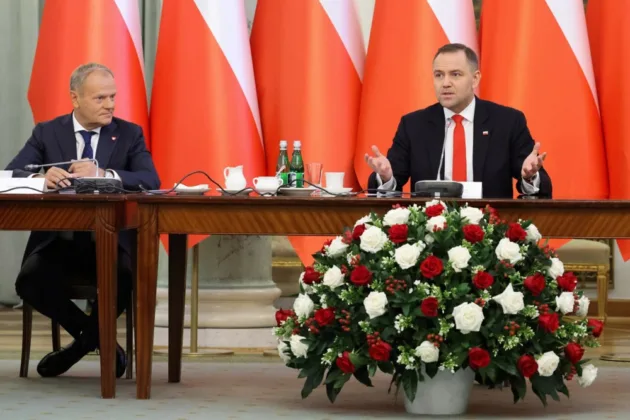
Poland’s centre-left government led by Prime Minister Donald Tusk was not surprised by the ECJ ruling, saying “it had been expected”, but said that it would continue to argue for a softening of the bloc’s climate policies.
While the court’s decisions are final, Poland will continue to push for targeted flexibilities, such as further delays to the new carbon market for heating and transport, whose launch has already been postponed by a year to 2028.
Meanwhile, moves are under way within the EU to soften parts of its climate legislation.
The European Parliament’s environment committee has backed a proposal to relax the bloc’s planned phase-out of combustion-engine cars. Under the proposed changes, carmakers could continue selling some new vehicles with combustion engines and hybrids beyond 2035 without facing penalties.
On November 4, the committee voted 48 to 30 to cut the 2035 CO2 reduction target for new cars from 100 per cent to 87.5 per cent, below the 90 per cent proposed by the European Commission. The full European Parliament is expected to vote in December.
Poland’s opposition PiS and the opposition-aligned President Karol Nawrocki, though, want to put pressure on the EU by holding a referendum on its climate policies, which they argue are proving disastrous for both businesses and individual consumers of energy.
Nawrocki has twice asked the Senate to approve such a vote, in May and July. The upper house rejected both requests, the second on August 6.
The country will hold a parliamentary election in autumn 2027, in which the opposition Right will argue that Poland must resist EU policies such as the Green Deal and the Migration Pact, and should not join the eurozone or accept any further restrictions on the member states’ power of veto.
There will, though, be some friction on the Right over the issue, since it was during the last PiS government that many EU climate policies were adopted.
The libertarian-nationalist Confederation (Konfederacja) party has consistently argued that the last PiS government did not do enough to stop these policies coming into force. Morawiecki, the last PiS prime minister, who now leads the breakaway Development Plus (Rozwój Plus) movement, backed by 40 former PiS MPs, maintains that Poland at the time lacked the necessary allies to prevent Green Deal policies coming into force.
The Polish Right will be united in arguing for restricting the powers of EU institutions such as the European Commission and the ECJ and for the supremacy of the country’s constitution over European legislation.
They hope that major change may be imposed on both the European Commission and the European courts via a change of government in key member states such as Poland, Spain and France over the coming 12 months, and the weakening position of the German coalition Government led by Chancellor Friedrich Merz.