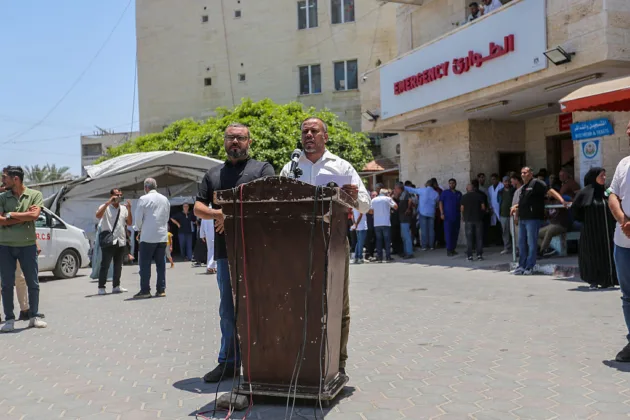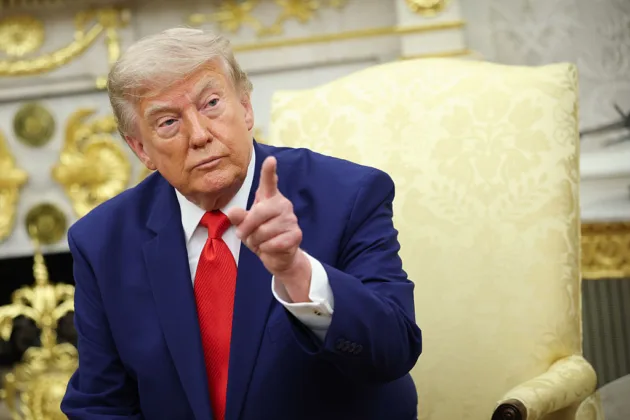





Israeli Prime Minister Benjamin Netanyahu has rejected the 15-point roadmap for Gaza drawn up by United States President Donald Trump’s Board of Peace, the body the European Union has funded around but declined to join.
“Israel rejects the 15-point document,” he said at the start of the weekly cabinet meeting on August 9. He said Israeli forces would carry out no withdrawal until Hamas was genuinely disarmed.
He defined that as the surrender of heavy and light weapons alike, and said Israel was discussing the text with Washington.
The Board of Peace published the roadmap on July 31, a day after Trump announced that Hamas and other armed groups had agreed to give up their arsenals.
The plan ties each stage of an Israeli pull-back to verified decommissioning rather than requiring Hamas to disarm first. It also hands civil administration to the Palestinian committee that took over from the Hamas-run authority in Gaza and refers to a credible pathway towards statehood.
Netanyahu ruled that last element out. He said no Palestinian state would be established in Gaza or in the West Bank while he remained in office.
Hamas said hours later that it remained committed to the roadmap agreed with the mediators and the Board of Peace, and pressed for a firm timetable. Bassem Naim of its political bureau accused Netanyahu of gambling with the talks for electoral gain.
The EU has endorsed the wider peace plan and UN Security Council Resolution 2803 that underpins it, though it sits outside the Board of Peace. Brussels pledged €900 million for early recovery in Gaza at a donors meeting on July 13 and has tied that spending to the removal of Hamas weapons.
EU foreign policy chief Kaja Kallas welcomed the disarmament agreement last month as “a constructive step” if carried out in full. She said verifying compliance would be a significant challenge and that Israel would eventually have to leave the Strip.
Two EU missions, the border assistance mission at Rafah and the police mission for the Palestinian territories, are earmarked for roles in the transition.
Israel’s security cabinet approved a first entry by the International Stabilisation Force on July 26, covering about 200 personnel from countries including Morocco and Uganda. Israel retains a veto over which states may contribute troops.
Board of Peace high representative Nickolay Mladenov, a former Bulgarian foreign minister, told broadcaster Channel 12 that the roadmap is meant to ensure Gaza never again threatens Israeli security.
Netanyahu faces a general election on October 27 with his coalition’s majority in doubt and right-wing ministers pressing him against any staged pull-out. Israeli forces have scaled back operations in Gaza since Mladenov met him on August 3.