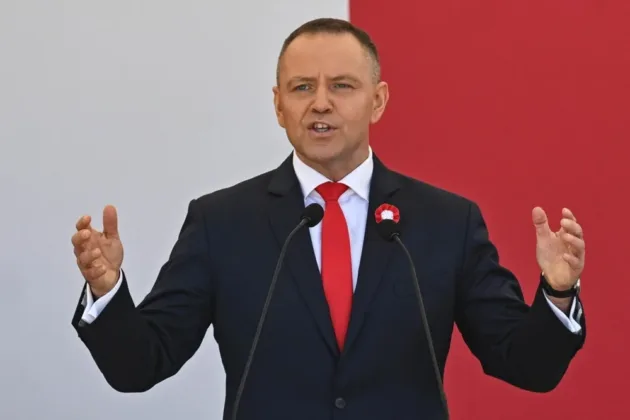











A council appointed by Poland’s right-wing, opposition-aligned President Karol Nawrocki has begun work on proposals for reforming Poland’s constitution in the direction of giving more power to the elected President at the expense of the government that is elected by the country’s parliament.
Nawrocki has authorised the council to prepare proposals for what he has called a “new-generation constitution” by 2030 and has argued that Poland’s current system of government divides executive authority too ambiguously between the President and Prime Minister. He has suggested that the country consider either a presidential system or a system with a strong prime minister.
Since the President, unlike the PM, is elected by popular ballot, Nawrocki has made clear that his preference would be for a system which strengthened rather than weakened the head of state’s executive powers.
The 47-member advisory body tasked with coming up with a new constitution includes constitutional lawyers, judges, academics and politicians.
The work of Nawrocki’s council is being boycotted by politicians from the ruling centre-left coalition led by Prime Minister Donald Tusk, so most of the politicians who have become its members are from either the former ruling Law and Justice (PiS) party or Confederation (Konfederacja).
The parties that back Tusk’s government, which came into office in 2023, have argued that the country does not need a new constitution, only to remove appointees and some institutions set up by the previous PiS administration which governed Poland in the period 2015-2023.
Tusk and his allies maintain that there is no likelihood of securing the parliamentary support required for a new constitution and that there is no support in the country or in parliament to work on one.
A constitutional amendment requires a two-thirds majority in Poland’s parliament. No political party or coalition of parties has enjoyed such a majority since the new constitution was approved in 1997.
Nawrocki’s political allies do not currently have any prospects for winning such a majority, meaning that any major constitutional changes would require support from parties outside the political Right. The current polarised Polish political climate in the run-up to the parliamentary election due in autumn 2027 makes that a doubly unlikely prospect.
The council’s membership and proposals already advanced by some of its members suggest that the balance of power between the presidency and government will be one of the central issues in its work.
Paweł Kukiz, an MP and rock musician, who stood for President as an independent in 2015 and has since become part of the opposition Right, has said the council’s work should determine whether Poland should move toward a presidential system or one with a strong prime minister, or chancellor, along the lines of Germany.
Krzysztof Szczucki, an MP for Rozwój Plus (Development Plus), the 41-strong parliamentary club set up in July by former prime minister Mateusz Morawiecki after his break with PiS, has already proposed changes modelled partly on France’s political system that would give the president greater influence over the government and state institutions.
In France the President has the power to dissolve parliament, appoints the Prime Minister and represents the country at international fora such as the EU and NATO.
But Ryszard Piotrowski, a constitutional law professor and another member of the council, has argued for the status quo because he believes that Poland’s constitutional problems stem largely from the way politicians bend the constitution to their will.
“We do not need any reset; we do not need any new constitution,” he said after joining the council.
Under Poland’s current constitution, the directly elected President has significant powers, including the right to veto legislation, the right to submit legislative proposals to parliament, the power to appoint judges and ambassadors and the discretionary power of mercy.
The government is accountable to parliament and is responsible for most domestic and foreign policy.
The division of powers set in the constitution, adopted in 1997 after a national referendum in which 53.45 per cent voted for the new constitution on a turnout of 42.86 per cent, has repeatedly caused disputes when the President and government come from opposing political camps.
Under Nawrocki and his predecessor Andrzej Duda, who was also allied to the opposition PiS, conflicts with the Tusk government have included ambassadorial and judicial appointments as well as presidential vetoes of government legislation.
That conflict has been particularly marked since Nawrocki won the presidential election in 2025. In his first year of office Nawrocki has vetoed more than 40 pieces of legislation proposed by the Tusk majority and refused to sign judicial nominees backed by the ruling party.
Ratings agencies have tied that gridlock to Poland’s credit standing. Fitch has affirmed the country at A- with a negative outlook, saying non-cooperative relations between the government and the President, including a record number of vetoes, constrain Poland’s ability to implement economic policy. Moody’s has also moved its outlook on Poland’s A2 rating to negative, citing the stand-off. Fitch expects real GDP growth of 3.3 per cent this year, above the peer median, alongside a general government deficit of 6.9 per cent of GDP. Public debt passed the EU’s 60 per cent ceiling for the first time in the first quarter of 2026.
While the balance between the executive, legislative and judicial arms of government is likely to remain the biggest issue facing the council, there will also be other issues which will have to be addressed if a new constitution is to be proposed in 2030 ahead of Poland’s next presidential election.
Tusk’s party, the Civic Coalition (KO), when in opposition in the 2000s argued that Poland should move away from proportional representation and that parliament should be elected in single-member constituencies. It also argued for the abolition of the second chamber, the Senate, which it said has few powers and merely duplicates the work of the Sejm, and for the removal of parliamentary immunity.
When in power, though, the KO has not pursued any of these proposals, preferring to argue that there was insufficient support in parliament for them.
There have also been voices, such as that of foreign minister Radosław Sikorski from Tusk’s party, who have argued that the disputes around the Constitutional Tribunal, whose members are elected by parliament, show that it should be scrapped and its responsibilities taken over by a new chamber of the Supreme Court, the top court which currently deals with all non-constitutional legal matters.
Politicians who wish to see closer integration with the EU would want the bloc to be mentioned in the constitution with regard to the primacy of European law, and the zloty removed as Poland’s national currency.
The Polish Right will strongly oppose any such change, though, as it does not want any more transfer of powers to the EU nor the adoption of the euro.
The Liberals would also wish to remove from the constitution protection for the unborn child and marriage being defined solely as a union between man and woman, whereas the Right will want provisions definitively ruling out same-sex marriage and abortion.
Nawrocki will need his right-wing allies to win a majority in the Polish parliament next year for any progress to be made on his constitutional proposals. Only parliament could agree to a constitutional referendum that could put enough political pressure on Poland’s politicians to agree to any changes.
Judging by the past, though, there is little appetite among the public to debate constitutional matters. Not only was the referendum on the present constitution poorly attended but a referendum on proposals to introduce single-member constituencies in parliamentary elections held in 2015 drew a turnout of 7.8 per cent, the lowest recorded in any nationwide vote since 1989. Its result was not binding because the referendum law requires a turnout of more than 50 per cent.
The only referendum in Poland’s modern history to clear that threshold took place in 2003, when a turnout of 58.85 per cent saw 77.45 per cent of those voting back joining the EU.
Nevertheless, should it prove difficult for parliament to produce a stable government after the 2027 elections, Nawrocki may find there is political space opening up for him to argue for a more presidential form of government modelled on France.
Nawrocki, since taking office in August 2025, has become the only unifying figure on the Polish Right as the parties of that orientation have fragmented. As a result he is currently the most important figure on the Polish Right and likely to be its agenda maker in the coming years.
The head of state cannot count his chickens before they are hatched, though. The Right is currently split into four parties, with no single one able to dominate the others. This makes it unlikely Nawrocki will be able to act as a midwife to any electoral alliance between them and he will face a tricky job of negotiating an agreement between them after the autumn 2027 contest.
It is also acknowledged that should Tusk manage to herd together onto one electoral slate all the parties that support his government and then manage to hold on to his parliamentary majority, Nawrocki’s plans for reforming the constitution could be dead in the water.