





The centre-left government led by Prime Minister Donald Tusk has refused to allocate any funding whatsoever in its 2027 budget for Poland’s constitutional court, with which it has been engaged in a bitter dispute since Tusk took office in December 2023.
The Tusk administration has prepared a budget for election year 2027 with a projected general government deficit of 7.1 per cent of GDP, well above the level of 3.7 per cent the government had committed to reach by 2027 after Poland was placed under the European Union’s excessive deficit procedure in July 2024.
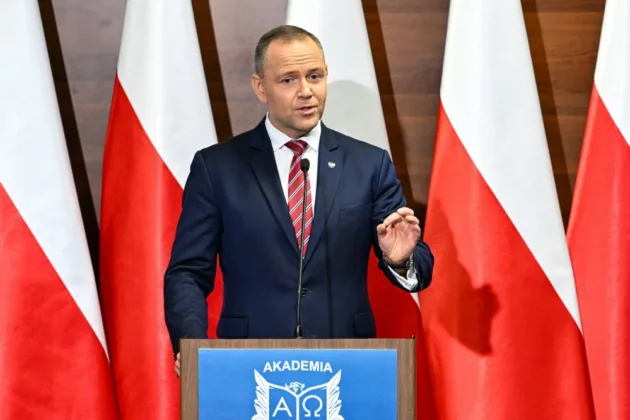
Answering questions why the budget for 2027 made no provision for the constitutional court (TK) finance minister Andrzej Domański said that it was left out of the draft because the court failed to submit a properly approved spending plan. Deputy finance minister Hanna Majszczyk said the plan had to be adopted by the General Assembly of TK judges.
The government argues that the opposition allied President Karol Nawrocki has broken the constitution by refusing to swear in four justices elected to the court and that the present president of the court Bogdan Święczkowski has invalidated the court’s budget submission by not allowing the four judges to participate.
The constitutional court has rejected that explanation and said that the failure to fund the court was a violation of law as the TK is a body the existence of which is guaranteed in the constitution. It said Święczkowski had sent the 2027 spending plan on July 30, in line with 30 years of practice.
The four took their oath of office in the Sejm on April 9, 2026, though by law the exclusive right to take the oath of office from TK judges remains with the President, therefore the head of state does not accept that they are judges in that court.
The Tusk government has, since coming into office in 2023, refused to publish decisions taken by the court as it considers the court’s membership to be illegitimate because of a disputed election of three judges during the lifetime of the last Law and Justice (PiS) government.
Right leaning judges in the TK still have a majority on the court but a dispute between the Tusk majority in parliament, which has elected four judges the election of which had been delayed for two years, and the President and TK which challenge that election is likely to paralyse the working of the court.
Unlike other legislation, the budget law cannot be vetoed by the President, the office currently occupied by the opposition right’s ally Karol Nawrocki, who may only refer it to the TK, otherwise he is required to sign it within seven days of receiving the law from parliament. If he did decide to do that the draft budget would come into operation until the TK ruled on its constitutionality.
According to the budget Poland is set to spend around 977.6 billion zloty (€226 billion) against revenue of around 695 billion zloty (€161 billion), meaning that the budget deficit projected for 2027 is 282.6 billion zloty (€65.3 billion), or about 6.4 per cent of the country’s GDP. The wider general government deficit is put at 7.1 per cent.
Tax revenue is forecast to be at the level of 622.4 billion zloty (€144 billion) driven by higher VAT and corporate tax receipts, which the government attributes to stronger profitability among Polish firms and to a planned rise in corporate tax from 19 to 22 per cent for the largest firms.
Poland’s gross borrowing needs are projected at 565 billion zloty (€131 billion) in 2027, lower than the under 600 billion zloty now expected for this year. Debt servicing costs, though, are set to rise to almost 107 billion zloty (€24.7 billion), 17 billion zloty (€3.9 billion) more than this year, reflecting both a growing level of national debt and the need to refinance older bonds issued at near-zero interest rates.
The projected deficit leaves Poland under continued pressure to bring its public finances into line with EU fiscal rules.
In 2024, the country was placed under the EU’s excessive deficit procedure after its 2023 deficit exceeded the bloc’s limit of 3 per cent of GDP. Warsaw pledged itself to bring the deficit below 3 per cent by 2028.
The deficit rose from 6.4 per cent of GDP in 2024 to 7.3 per cent in 2025, which was the second-highest level among all EU member states, behind Romania.
This year, Poland’s public debt is projected to pass the EU’s limit of 60 per cent of GDP for the first time since Poland entered the community, reaching 67.9 per cent against 59.7 per cent at the end of 2025, with 70.6 per cent forecast for 2027.
According to the government the budget presented on August 28, 2026 prioritises national security and defence, healthcare and strategic investments in infrastructural projects. It now goes to the Sejm and, for the first time, to the new fiscal council.
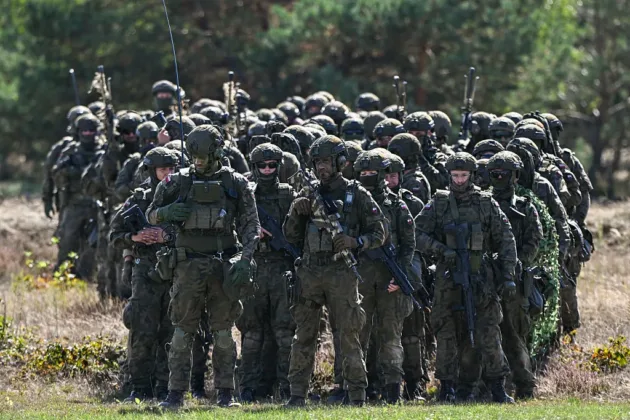
Defence will be a key spending priority, reaching 198.1 billion zloty (€45.8 billion), the equivalent of 4.51 per cent of GDP and public security services, including police, border guards, the fire service and the special services, have been allocated 36.5 billion zloty (€8.4 billion). Healthcare funding is to rise by 26.3 billion zloty (€6.1 billion), reaching 274.1 billion zloty (€63.3 billion) in total.
Energy security and transformation initiatives will receive 19.7 billion zloty (€4.6 billion), an 8.3 per cent increase on 2026, including 8 billion zloty (€1.8 billion) to recapitalise Poland’s first nuclear power plant project. Other planned energy investments include the 1.5 GW Baltica 2 offshore wind farm, a combined-cycle gas unit in the town of Rybnik in the Silesia region and a lithium-ion energy storage facility at Żarnowiec on the Baltic coast. Combined spending on road and rail transport infrastructure will total 62.4 billion zloty (€14.4 billion).
Tusk told reporters that the budget deficit is high as a result of pressures of military spending caused by the tense situation on Poland’s eastern border with the war raging in Ukraine, the conflict involving Iran raising energy prices and the need to preserve social spending and boost expenditure on healthcare.
He promised that the government would not let those constraints bring the Polish economy to a halt.
Domański said the government expects economic growth of 3 per cent next year, with inflation projected as averaging 2.8 per cent, within the central bank’s target of 2.5 per cent, plus or minus one percentage point, and unemployment is expected to be 6 per cent by the end of 2027, broadly the same level as at present.
Average wages are expected to rise by 5.9 per cent next year in nominal terms and 3 per cent in real terms, slightly slower than the 6.4 per cent forecast for this year, but still above the projected annual rate of inflation.
Analysts in major Polish banks agree that the 2027 budget marks the continuation of expansionary fiscal policy, and that Poland is making no progress in correcting its excessive deficit, taking no action to bring it below 3 per cent of GDP. Ernest Pytlarczyk, chief economist at Bank Pekao, said the absence of any assumed consolidation was unsurprising given the political cycle.
The ratings agencies Fitch and Moody’s, which have shifted Poland’s credit outlook to negative, have pointed to political gridlock between the government and the opposition allied President Nawrocki as being a significant factor. Fitch confirmed the A- rating with a negative outlook on August 21, 2026.
Nawrocki has vetoed tax increases, though he did approve a higher rate of corporate tax on banks, which took effect this year.
Given that 2027 will also see pivotal parliamentary elections, at which Tusk’s ruling coalition, which ranges from left to centre right, will seek a second term while the right-wing opposition, supported by Nawrocki, will attempt to win power the chances of cooperation between the head of state and the government are virtually nil.