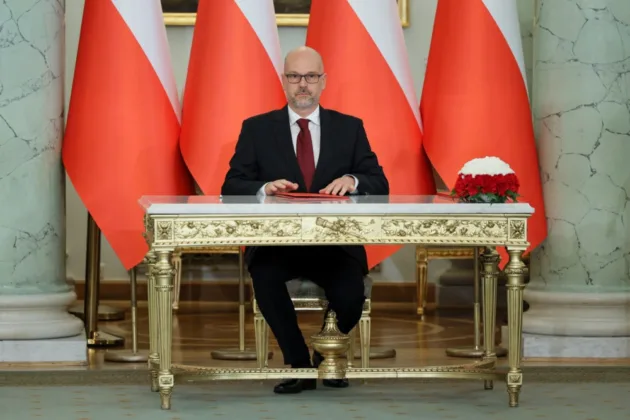




Poland’s parliament has voted to elect Maciej Berek, a key minister in the centre-left government led by Prime Minister Donald Tusk, to be a judge of the country’s Constitutional Tribunal (TK).
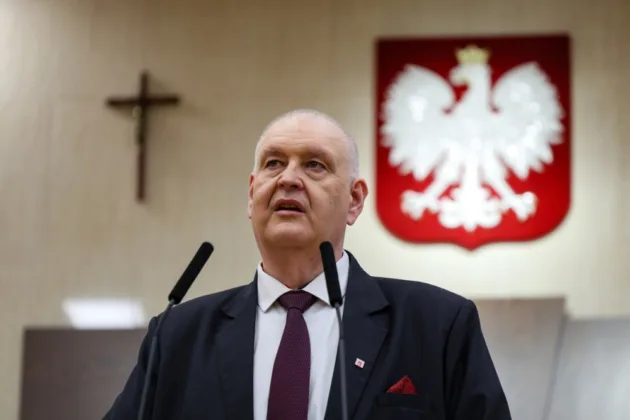
Berek, whom Tusk once described as his “right hand man” and who served as coordinator of the government’s legislative programme since Tusk came into office in December 2023, won the vote in the Sejm, the lower house of parliament, on September 4. He took 226 votes against 184 for Artur Kotowski, the candidate put forward by the opposition Law and Justice (PiS) party, with 27 deputies voting against both men. The absolute majority required was 219. Several deputies from the ruling coalition abstained or stayed away, among them Franciszek Sterczewski of the Civic Coalition, Marek Sawicki of the Polish People’s Party and Ryszard Petru of Centre.
The vote fills a vacancy which will arise on September 18 when the nine-year term of office of one of the current judges on the TK, Justyn Piskorski, expires. Judges of the TK are elected individually by the Sejm for single nine-year office terms, by an absolute majority.
Opponents, including the whole of the opposition right, argued that Berek, who until August served as a minister in Tusk’s government, should not sit on the tribunal.
Adrian Zandberg, co-leader of the left-wing opposition party Razem, held up a photograph from 2016 rule-of-law protests during Law and Justice’s time in power, telling Tusk directly: “you are simply betraying these people.”
Berek’s candidacy had drawn criticism within the ruling coalition itself pointing to 2024 legislation, ultimately vetoed by then-President Andrzej Duda, that would have barred former government ministers from becoming judges for four years after leaving office. Because that law never entered into force, the four-year bar does not apply and the coalition was free to proceed.
But despite the criticism, sometimes vociferous, the parties that form the coalition in the end swallowed their pride and backed Tusk’s candidate. Commentators feel that this was the biggest gain for Tusk from this dispute.
“Having broken the spines of his coalition partners the road is now open to push harder for the joint slate of all government parties in next year’s parliamentary election”, said Igor Zalewski, commentator for popular YouTube channel Kanał Zero.
He was referring to the fact that Tusk is keen to establish one slate to ensure that no votes are wasted through some of his coalition partners failing to reach the 5 per cent electoral threshold at the 2027 election and to give his political camp an advantage over the Polish right which is likely to fight the election on four separate slates – the Conservatives (PiS), the libertarian nationalist Confederation party, the Polish Crown party led by Grzegorz Braun MEP and the breakaway from PiS Development + led by former PiS PM Mateusz Morawiecki.
The issue now moves into the domain of the opposition-aligned President Karol Nawrocki who has to take the oath of office from Berek.
According to the constitution the justices elected by parliament to the TK have to take their oath of office before the President who must accept them unless evidence is produced of them being ineligible to hold the office.
Presidents have used this provision to withhold their consent before. Lech Kaczyński, brother of the PiS leader Jarosław, during his term in office declined for three months to swear in one such parliamentary nominee, President Duda refused to take the oath from five judges citing a breach in the parliamentary standing orders in their election and recently President Nawrocki has refused to take the oath from four judges elected on March 13 this year, his chancellery arguing that the Sejm had made procedural errors in electing them.
It is now highly likely that Nawrocki will decide to refuse to take the oath of office from Berek, citing the fact that he does not fulfil all the formal qualifications described in legislation with regard to candidates for membership of the TK. The head of the Presidential Chancellery, Zbigniew Bogucki, said before the vote that there were “far-reaching doubts” over whether Berek had genuinely practised as a legal adviser for the 10 years the post requires rather than simply appearing on the professional roll. Berek published a certificate from the dean of his regional bar only after the parliamentary justice committee had endorsed him, and Sejm Speaker Włodzimierz Czarzasty said the chamber’s own office had verified the candidate’s documents.
“I think the last thing the TK needs is another politician, especially a politician who is a close collaborator of Prime Minister Donald Tusk,” said Nawrocki one day ahead of the parliamentary vote.
Though, according to PM Tusk, during his term in government Berek had undertaken a technocratic role that was “apolitical and nonpartisan” and his extensive experience in constitutional law and the legislative process made him an ideal candidate to sit in the TK, but it is hard to make the case that the job of a minister in the cabinet is apolitical. Tusk has also stressed that Berek never belonged to a political party. Berek joins a long list of former parliamentarians and ministers who have served on the TK soon after performing political functions.
The Tusk government says that the President does not have the right to assess their candidacies and that the swearing-in is merely a formality.
That is why the ruling majority organised their own swearing-in ceremony in the Sejm’s Column Hall on April 9, after which they forwarded their oaths to the President.
Nawrocki refused to recognise this citing the fact that he had not as yet taken a decision on taking an oath of office from them but adding that them taking an oath of office outside of the law which states that they must do so before the President invalidates their candidacies.
The four judges – Marcin Dziurda, Anna Korwin-Piotrowska, Krystian Markiewicz and Maciej Taborowski – nevertheless attempted to take their seats in the TK to join the three elected by Tusk’s majority which the President had accepted. Though the chief justice of the TK, Bogdan Święczkowski, has thus far refused to allow them to adjudicate in cases since they have not taken their oath of office from the President.
On May 5 the European Court of Human Rights (ECHR) issued an interim order requiring that the four judges be allowed to take up their positions but that was denied by the chief justice of the TK on the ground that the European court does not have the authority to make such decisions as they are reserved for Poland’s own constitutional organs.
The situation is further confused by the fact that thus far the Tusk government has regarded the TK as being illegitimate because of the presence of judges which they allege were unlawfully appointed when the last Conservative (PiS) government was in office and that it has chosen not to publish any of the TK’s rulings since it came into office.
Tusk does not hide his intention to seize control of the TK now that he maintains that there are eight out of the 15 judges who have been elected since his coming into office.
He told the Campus Polska Przyszłości conference in Olsztyn on August 29 that he had to be certain in September that “our judges will enter this building” and that everything would be done lawfully, adding that he had no intention of capitulating.
Both he and his justice minister Waldemar Żurek have said that they are prepared to take drastic action to ensure that the new majority takes power. They have hinted that they may authorise security forces to install all of the judges elected to overcome resistance by chief justice Święczkowski.
On the same day that Berek was elected to the TK the government and Nawrocki clashed again in parliament over the President vetoing legislation to regulate the crypto-assets market.
Parliament voted for the third time in an attempt to overturn the President’s veto and yet again failed to achieve that since the Tusk majority does not have the three-fifths majority required to overturn vetoes. Some 241 deputies backed the bill and 198 opposed it, with three abstentions, leaving the government 25 votes short of the 266 needed.
The reason for the veto was the President’s view, supported by the right-wing opposition, that the law proposed by the government gave too much power to government officials and went well beyond the EU’s Markets in Crypto-Assets Regulation (MiCA). Nawrocki, who rejected the bill for the third time on June 11, has said he supports regulating the sector but that the government ignored most of the proposals drawn up by his own office.
The President’s move was met with an immediate attack from Tusk who suggested that the President had been influenced by lobbyists and accused the head of state and the opposition of having been involved with the failed crypto-currency exchange Zondacrypto, whose Estonian operator BB Trade Estonia OÜ was declared bankrupt by a Tallinn court on August 27. Prosecutors put customer losses at about 350 million złoty (€81 million).
Tusk, during a speech in parliament, cited evidence given by Przemysław Kral, the ex-CEO of Zondacrypto, and accused former justice minister Zbigniew Ziobro of having taken 2 million złoty (€464,000) from him in return for burying the investigations into the exchange once he returned to office, and of promising Kral that he would secure him a presidential pardon should Nawrocki win the presidency.
Ziobro has denied the accusations, describing them as part of a “special operation” to destroy the Polish right, though he has acknowledged that Kral donated 450,000 złoty (€104,000) to a foundation linked to him in 2025 and said he would not have accepted the money had he known then what is known about the businessman now.
The President’s chief aide Zbigniew Bogucki responded by saying that Tusk was “scraping the barrel” by citing the testimony of people accused of major crimes. Kral is charged with fraud and money laundering and may also eventually be charged for involvement in the disappearance and possibly death of the former owner of the company. The Zondacrypto inquiry was formally merged in early August with the investigation into the disappearance of Sylwester Suszek, founder of the BitBay exchange, who vanished on March 10, 2022.
Bogucki said that the current government had almost three years to have produced legislation to implement the EU’s MiCA rules, which have applied across the bloc since the end of 2024, but failed to either do that or to protect Poles from potential threats with regard to the crypto currency market. He accused the prosecution service of a record of discontinuing investigations and thereby aiding and abetting Zondacrypto.
The President’s chief aide also expressed surprise that Kral was being defended by Tusk’s family lawyer and MP Roman Giertych and securing Kral the status of a state witness. “Why is the PM’s lawyer engaging in the defence of a man whom the PM believes is in bed with the Russian mafia” asked Bogucki, referring to the fact that Tusk has consistently accused Zondacrypto of being involved with the Russian mafia.
He also dismissed allegations that the opposition and the President had in the past talked to Zondacrypto by citing examples of government ministers having attended meetings with that company.
The Tusk government has spent the period since late August arguing that the opposition had been funded by Zondacrypto and that the company had funded a CPAC event in Poland during President Nawrocki’s victorious election campaign.
Though Nawrocki himself on September 4 hit back by giving examples of how Zondacrypto had sponsored and participated in conferences which were attended by Tusk, Ursula von der Leyen and ministers from Tusk’s coalition.
Zondacrypto has funded foundations controlled by the former justice minister Zbigniew Ziobro and Confederation MP Przemysław Wipler and it is a fact that PiS MPs who had been in touch with the company had then participated actively in the legislative process on crypto assets.
The company has been a significant source of advertising revenue for independent conservative broadcaster TV Republika but has also advertised heavily in the mainstream media and provided funds for charity.
It was also the sponsor of the Polish Olympic Committee (PKOl), becoming its general sponsor in October 2025, when the committee’s Warsaw headquarters was renamed after the exchange. The head of the PKOl Radosław Piesiewicz, a close ally of a former PiS minister Jacek Sasin, was detained on August 27 and charged with trading in influence over a Patek Philippe watch valued at about €40,000 (170,000 złoty) which prosecutors say Kral gave him in return for using his contacts at the competition regulator UOKiK. He faces a second charge of settling with some Zondacrypto creditors at the expense of others and has been remanded in custody for three months. Piesiewicz denies wrongdoing and says he paid for the watch himself.