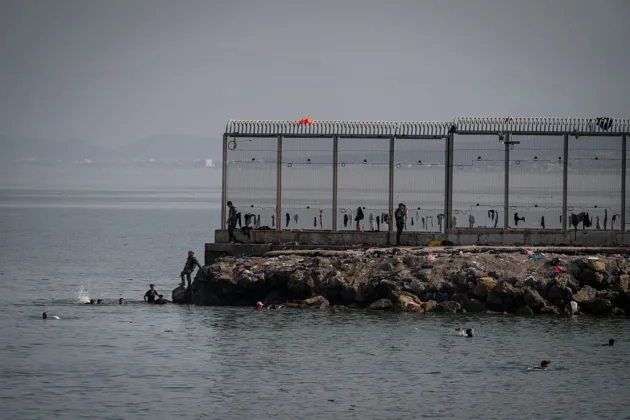



Take the story of Omar Danbor. Danbor is 17 and lives in Fnideq, the very Moroccan town whose beach ends at the Ceuta fence, and when the Associated Press talked to him after making his way into the Spanish exclave in late July, he appeared somewhat disillusioned: “I saw online that the border was open, and I decided to go. There are no mafias. The border was open, and I crossed. But now I regret it.” It might be true that there was no mafia of human traffickers, but obviously someone created the viral social media posts that created the impression that the border was “open”, which ultimately led to it being overrun. It is a bit like a manufactured bank run, where a rumour is started that your deposit is no longer safe so you better go and withdraw all your savings, and when everyone starts doing so, the initial rumour turns into a self-fulfilling prophecy.
A similar story is that of Brahim, a bakery worker from Fez who had quit his job and was hoping to get into Spain, after watching clips of thousands trying to do the same. He had survived three days in Ceuta on water alone, since a tuna sandwich cost 100 dirhams (€9) that he could not afford. A 16-year-old who had joined the rush after a Facebook post was found crying and asking strangers for taxi money home. Ultimately, of the 72,000 who entered the Spanish exclave — a city of some 84,000 — the interior ministry says about 70,000 returned to Morocco within days. Estimates of how many remain run from the 5,000 given by Prime Minister Pedro Sánchez on August 31 to the 13,000 claimed by the city’s president, Juan Jesús Vivas, on September 11, very much to the frustration of the local population that feels left alone by the central government in Madrid and that appears to be helpless, despite widespread displays of solidarity by other Spanish cities.
The social media stories that ignited the invasion must have been manufactured with some care, as even the legacy media is beginning to admit. Marianna Spring of the BBC, posing as a young Moroccan online, was quoted 5,000 dirhams (€457) by an Instagram account for “information that will help you enter Ceuta”, while other profiles on social networks were “actively recommended by Instagram’s algorithm” and also promised routes first into Ceuta and then on to Spain. The human trafficking business got very creative, and some Facebook groups shared screenshots from vessel-tracking sites to find the hours when the coast guard was thin before advertising wetsuits for sale. One “promotional” TikTok video mapped the swim of two young women who had made it across, showing them alive and smiling. At the last count the video had reached a stunning 32 million views across platforms, and on July 28 alone the shortened clip was amplified by as many as 215 separate accounts, indicating that this was not a spontaneous movement, but deliberately triggered via the use of social media.
Alas, none of this is new and the European Union as well as its member states are slow to react. Already in 2017 the German Foreign Office had to launch a website called Rumours about Germany to contradict human traffickers who lured in their victims by telling them that everyone arriving in Germany will receive a job, a house and €2,000 in cash. A year earlier a group of Iraqis boarding flights home from Berlin told the Los Angeles Times they had been falsely promised “big houses, well-paying jobs and the life of luxury”. A young Gambian woman who reached Spain in 2023 recounts a similar story: “I would scroll through Instagram and see people posting photos of their nice apartments and cars. I thought it was easy to get all of that if I moved there.” Europol has described the advertising of routes and prices on social media as “a widely used recruiting method” among smuggling networks. But sometimes even the human traffickers have become optional, and in the case of Ceuta it was the algorithm that did the recruiting and people were paying for wetsuits and tips on how to make it permanently across the border.
In the realm of geopolitics, this has been used as a means to blackmail Europe for at least half a decade. When, for example, Turkish leader Recep Tayyip Erdoğan declared the Greek border open on February 28, 2020 and his interior minister tweeted that an unverified number of 76,385 people had already left through Edirne, TRT Arabic published a map of routes into Europe, and WhatsApp and Telegram did the rest to get people moving. Back then, Sharukh, a 22-year-old Afghan baker who tried to reach the Greek border after reading on Facebook and WhatsApp that the border was open, told the London Review of Books that “it was a lie.” Although the EU’s foreign ministers “strongly rejected” Turkey’s “use of migratory pressure for political purposes”, the practice started to catch on. Belarusian leader Alexander Lukashenko’s version came in the form of tourist visas advertised on Facebook by an Iraqi travel agent that read “European airlines only, need 1.2 million refugees. Seize the opportunity. Pay us after arrival.” Once again, the European Commission objected in words only, calling this “a particularly cruel form of hybrid threat”. Russia’s turn came in 2023, when more than 1,300 people were led to Finland’s border crossings, and the Finnish government’s own bill records that “suitable open routes, as well as ancillary services, are actively advertised in social media”. That border has been closed ever since by the Finnish authorities.
Although, in the case of Ceuta, Spain’s National Intelligence Centre (CNI) concluded that Morocco did not plan the crossing, it certainly allowed for it and profited from it. That another outcome would have been possible is evidenced by what happened in September 2024, when a TikTok call for a mass crossing spread through social media, but Morocco put a reported 7,000 police between Tangier and Fnideq, arrested 152 people for incitement and stopped the whole thing before it could spiral out of control.
Yet in July 2026 the same kind of social media call was met with almost no action by Morocco’s security forces, which nourishes the suspicion that they had orders not to do anything. The country’s interior ministry pointed towards “the malicious exploitation of digital platforms”, and Morocco’s regime press blames Algeria, citing as evidence WhatsApp groups run on numbers with the Algerian country code. Algeria’s media, on the other hand, called the crossing Rabat’s “migration bomb” against Madrid and saw it as an attempt by Morocco to sabotage better relations between Spain and Algeria. In any case, at least both sides openly admitted that social media played a massive role in what unfolded. And Madrid itself? Ten days before the crossing, on July 20, Prime Minister Pedro Sánchez had flown to Algiers to end four years of frozen relations, which is why the news outlet Politico also speculated whether the mass crossings were “potentially a reaction to Sánchez’s recent rapprochement with Algeria.” Whatever the truth of the matter, it is undeniable that social media and the malicious use of it played a central role throughout the entire incident.
And it is not as if Brussels has not woken up to this new reality, but concrete countermeasures are at best debated instead of implemented. On September 16 this year, European Commission President Ursula von der Leyen told the European Parliament that the EU needs the means to protect its borders “when mass movements are engineered and weaponised” and described foreign disinformation as “cognitive warfare”. So far so good. But then she went on to announce the EU KIDS Act (Keeping Internet Digital Spaces Accountable and Trustworthy) that would restrict the use of social media for the youngest among us: The proposal suggests no social media under 13 years of age, no personal account under 15, as well as parent-run and monitored accounts capped at one hour a day for 13- to 15-year-olds.
This seems to be the conflation of two very different issues: One is the domestic protection of children from the potentially harmful use of social media, the other is social media as a tool for international blackmailing among states. The problem is not, from a geopolitical viewpoint, how much time European teenagers spend on social media, but that foreign powers are using social media to stage “natural” invasions of European borders. Protecting children from an attention machine might be a legitimate task for a state, but so is the protection of its borders. The European Union wants age verification for every European teenager, but its reaction to what happened in Ceuta is a voluntary coordination mechanism agreed with Meta and TikTok in August, and the border agency Frontex has told the European Parliament that it “does not perform social media monitoring” at all, which is absurd. Europe treats the platforms as a dangerous playground that needs a fence around it to protect the children, while hostile powers use them as a hybrid weapon.