





India and the European Union are increasingly meeting in a field that for decades was dominated by the United States, Russia and, more recently, China: Space autonomy.
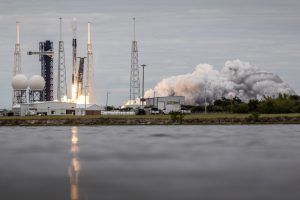
India’s launch of EOS-05 aboard the GSLV-F17 from Sriharikota, southeast India, on September 4 is a good example. It does not put New Delhi on an equal footing with Europe in Earth observation, but it does add an important capability: India’s first imaging satellite designed to operate from an orbit synchronised with the Earth, according to the Indian Space Research Organisation (ISRO).
The satellite replaces EOS-03, which was lost in August 2021 when the GSLV-F10 rocket carrying it failed.
Why does that matter for an emerging space power? Low-Earth-orbit satellites generally provide higher-resolution images, but they pass over a given area only for relatively short periods. EOS-05, positioned at an altitude of close to 36,000 kilometres, can keep a much larger region under observation and return to the same area far more frequently.
That makes it possible to monitor cyclones, floods, fires, agriculture or activity in coastal areas for longer periods.
Beyond the capability itself, the question is who controls the information when a crisis occurs.
For India, having its own satellites, domestic launch systems and the ability to schedule its own observations means relying less on foreign providers to understand what is happening over its territory, along its borders and across the Indian Ocean. It is a question of technological sovereignty.
Europe, by contrast, has taken a different path.
Its architecture is broader and more diversified. Copernicus combines several Sentinel satellites to observe land, oceans and the atmosphere.
The European Organisation for the Exploitation of Meteorological Satellites (EUMETSAT) operates Meteosat, while Meteosat Third Generation provides continuous meteorological monitoring from an altitude similar to that of EOS-05. Sentinel-4, launched in July 2025 aboard the MTG-S1 satellite, also adds hourly observations of atmospheric pollution over Europe and North Africa.
The systems are not equivalent. Europe has built a multinational ecosystem capable of combining radar, optical imaging, meteorology and atmospheric measurements. India is moving towards a more concentrated model, aimed at ensuring that as many critical capabilities as possible are available domestically.
Competition between the two can be beneficial precisely because neither needs to copy the other.
India wants to develop launchers, Earth observation, navigation, crewed missions and a future space station. Europe needs to preserve its own industrial autonomy and its ability to maintain strategic assets without depending on third countries.
In some commercial contracts, they will compete directly. In others, they will make use of their respective strengths, as they already do.
In December 2024, India launched the European Proba-3 solar observation mission aboard a PSLV-XL rocket. The European Space Agency (ESA) and ISRO have also expanded cooperation in human and robotic exploration, astronaut training, space operations and interoperability.
An exchange of letters signed in Paris on September 10 has extended their cooperation framework until January 8, 2032, adding space weather and the sustainability of outer space activities.
Cooperation on Earth observation goes back even further. Since 2018, the European Commission and India’s Department of Space have had an agreement to exchange data between Copernicus and selected Indian civilian satellites.
New Delhi gains access to Sentinel data, while Europe can use data from Indian missions, though commercial high-resolution imagery is excluded.
The most immediate field for deepening that relationship is disaster management.
EOS-05 can provide persistent observation over South Asia and the Indian Ocean. Europe can complement those images with radar, emergency mapping, multispectral information and processing capabilities. During rapidly developing events such as cyclones or floods, access to more sources can shorten response times.
There is also a strategic dimension whose value is growing every day.
Modern economies depend on space for navigation, telecommunications, meteorology, logistics and defence. As the number of satellites increases, so does the need to monitor objects in orbit, avoid collisions and protect critical infrastructure.
The agenda between Brussels and New Delhi already includes cooperation on space surveillance, communications and security.
At the EU-India summit in New Delhi on January 27, the two sides also signed a Security and Defence Partnership. According to the leaders’ joint statement, it covers maritime security, defence industry and technology, cyber and hybrid threats, space and counter-terrorism.
There will be limits. Neither side will freely share military sensors, secure communications or certain dual-use technologies, but that boundary does not prevent a broader partnership.
India brings scale, competitive costs and an expanding space industry. Europe brings a deeper technological ecosystem, operational experience and decades of integrating space data into civilian services.
The consequence is that the more autonomous India and Europe become, the more attractive cooperation between them may prove. Not because they are building the same space programme, but because they are trying to solve the same problem: Preventing capabilities essential to their security and economies from remaining permanently dependent on other powers.
In a world increasingly polarised between Washington and Beijing, space may be one area in which both powers can secure a more substantial place on the strategic board.