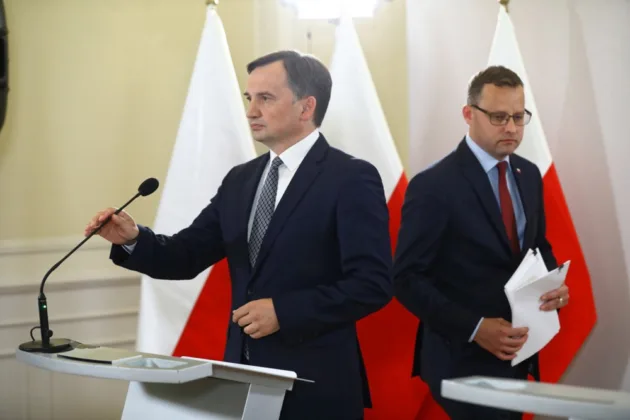






Between October 14 and October 17, police pushed protesters away from Poland’s Constitutional Court, a prosecutor arrived at the court with police officers, and prosecutors sought to have one of its defenders remanded in custody. President Karol Nawrocki, elected by 10.6 million Poles in June 2025, can veto laws, but the government has learnt to work around him. For more than five centuries, Poles have tried to keep power from gathering in one pair of hands. Their history suggests that a weak executive in Warsaw means strong influence from outside.
On October 14, the crowd outside the court chanted “Targowica”, the name of a confederation of Polish magnates who in 1792 called in Russian troops against the Constitution of 3 May 1791. The word remains a byword for treason in Polish. Under police protection, judges whose oaths Nawrocki has refused to accept drove into the court. One of them, Maciej Berek, a former minister in Donald Tusk’s government, had sworn his oath “before the president” that morning in the Sejm, with no president present. Tusk promised to restore constitutional order “using the methods available to the state”, and said the coalition would not retreat “a single step”.
On October 16, a prosecutor arrived at the court with police officers seeking CCTV footage and documents. The court said he was “attempting to search the seat of an independent judicial body”, but in the end it handed the material over voluntarily. Its president, Bogdan Święczkowski, called the visit a provocation and an offence against a constitutional organ of the State. Around noon, police chased a man from the protest camp who had refused to show his ID. Police say he attacked a policewoman, who was taken to hospital, and that he was carrying a knife. Witnesses say he lost consciousness while officers restrained him. Prosecutors wanted him remanded in custody for a month. According to his lawyers, a district court found “no need for any preventive measures”.
Targowica’s leaders claimed to be defending liberty. The 3 May Constitution had strengthened the king, and the magnates, who saw it as an attack on the nobility’s freedoms, turned to Catherine the Great. Three years after Russian troops marched in, the Polish-Lithuanian Commonwealth had disappeared from the map.
The liberty they invoked had deep roots. In the Middle Ages, Polish knights won the rule that the king could not raise taxes, call them to war or make new laws without their consent. The Sejm dates Polish parliamentary history from 1468, and from 1505 the principle of Nihil novi applied: nothing new without the consent of parliament. The state was run by the nobility, nearly a tenth of the population. Poles learnt to think of liberty mainly as a limit on power, and many of us still do.
In practice the weak crown served the magnates, who had private armies, their own foreign policies and patrons at foreign courts. A single deputy could break up a session of parliament, and foreign envoys soon learnt that such a vote could be bought. In 1768 Russia guaranteed the nobility its liberties, the veto and the free election of kings among them. In 1772 Russia, Prussia and Austria carried out the first partition of Poland, dividing nearly 30 per cent of the Commonwealth’s territory among themselves. Prussia and Austria then joined Russia’s guarantee of Polish liberties. The second partition, in 1793, left the Commonwealth less than a third of its 1772 lands; the third, in 1795, took the rest. Russia ended up with nearly two-thirds of the old state. The noble republic was carved up by three absolute monarchies that had promised to protect its freedoms.
The modern presidency was designed in the same spirit. Poland’s president is directly elected, yet parliament can override his veto with a three-fifths majority, many of his decisions need the prime minister’s countersignature, and in foreign policy he must cooperate with the prime minister and the relevant minister. The French call this cohabitation: a president governing alongside a hostile government. In Poland it has taken an extreme form. Nawrocki has already vetoed more bills than Aleksander Kwaśniewski did in ten years: 37 in his first ten months in office, against 35 for Kwaśniewski between 1995 and 2005. The coalition does not have the votes to override him, so it looks for ways around him.
Włodzimierz Czarzasty, the Speaker of the Sejm, in whose office Berek took his oath, has taken to calling the president a king. “The president thinks he is the Speaker of the Sejm, the prime minister and the president – that role usually belonged to a king,” he told RMF FM on September 11. On September 24 he appealed to Nawrocki: “Abdicate as king and return to being president.”
Poles like the European Union for much the same reason they distrust a strong presidency. In a Public Opinion Research Centre (CBOS) poll in January 2026, 82 per cent supported membership and only 38 per cent thought it excessively limited Polish sovereignty, against 50 per cent who did not. Many of us saw Brussels as one more safeguard against any government in Warsaw taking too much power.
History is repeating itself. The magnates looked for protectors at foreign courts; Tusk’s coalition finds its arguments in Luxembourg and Brussels. EU institutions, in turn, gain leverage from the weakness of the Polish presidency. On December 18, 2025, the Court of Justice of the European Union (CJEU) ruled in Case C-448/23 that Poland’s Constitutional Court “does not meet the requirements of an independent and impartial tribunal”. On July 17, in its annual rule of law report, the European Commission noted that a law reforming Poland’s judicial council, which Nawrocki had vetoed in February 2026, “restored the system of appointment of judicial members by their peers, taking into account European standards”. After the Luxembourg ruling, government spokesman Adam Szłapka wrote: “We will rebuild the rule of law. It is not a choice – it is a necessity.” On October 14, the necessity arrived in police vans.
Poles feared a king and got Brussels. The authors of the 3 May Constitution saw where a weak executive had led and gave the king real power.
Nawrocki does not need more power than the constitution gives him. He needs to use all of it: the veto, the right to propose legislation, addresses to parliament, the Cabinet Council, the National Security Council, the power of pardon. On October 15, Nawrocki vetoed an amendment to the electoral code that would have changed how seats are allocated between constituencies. “There will be no fiddling with elections,” he said.
Nawrocki is also the figure best placed to become the focal point for a fragmented Polish Right ahead of the parliamentary election in autumn 2027. The protest camp, the clubs of the conservative weekly Gazeta Polska, the Solidarity trade union and the parties of the Right could all gather around him.
On October 17, Law and Justice (PiS) politicians, Solidarity, the Gazeta Polska clubs, people from the camp and the president’s aides joined thousands of demonstrators outside the court. Jarosław Kaczyński, the PiS leader, spoke of “the last two institutions that have not yet been taken over by this government”, the Constitutional Court and the National Bank of Poland. Paweł Szefernaker, head of the President’s Cabinet, told the crowd that Nawrocki would stand guard over the constitution and defend it against state authorities that did not want to respect it.
I was there in the morning and again in the evening. I talked to people who stand there for their children and grandchildren, though those children and grandchildren, absorbed in their own lives, often do not see the crisis in the same terms. For the generation raised after 1989, freedom is a given. For their elders it is not.
At TV Republika‘s improvised studio we talked on air late into the night about what the coalition’s attempt to take over the court and the central bank would mean. The coalition wants to put the bank’s governor, Adam Glapiński, on trial before the State Tribunal. The Sejm’s constitutional accountability committee backed the motion on October 9, and a vote by an absolute majority of the chamber would suspend him. The bank holds one of the world’s ten largest central-bank gold reserves, more than 613 tonnes. People are freezing in their tents, but they have stood outside the court since September 12. They believe that its judges have immunity, and that the court can interpret Polish law differently from the government and the European Commission.
The 3 May Constitution lasted little more than a year. About a year remains before the election.