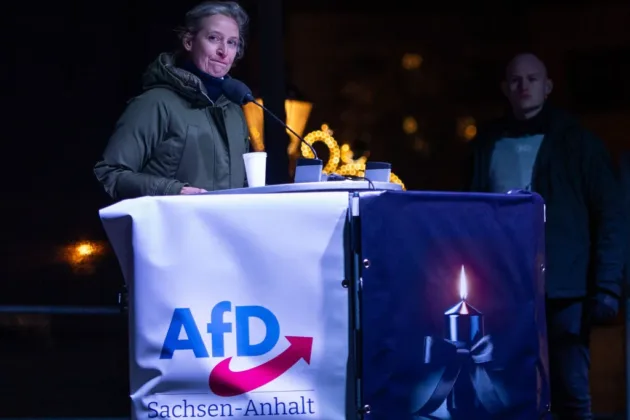






Alternative for Germany (AfD) Saxony-Anhalt leader Ulrich Siegmund has announced plans to form Germany’s first AfD-led state government in Saxony-Anhalt in December, saying he expects to be elected Minister-President with a “notable majority” in the first ballot.
“I assume that in the first ballot I will be elected with a notable majority, so that this first ballot will be successful,” Siegmund said on September 29, speaking to reporters in Magdeburg after a meeting of the AfD parliamentary group, where he confirmed that he would stand as a candidate for Minister-President, the head of a German state government.
Saxony-Anhalt is one of Germany’s 16 federal states, or Länder, each with its own parliament and government and responsibilities including education, policing, healthcare and regional administration. The Länder also have a direct role in national politics through the Bundesrat, where state governments participate in federal legislation, meaning political shifts at state level can have wider implications for the balance of power in Berlin. Saxony-Anhalt holds four of the chamber’s 69 votes.
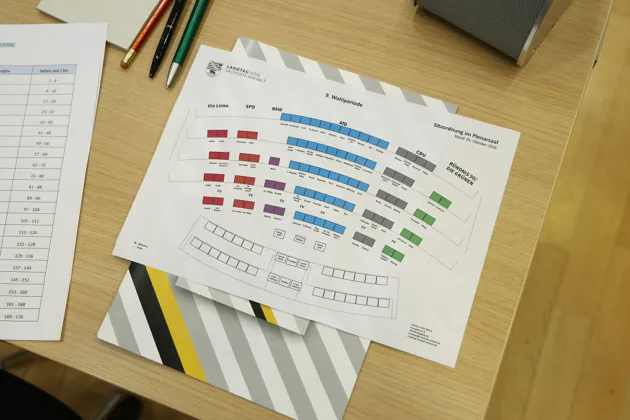
The AfD won Saxony-Anhalt’s state election on September 6 with 43.8 per cent of the vote, securing 39 of the 83 seats in the Landtag, the state’s parliament. The Christian Democratic Union (CDU) came second with 17.2 per cent and 15 seats.
The Social Democratic Party (SPD), the Greens and the Left took eight seats each and the Sahra Wagenknecht Alliance (BSW) five. Turnout was 77.8 per cent, up from 60.3 per cent in 2021.
Together, the two parties command a clear majority of seats, but the CDU has ruled out joining an AfD-led government and said it would go into opposition, in line with its so-called Brandmauer, or “firewall” — the CDU’s policy of refusing formal cooperation or government alliances with the AfD. The policy is enforced by the CDU’s national leadership under Chancellor Friedrich Merz.
Given that the AfD does not hold an absolute majority in the Landtag, Siegmund’s election in the first ballot would mean that at least three lawmakers from outside the AfD would have to support his candidacy. An absolute majority requires 42 of the 83 seats.
Under the state constitution, that threshold applies to the first two ballots only. A third round is decided by a majority of the votes cast, which the AfD could clear without additional support if enough members abstained. The BSW has said it would abstain.
Siegmund has indicated that he expects to have the necessary support. “I would not enter the election for Minister-President if I did not have certainty about stability beforehand,” he said on September 29, without disclosing where the additional votes would come from, though he referred to continuing soundings with the BSW and individual lawmakers.
He said he was seeking an arrangement that went beyond a minority government and could hold for a five-year term, in particular to secure passage of state budgets.
If those votes came from the CDU, the consequences could extend far beyond Saxony-Anhalt, deepening an ongoing internal conflict within the party. Such support could challenge Merz’s authority over the CDU’s Brandmauer against the AfD, raise questions about his leadership and create tensions within the national coalition government he leads.
The new Landtag holds its constitutive session on October 6. Sven Schulze of the CDU has been Minister-President since January, when he took over from Reiner Haseloff mid-term, and stays in office until a successor is elected.
The AfD is also currently Germany’s strongest party in national polling. The latest ZDF Politbarometer, published on September 25, puts the party at 28 per cent, seven points ahead of the CDU/CSU at 21 per cent.
The party has also emerged as the largest party in several eastern Länder, including Thuringia, Saxony-Anhalt and Mecklenburg-Western Pomerania, where it came first in the state election on September 20 and the CDU failed to win any seats.
It has never entered government at either state or federal level, with the CDU’s Brandmauer preventing formal cooperation. If Siegmund succeeds in forming an AfD-led government in Saxony-Anhalt, it would mark the first breach of that firewall and the party’s first entry into government in Germany.