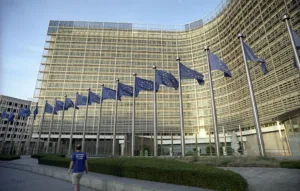




The European Union and Morocco have agreed to widen their cooperation on security at a meeting in Brussels, in a stocktaking exercise that passed over the breach of the bloc’s only African land border three months ago.
The second High-Level Security Dialogue between the two sides was held on October 6 and co-chaired by Cosmin Dobran, director for peace, partnerships and crisis management at the European External Action Service (EEAS), and Ismail Chekkori, director of global affairs at Morocco’s foreign ministry.
The delegations exchanged views on peace and security in the Maghreb and in Africa, including the Sahel, and on the situation in the Middle East, taking in Iran, the occupied Palestinian territories, Lebanon and Syria, as well as Ukraine.
Counter-terrorism and the prevention of violent extremism were also on the table, alongside coordination on international cyber security and on non-proliferation and disarmament.
Both sides reaffirmed a commitment to a rules-based international order, to effective multilateralism and to the role of the United Nations, and agreed to “deepen their cooperation in international and regional fora”, with particular attention to the Euro-Mediterranean area and to African partners.
The dialogue alternates between Rabat and Brussels. The first edition took place in the Moroccan capital in May 2024, and the latest meeting follows the EU-Morocco Association Council held in the Belgian capital in January.
Migration does not appear in the published account of the meeting. Neither does Ceuta.
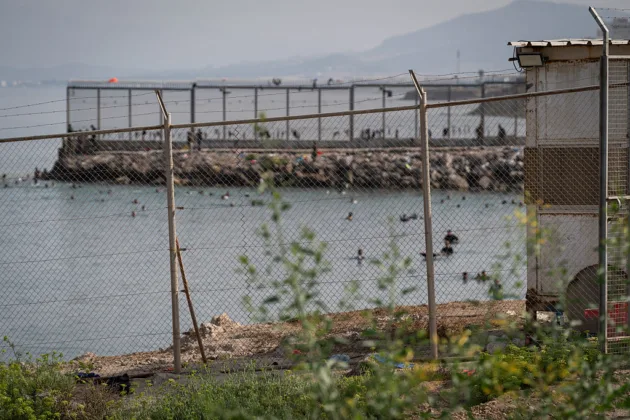
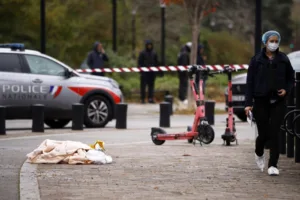
On July 30 and 31, Spain’s Interior Ministry registered at least 80,000 entries into Ceuta, the Spanish city on the north African coast that forms, with Melilla, the EU’s only land frontier in Africa. It was the largest influx recorded there.
More than 100 people died, most of them by drowning or in crushes at the breakwaters. The majority of those who got through walked back into Morocco within days.
Thousands did not. About 5,000 were still in the city at the end of September, many of them sleeping on streets, beaches and hillsides. Hundreds of unaccompanied minors remain among them.
The Spanish Government has committed €309 million to housing, processing and returns, and the European Commission released €114.7 million in emergency assistance. Rabat denied having encouraged or tolerated the entries, blaming smuggling networks.
Ceuta has a population of roughly 84,500.
The political reckoning, such as it was, came in September. On September 17 the European Parliament adopted a resolution that held Morocco responsible for the crossings, describing them as an invasion of the Spanish city and as “hybrid warfare” against a member state.
The text passed by 339 votes to 225, with 16 abstentions, carried by the European People’s Party, Renew Europe and the three right-wing groups. The Socialists and Democrats, the Greens and The Left voted against.
MEPs called Moroccan sovereignty claims over Ceuta and Melilla incompatible with Rabat’s status as a partner, and opened the way to tying EU funds to Moroccan compliance on border surveillance.
The resolution is not binding. Nothing in the October 6 readout indicates that it shaped the agenda.
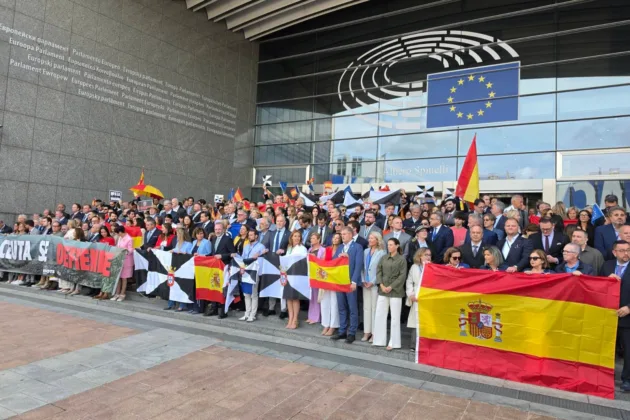
A day before the vote, in her State of the Union address on September 16, European Commission President Ursula von der Leyen told the chamber: “Ceuta is Spain. Ceuta is Europe.” She pledged a European emergency response framework for mass arrivals, a strengthened Frontex and faster returns.
She did not mention Morocco once.
Brussels has meanwhile kept its migration funding to Rabat on course. Morocco is the beneficiary of an indicative package of some €500 million for 2021-2027, of which €222 million was committed between 2021 and 2024, with a further €160 million in budget support for the kingdom’s migration and asylum strategy running to 2027.
Markus Lammert, the Commission’s home affairs spokesman, said Morocco mattered above all in the fight against migrant smuggling, and that cooperation with Rabat had increased in recent years.
The return on that spending is open to question. Irregular arrivals in Ceuta rose from 753 in 2021 to 3,523 in 2025, before the July breach pushed the figure into a different order of magnitude altogether.
Von der Leyen offered Rabat additional support within days of the crossings and has signalled that she wants a strategic and comprehensive partnership with Morocco concluded before the end of the year.
Several member states have drawn harder conclusions than the Commission. Italy suspended Schengen cooperation with Spain after the breach, and Finland, Denmark, the Czech Republic, Sweden and Austria have threatened or introduced checks of their own. German Chancellor Friedrich Merz told Madrid it had to regain control of the city.
What has not happened, in Brussels or in Madrid, is any formal demand that Morocco account for what took place at the fence. Three months on, the security track with Rabat is running as scheduled, on its own subjects, in its own rotation between capitals.
The Sahel, Iran and Ukraine were worth a paragraph each. The 72,000 people who walked into a European city over two days in July were not worth a line.