



The European Parliament has held Morocco responsible for the mass crossings into Ceuta at the end of July, in a resolution that describes the events as an invasion of the Spanish city and as an act of hybrid warfare against a member state.
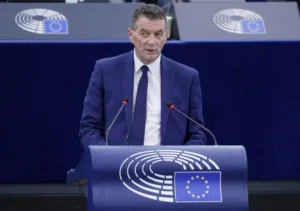
The text was adopted in Strasbourg on September 17 by 339 votes to 225, with 16 abstentions. Drafted by the European People’s Party (EPP), it drew support from Renew Europe and from the three right-wing groups, the European Conservatives and Reformists (ECR), Patriots for Europe (PfE) and Europe of Sovereign Nations (ESN). The Socialists and Democrats (S&D), the Greens and The Left voted against.
Seven rival drafts had been tabled after talks between the groups failed to produce a compromise. The resolution is not binding.
The Parliament called on Morocco, which it described as a key partner of the Union, to meet its commitments on border surveillance, readmission and migration cooperation. Moroccan claims over the sovereignty of Ceuta and Melilla were called unacceptable and incompatible with that partnership.
The text condemns the use of irregular migration “as a tool of hybrid warfare” against the territorial integrity of a member state. It opens the door to tying European funding to Moroccan compliance, though it orders no suspension of payments to Rabat.
A day earlier, on September 16, the plenary adopted a report on hybrid threats by 435 votes to 209, with 13 abstentions. An amendment tabled by its rapporteur, Lithuanian EPP member Rasa Juknevičienė, condemned the attack on the Union’s southern border on July 30 and 31 and the subsequent invasion of the city, and called for an independent and thorough investigation into who planned and carried out the operation.
That demand is political rather than judicial, and stops short of a formal finding of Moroccan responsibility. The report names Russia as the main source of hybrid threats, followed by Belarus, China, Iran and North Korea.
Morocco’s mission to the EU and NATO wrote on September 14 to several Spanish members of the European Parliament, leaving out those of the People’s Party (PP) and Vox. The letter denied Moroccan responsibility for the events and said the kingdom would readmit everyone who entered Ceuta on those days, including Moroccan nationals, unaccompanied minors and third-country nationals.
Morocco World News reported that the Parliament had levelled hybrid-war accusations without producing evidence.
European Commission President Ursula von der Leyen addressed the crisis for the first time on September 16, telling the plenary that the frontier at Ceuta is a European frontier because the city is Spanish.
The resolution records that about 80,000 migrants crossed irregularly into Ceuta from Morocco by land and by sea between July 29 and 31, and that several hundred reached Melilla. At least 141 people died during the crossing, it states, and up to 11,000 remain in the city after refusing to go back to Morocco. The exact figures, and the identities of those still there, are not known.
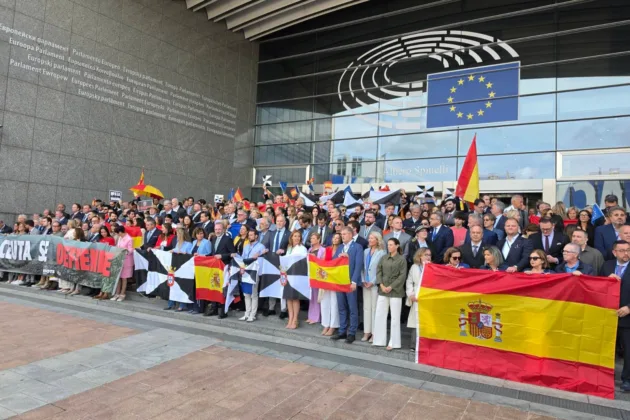
Ceuta and Melilla are described as Spanish and European cities whose sovereignty and territorial integrity are “beyond question”. Ceuta, a city of about 84,500 residents, saw its reception facilities, health services and infrastructure pushed to the brink of collapse, and the protection of the EU’s external land and maritime borders there is treated as a matter of priority.
The Parliament also turned on Madrid. It asked the Spanish Government to restore normality as a matter of urgency, through a larger security presence and economic support for affected businesses, workers and residents, and to make full use of the €114.7 million in emergency aid granted by the European Commission.
On returns, it asked for the swift and effective removal of everyone with no right to remain in the Union, unaccompanied minors included. Any removal would have to respect European and international law, with each case assessed individually, the best interests of the child protected and safe reception guaranteed in the country of destination.
The text singles out the large-scale regularisation drive pursued by Spanish Prime Minister Pedro Sánchez, saying it “acts as a pull factor” and sends the wrong signal to potential migrants and to criminal smuggling networks. Illegal entry, it adds, must never become a shortcut to legal residence.
Madrid was also asked to apply the Migration and Asylum Pact in full. It entered into application in June, and Home Affairs Commissioner Magnus Brunner has pressed member states to speed up its use since the crossings.
Dolors Montserrat, EPP secretary general and leader of the PP delegation, said the Parliament had made clear that “Ceuta is not for sale”.
The vote split the Spanish delegation. The PP and Vox backed the text, the Spanish Socialist Workers’ Party (PSOE) and the parties to its left opposed it, as did the Basque Nationalist Party (PNV).
Spain’s Interior Ministry counts at least 72,000 entries on July 30 and 31, while the city government puts the figure above 80,000. Interior Minister Fernando Grande-Marlaska and Migration Minister Elma Saiz did not appear before the Parliament’s civil liberties committee, which had summoned them on August 6.
Ceuta and Melilla give the European Union its only land borders with Africa. Protests in support of the city reached more than 260 Spanish municipalities on September 2.