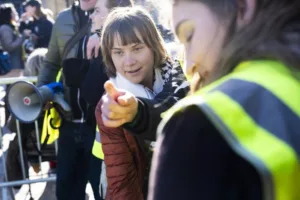



Swedish climate activist Greta Thunberg, now 23, has joined demonstrating pupils outside the Lycée Paul-Éluard in Saint-Denis, a suburb north of Paris, on October 13, one of the focal points of the ongoing French secondary-school protest movement.
She stood with students who have blockaded the school and addressed journalists while wearing a keffiyeh over her shoulders.
Lawyers in their robes formed a human chain nearby, citing allegations of police brutality during earlier demonstrations.
“Young people are not being included in the conversation. Our future is being robbed away from us,” Thunberg told reporters, according to AFP.
“As we have seen here, the schools are not receiving the investment they need.”
She continued: “What are we supposed to do? Give up? Of course not. That is precisely what people are expressing here: We are not going to give up and we are going to fight for this future that is being stolen from us before our eyes.”
She said she was “extremely proud of the French students” and later described the police response as “extremely violent”, accusing authorities of protecting the status quo rather than addressing young people’s basic demands.
Greta Thunberg est venue manifester mardi matin devant le lycée Paul-Eluard de Saint-Denis, un des épicentres du mouvement lycéen, où plus d'une centaine de jeunes étaient rassemblés pour l'acte V de la mobilisation ⤵️ #geneu_AFP pic.twitter.com/dd1Rur6NZb
— Agence France-Presse (@afpfr) October 13, 2026
Thunberg, who first gained international attention through school strikes demanding climate action, has broadened her activism to encompass social and educational justice issues, using Marxist rhetoric. Israel detained and deported her in October 2025 after she sailed with the Global Sumud Flotilla towards Gaza.
The mobilisation, now in its fourth week, has involved school blockades, marches and strikes across France.
Pupils and students have demanded improvements to dilapidated buildings, the replacement of absent teachers, smaller class sizes, shorter and better-organised school days, and changes to Parcoursup, the centralised higher-education admissions platform introduced in 2018 and widely criticised as opaque.
The Union syndicale lycéenne (USL) has joined four student organisations behind a platform of 10 demands published on October 5, among them an emergency renovation programme for run-down buildings, 250,000 extra higher-education places from September 2027 and an end to what it calls algorithmic selection through Parcoursup.
The protests have been overshadowed, though, by serious violence that the French Government has attributed to radical groups operating outside the schools.
The movement is backed by education unions and the left-wing opposition party La France Insoumise (LFI), which French education minister Édouard Geffray has accused of manipulating the mobilisation. The party rejects the charge.
Protests began on September 18 at the Lycée Saint-Exupéry in Créteil, southeast of Paris, initially over unfilled teaching posts, before spreading nationally from September 28.
Previous large days of action drew substantial crowds: 71,500 people on October 8, according to the interior ministry, after a peak of 266,000 on October 6, when organisers claimed 450,000.
Authorities have reported thousands of arrests, alongside injuries to pupils, school staff and police officers. The interior ministry counted 6,547 arrests in the first three weeks and more than 700 injured officers.
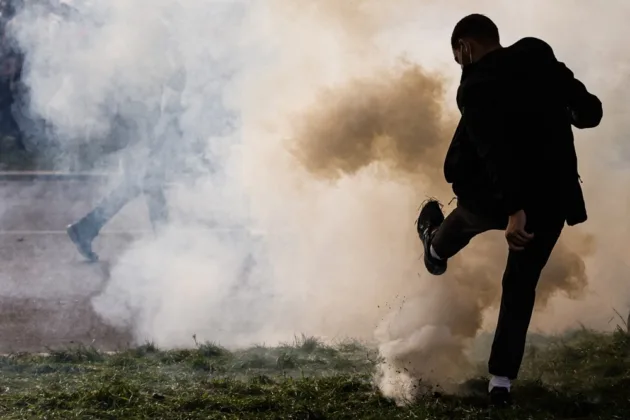
Some incidents involved damage to schools, clashes and the use of tear gas and other crowd-control measures. Geffray said 24 lycées, or secondary schools, had been burnt or ransacked, leaving some 30,000 pupils without classroom teaching for several weeks. After a 15-year-old lost a hand in Lens, northern France, interior minister Laurent Nuñez suspended the use of stun grenades at school operations.
Geffray has acknowledged certain grievances over staffing and buildings as legitimate whilst condemning violence and “urban violence” connected to the movement.
He has announced the deployment of around 3,000 substitute teachers to the most affected schools and expressed hope that the mobilisation would ease ahead of the half-term holidays.
Higher-education minister Philippe Baptiste has refused to scrap Parcoursup but agreed to discuss its transparency and the number of university places. Talks with student organisations resumed on October 12, and the unions called a fifth national day of action for October 13 even so.
On October 13 he said roughly 200 schools were closed, some as a safety measure linked to planned marches.