
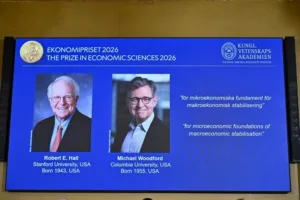






The Royal Swedish Academy of Sciences has awarded the 2026 Nobel Prize in Economic Sciences to Robert E. Hall and Michael Woodford for “microeconomic foundations of macroeconomic stabilisation”. The two Americans have spent their careers explaining how the decisions of households and firms add up to inflation, unemployment and the slumps that governments try to cushion.
Hall teaches at Stanford University and Woodford at Columbia University. They share a prize of 12 million Swedish crowns, about €1.1 million, announced in Stockholm on October 12.
The academy said the pair had built models that allowed governments and central banks to time fiscal and monetary measures more precisely. John Hassler, who chairs the prize committee, said economies were now “better equipped to deal with shocks” such as energy crises.
That is close to a description of the European Central Bank’s past year. On June 11 the bank raised its three key interest rates by 25 basis points, the first increase since September 2023, after the war in the Middle East drove energy costs up and pushed euro area inflation above 3 per cent.
The deposit rate now stands at 2.25 per cent. ECB President Christine Lagarde presented the move as a signal meant to stop the energy shock from spreading into wider prices.
Woodford’s 2003 book Interest and Prices became the standard text for inflation targeting and he has advised the Riksbank, the Swedish central bank that funds the award. Much of his later work concerns expectations, which is why central banks now treat their own communication as an instrument of policy.
Hall, a senior fellow at Stanford’s Hoover Institution, long chaired the committee at the National Bureau of Economic Research that decides when American recessions begin and end. His research on consumption undercut the assumption that household spending moves predictably with income.
The theory has not settled the European quarrel over who should do the stabilising and with whose money. The European Commission rejected Italian and Greek requests for more room under the EU fiscal rules on October 8, with the bloc’s deficit projected to reach 3.5 per cent of GDP this year and average 10-year borrowing costs at 4 per cent.
Economy Commissioner Valdis Dombrovskis argued that adding exemptions would damage the credibility of the rules themselves. Eurogroup President Kyriakos Pierrakakis said ministers agreed that support measures should stay temporary and targeted.
The economics prize is not part of Alfred Nobel’s bequest. It was created by the Riksbank in 1968 to mark the bank’s 300th anniversary and first awarded a year later to Ragnar Frisch of Norway and Jan Tinbergen of the Netherlands.