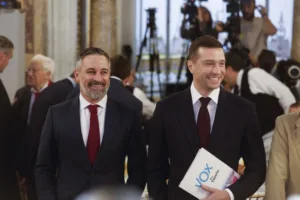

The Patriots for Europe group has said the biggest threat to the rule of law in Europe sits in Brussels itself, claiming the EU has become increasingly authoritarian.
Hungarian, Polish, Slovenian, German and American speakers accused the EU of double standards and political bias.
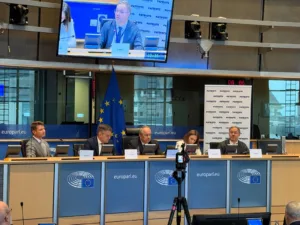
At a European Parliament conference titled “Rule of Law Decline in the EU” and hosted by Fidesz, MEPs and think-tank figures from Europe and the United States set out their case that the EU abuses the rule of law.
Organisers said they wanted to draw lessons from “fighting back against lawfare in America”.
Tamás Deutsch, head of the Hungarian delegation in the Patriots group, opened proceedings by recalling his arrest under the Communist regime, stressing he would not be intimidated by what he called the spiritual successor of the Soviet Union.
Polish MEP Anna Bryłka focused on what she described as the creeping centralisation of power in the EU.
She accused Brussels of taking over national competences and interfering in internal affairs, including the judiciary, which she stressed remains a national matter.
She cited the annulment of Romania’s presidential election result in December 2024 and what she called financial blackmail of member states as examples.
Bryłka also said the Commission had pressed ahead on Mercosur while Parliament had asked it to wait, which she said put it in breach of international law.
Asking who monitors the EU itself, she argued that the Commission had no democratic mandate and was disconnected from citizens.
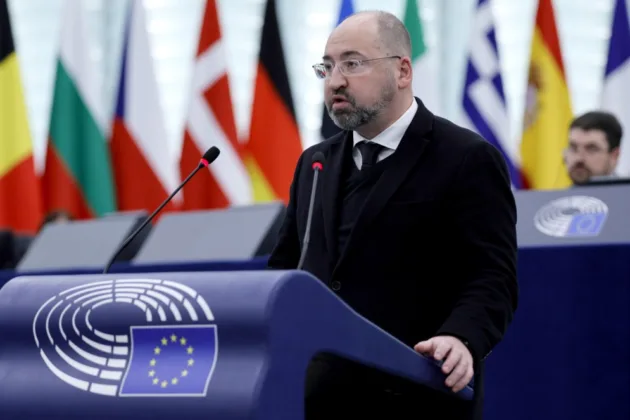
Fidesz MEP Balázs Orbán, Viktor Orbán’s former political director, who took up a seat in the European Parliament in July, said Europe needed national leaders who put their nations first.
He framed the pressure on Hungary’s previous government, including the attacks on the Brussels branch of the Mathias Corvinus Collegium (MCC) think tank, as coming on command from the EU. MCC’s Hungarian parent foundation was dissolved on July 31 after its funding was cut off.
He claimed the Brussels institutional machine, through withheld funding, the dispute over the oil pipeline and online censorship, had worked hand in hand with the Hungarian opposition against the previous government.
While many still have the impression that Hungarian Prime Minister Péter Magyar is a conservative, Balázs Orbán noted that George Soros, Barack Obama, Hillary Clinton and Commission President Ursula von der Leyen had all applauded his victory.
Magyar’s Tisza party took 141 of the 199 seats in the National Assembly at the April 12 election, ending Viktor Orbán’s 16 years in office. Magyar was sworn in on May 9.
Six months after that vote, he argued, the new government could not keep its promises on taxes, unemployment and energy.
He accused it of dismantling the conservative ecosystem, including think tanks and Budapest’s House of Terror museum, and of compiling databases on its opponents.
Turning to double standards, Balázs Orbán asked how Brussels would react if the previous government had done what the current one is doing.
He pointed to the removal of President Tamás Sulyok, ousted by a constitutional amendment passed on July 13 by 139 votes to six, the barring of opposition figures and the takeover of opposition structures, something he said Viktor Orbán had never contemplated.
Full house in Brussels at our conference on liberal authoritarianism and how to stand up against it!
There is complete agreement on two points:
1. The rise of liberal authoritarian rule in EU member states, with Brussels’ support, is unacceptable.
2. The Hungarian people can… pic.twitter.com/DXIb6pmBy9— Balázs Orbán (@BalazsOrban_HU) October 13, 2026
René Aust, a German MEP from the Europe of Sovereign Nations (ESN) group, spoke about the situation of the Alternative for Germany (AfD).
He described a climate in which people can no longer speak their minds, or even state facts and statistics, especially on migration, calling it a “schizophrenic situation”.
Efforts to cut the ESN party’s funding showed that opponents “can’t win the argument”, he said, so they resort to other means. Parliament voted on July 7 to ask the Authority for European Political Parties and European Political Foundations to investigate the party, a step that could strip it of EU money.
He accused the authorities of criminalising the ecosystem around the AfD, citing young people prosecuted for mild exaggeration, while a rival artificial ecosystem of lavishly funded NGOs is promoted.
He described it as “inverse democracy”, in which governments use taxpayers’ money to manipulate citizens.
Slovenian MEP Branko Grims said one can recognise Communists in power when criminals are supported and the opposition is being criminalised.
Grims said NGOs were being outsourced to fight against the Right. On migration, he argued that the crisis began when Angela Merkel and Brussels abused their power and stopped enforcing the EU’s borders.
He claimed that NGOs go abroad to tell migrants how to enter Europe and “play the system”, encouraging people to break the law.
He also criticised the protection that parliamentary immunity affords to radical left-wing militants who used violence in the streets, referring to Italian MEP Ilaria Salis. The European Parliament voted to uphold her immunity by a single vote on October 7, 2025.
Along every step of the way, it is the Left that goes against the rule of law, Grims argued.
He also referred to his personal situation, where his family was compared to that of Joseph Goebbels and where, he said, some had suggested his “children should suffer”, but no one got into trouble for the call to violence, shielded by what he called press freedom.
Lili Zemplényi of the Hungarian Nézőpont Institute presented its latest report on the rule of law in EU institutions.
The report argues that the rule of law within EU institutions is deteriorating, citing alleged abuses of power, treaty violations, corruption and a lack of transparency and accountability.
It accuses the European Parliament and Commission of undermining member states’ decision-making rights, bypassing institutional safeguards and applying rules selectively for political purposes.
It portrays the pending procedure against the ESN party and EU funding for NGOs as examples of political discrimination, conflicts of interest and opaque spending.
Finally, it questions the independence and impartiality of certain EU judges and advocates general, arguing that their political backgrounds and public positions raise concerns about judicial neutrality.
Frank Furedi, president of the Freedom and Sovereignty Initiative Europe, launched on September 23 by the former MCC Brussels team, described a politicised system of officials and bureaucrats who are selected and recruited according to an agenda. He argued that they enjoy agenda-setting autonomy and are insulated from national law.
He said this has given shape to “critical legal theory”, where judges are all trained the same, left-leaning way, often after “socialisation” in Brussels.
Ágoston Sámuel Mráz, also of Nézőpont, went deeper on what he described as democratic backsliding and a lack of transparency in the EU, pointing to the opaque way judges of the European Courts are selected and noting that member states have only limited powers over the process.
He argued that Europe needs a conservative ecosystem and set out three “nevers” for the movement: Never accept a constitution being trampled, never go after the opposition and never use violence.
Mráz also told the audience that two former ministers were being held in Hungary without a court ruling. Prosecutors detained former development minister Miklós Seszták and former culture minister Balázs Hankó on September 28, after parliament lifted their immunity. Both deny wrongdoing.
Paul McCarthy of the Heritage Foundation spoke of a “long march” through the institutions and of suspicion towards supranational systems. He described a network of patriots built around the nation state and announced a Washington event on December 8 titled “Europe beyond the EU”.
Zack Smith, also of Heritage, said judicial and bureaucratic overreach was being resisted in the United States, with President Donald Trump “fighting back in line with the constitution”.
He said America was in a better position than a decade ago and that the separation of powers protects many other freedoms. On paper, he added, the EU’s constitutional framework is even more expansive, but the US is structurally better placed.
He also warned that the criminal charges brought against Trump set a dangerous precedent, and criticised critical legal theory in universities and law schools.
Organising MEP András László noted that the large crowd attending the conference exceeded the small turnout at Parliament’s civil liberties committee (LIBE), where he said rule of law violations are often overlooked, depending on political connections.
The EU has a comprehensive “deep state” which functions to solidify the ideology of the European Union.
It exists in the way judges are trained, bureaucrats are schooled, regulators are given power, and NGOs are funded. @Furedibyte from the European Parliament pic.twitter.com/K9eXrWi0Yn
— Freedom and Sovereignty Initiative Europe (@FSI_Europe) October 13, 2026