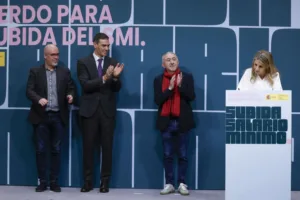


Direct state subsidies to Spain’s major trade union federations have multiplied nearly fourfold under Prime Minister Pedro Sánchez, even as trade union membership nationwide falls to historic lows, according to data from the Finance Ministry reported by Spanish daily ABC.
Annual direct allocations to the country’s two largest union organisations, the General Workers’ Union (UGT) and the Workers’ Commissions (CCOO), have risen from €8.8 million under the previous government of Mariano Rajoy to €32 million now.
That rise came in stages. The Ministry of Labour, run by Yolanda Díaz since January 2020, lifted the line to €13.88 million in 2021 and held it at €17 million between 2022 and 2024, before awarding €32 million for 2025, a figure carried over into the 2026 allocation.
Between 2018 and 2025, total public funds allocated to both federations, alongside their territorial branches and linked foundations, exceeded €569 million.
Overall public funding to the two major unions grew by 34 per cent during this period, rising from €69.6 million in 2018 to €93.7 million in 2025.
In addition to millions of direct (extra) cash subsidies, UGT and CCOO currently enjoy the free use of 58 State-owned buildings (33 assigned to CCOO and 25 to UGT) under the 1986 Accumulated Union Assets Act, which handed the property of the Franco-era vertical syndicate to the organisations that replaced it.
The real estate portfolio, covering more than 22,800 square metres, carries an estimated market value exceeding €200 million.
The Spanish state covers the associated property taxes known as IBI, amounting to at least €700,000 annually, as well as capital expenditure.
In 2021, the Ministry of Labour allocated €100 million in European recovery funds toward energy**-**efficiency renovations across 42 union headquarters.
The surge in financial backing contrasts with union membership trends across Spain.
According to figures from the Organisation for Economic Co-operation and Development (OECD), union density in Spain fell to 12.5 per cent of salaried employees in 2023, down from 16.7 per cent in 2012, ABC reported.
This places Spanish union representation below the EU average and well behind European counterparts such as Italy (30 per cent) and Sweden (62.3 per cent).
Membership is not the only measure of the federations’ reach. Agreements they sign are extended by law across entire sectors, leaving collective bargaining coverage in Spain close to 80 per cent of employees, among the highest in the OECD.
The financial reliance of UGT and CCOO on the state has fuelled ongoing debate in Madrid regarding their political independence.
Opponents point to the close alignment between union leadership and the ruling coalition, noting that neither federation called a general strike between November 14, 2012 and this year.
The funding for the two federations comes on top of the corruption allegations and investigations that have been plaguing the Sánchez government since 2024.
Now, for the first time in 14 years, UGT and CCOO have called a general strike for November 11, two days before campaigning opens for the general election Sánchez called on October 5 after losing a parliamentary vote on housing. Spaniards go to the polls on November 29.
The unions have framed the 24-hour stoppage around housing costs and pay, arguing that wages have risen by about 28 per cent over the past decade while purchase prices per square metre have climbed about 80 per cent and rents about 87 per cent.
The protest initiative was originally launched by smaller, grassroots labour and tenant organisations which have gained ground amid declining membership for traditional federations. The CGT has joined the call, with backing from the regional unions CIG, ELA and LAB and from the tenants’ organisation Sindicato de Inquilinas.
Three other federations, CSIF, USO and FETICO, have refused to take part, describing the action as political, and the employers’ confederation CEOE has questioned whether the demands are labour matters at all.
Under the previous government, the major unions were much more active. They called a general strike on March 29, 2012, barely three months after Rajoy took office, and a second on November 14 that year.
Unai Sordo, general secretary of CCOO, told Spanish radio station COPE on October 6 that the public money they received was “distributed among all organisations according to their representativeness and represent less than 10 per cent of the budget of CCOO”.
COMMENT: Sánchez names the date before the courts name it for him, writes @OMullony_ https://t.co/rUcdZXSOxf
— Brussels Signal (@brusselssignal) October 7, 2026