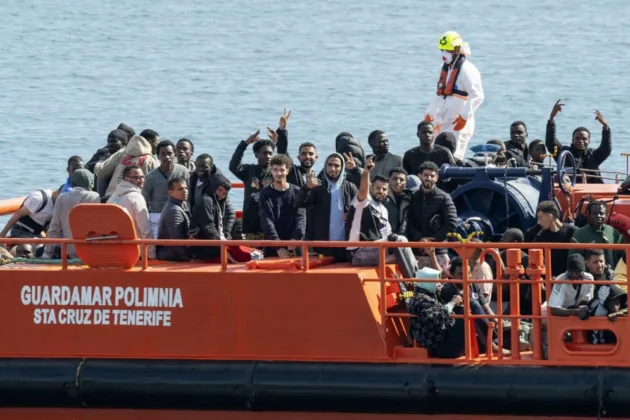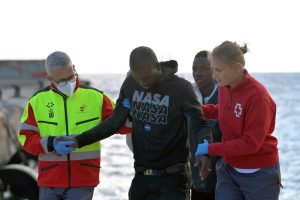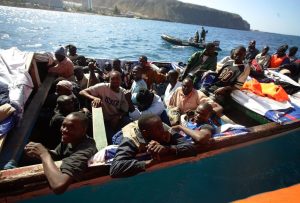












More than 11,000 irregular migrants from West Africa have reached Spain’s Canary Islands by boat since the start of November, pushing reception facilities on the archipelago’s smallest islands to breaking point days ahead of Spain’s general election.
According to figures published by Spain’s Ministry of the Interior on November 16, 11,037 people arrived aboard 106 makeshift wooden vessels, known as cayucos or pirogues, between November 1 and 15.
That two-week total alone surpassed the 6,194 arrivals recorded across the entire month of October.
Subsequent provisional tallies from the Canary Islands regional government indicate that cumulative arrivals between November 1 and 16 climbed to 11,657 people across 118 boats, an increase of almost 1,000 per cent on the same period in 2025.
The surge peaked on November 14, when Spain’s maritime rescue service, Salvamento Marítimo, picked up 1,488 people from 14 boats, with provisional tallies compiled by news agency EFE reaching 1,580 people aboard 15 boats. That surpassed the previous single-day record of 1,461 arrivals on the Atlantic route, set on November 7, 2020.
Twelve of the boats rescued on November 14, carrying 1,235 people, landed on El Hierro. The overwhelming majority of vessels, departing primarily from Senegal, Gambia, Mauritania and Guinea, have landed on the island.
With a permanent population of fewer than 12,000 residents, the tiny volcanic island has seen more than 12,000 migrants arrive so far this year, prompting the island council, the Cabildo de El Hierro, to declare a social emergency on November 7.
On November 5, several hundred new arrivals had to spend the night in a warehouse to avoid sleeping in the open, according to Cabildo president Alpidio Armas, who said reception facilities in Tenerife and Gran Canaria were full.
The Canary Islands regional government has said it is caring for 3,313 unaccompanied foreign minors, 835 of whom were taken in during the first 16 days of November.
Between January 1 and November 15, total sea arrivals in the Canary Islands reached 24,364, representing a 65.9 per cent increase compared with the same period last year.
Across Spain as a whole, the Interior Ministry recorded 44,238 irregular entries over the same timeframe, up 39.4 per cent year on year, running counter to falling irregular border crossings elsewhere in the European Union.
Following an urgent meeting of Spain’s Interministerial Commission on Immigration on November 10, Prime Minister Pedro Sánchez’s government declared a migration emergency in the Canary Islands and allocated more than €15 million to expand reception capacity and accelerate transfers of migrants between the islands.
After a second session of the commission on November 17, Canary Islands regional president Fernando Clavijo announced that a temporary field hospital would be set up next to the temporary reception centre for foreigners in San Andrés, on El Hierro. It is to be funded with €3 million from the Spanish Government, alongside a further €2 million for the Cabildo.
Clavijo described the situation as “unsustainable” and wrote to European Commissioner for Internal Affairs and Migration Magnus Brunner requesting the activation of solidarity mechanisms under the EU Pact on Migration and Asylum. On November 16, he also wrote to Sánchez, urging him to activate the EU resources available to deal with the migration crisis.
Meanwhile, Spanish Interior Minister Fernando Grande-Marlaska travelled to Dakar on November 6 to urge Senegalese authorities to step up migration controls. According to his ministry, Senegalese security forces have intercepted 64 boats and more than 4,000 people bound for the archipelago this year.
The spike has become a central issue ahead of Spain’s snap general election on November 29.
Conservative People’s Party (PP) leader Alberto Núñez Feijóo and right-wing Vox leader Santiago Abascal have accused Sánchez’s Socialist administration of border laxity. Abascal has called for the Spanish Navy to be deployed to halt the boats, a demand echoed by the PP’s Xavier García Albiol.
Government officials attribute the autumn surge to calm Atlantic sea conditions and instability across the Sahel.
The Atlantic passage from West Africa to the Canary Islands is considered one of the world’s deadliest sea migration routes.
Unlike shorter Mediterranean crossings, voyages from Senegal, Gambia and Mauritania require spending days or even weeks on the open ocean in overcrowded wooden fishing boats, where strong currents, rough swells and engine failures frequently cause vessels to capsize or drift off course without sending a distress signal.
🚨The Canary Islands have already received more migrants by boat this year than in the whole of 2025.
Local authorities are warning that El Hierro cannot cope with the surge.
🤔 Could the situation become one of the EU's next major migration challenges?…
— Brussels Signal (@brusselssignal) November 9, 2026