
For decades, the European Union fancied itself a global teacher. From its lofty perch in Brussels, it lectured developing nations, particularly across Africa, on structural governance, fiscal discipline and the avoidance of “tribalism”. Yet today, an enormous irony is playing out across the continent. Europe is not elevating the rest of the world; it is actively mimicking the structural decline, institutional weakness and resource vulnerability historically associated with the post-colonial developing world.
Europe is rapidly deindustrialising, displaying fracturing along ethnic lines and losing its global position. In key respects, the continent is undergoing a profound process of Africanisation.
The structural weakness of many post-colonial African economies lay in a familiar imbalance: Exporting raw materials and talent while importing finished goods, leaving much of the added value and profit in foreign hands. Today, Europe has engineered its own version of this trap.
Crippled by self-inflicted energy shortages and uncompetitive labour costs, European industry is dying. EU companies pay electricity prices two to three times those of their American competitors, according to the 2024 competitiveness report drawn up for the European Commission by former European Central Bank president Mario Draghi. High-value manufacturing is shuttering or moving across the Atlantic or to China.
Instead of producing wealth, large parts of Europe now operate on a deficit economy. We export our capital to wealthy jurisdictions. From the American tech sector, the cash-rich Gulf states or the productive Far East.
In return, we buy back the essential technology, energy and finished goods we no longer produce.
Our brightest minds and capital are flowing outward and the profits are permanently captured abroad.
Industry relocates or shrinks. What remains is assembly, services and welfare.
Nowhere is this modern vassalage clearer than in the arena of artificial intelligence.
In what can only be described as a digital extraction scheme, Europe willingly bleeds its most vital raw assets while importing finished algorithmic dependency from abroad where it is commercialised.
We watch passively as our leading computer scientists, researchers and university professors flee the continent, lured by the massive compute resources and capital of Silicon Valley and Beijing. Only four of the world’s top 50 technology companies are European, the same report found.
Meanwhile, superstitious locals oppose the data centres that are essential to building a sovereign AI infrastructure, just as they opposed fracking. In the greater Dublin area, grid operator EirGrid has blocked new data centre connections since 2021, a restriction that may hold until 2028.
Concurrently, European citizens are treated as nothing more than a resource-rich colony to be mined: Our personal data is harvested daily, funnelled across our borders to train foreign neural networks.
And what do we get in return for this asymmetric exchange? We receive the privilege of buying back licensing agreements for American and Chinese big tech products. Having surrendered our brains and our data to build foreign empires, we are left as passive consumers, paying rent to overseas corporations for the very technologies built on our backs.
Another parallel lies with the Green Deal and its ilk. Stripped of scientific pragmatism, our climate policies have degenerated into a form of modern voodoo. European politicians now act like tribal shamans, chanting green mantras and sacrificing our industrial base to appease the gods of nature instead of investing in the science and engineering we need for a changing world. While they practice this political witchcraft about net-zero milestones on the international stage, our domestic reality crumbles into infrastructure deficits, unstable energy grids and systemic economic contraction.
In the mid-20th century, many newly independent African nations fell victim to ballooning bureaucracies, top-down price and regulatory distortions and weak, corrupt political classes that choked off free market development. Brussels has mastered this blueprint.
European leadership has rarely been more technically incompetent or strategically blind than in the last decade.
Rather than fostering innovation, the European Commission responds to economic stagnation with more regulation, strangling local enterprises while protecting globalist NGOs where the main focus lies on ideological and political capture.
Tin-pot dictatorship regulation of free speech is another example.
Or consider the erosion of the nation-state.
Decades of unvetted mass migration and open-border dogmatism have imported deep-seated ethnic and tribal fractures into the heart of Europe.
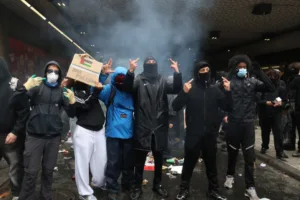
Old clan wars from across the globe are being fought out in our streets.
Rather than integrating newcomers into a unified European civic identity, multicultural policy has fostered a fierce, localised balkanisation. Large urban centres are fracturing into parallel societies where State law stops and sectarian allegiance begins.
The predictable consequences, spiralling crime rates and the persistent threat of radical terrorism, are met with complete impotence from governments that lack the stomach to enforce public order.
As our major city centres, the nexus of political power, deplete under crime and drugs, they increasingly resemble the volatile, secure-fenced enclaves of Johannesburg or Cape Town rather than the safe, bourgeois capitals of Europe’s past.
During the Cold War, African nations became the playground for foreign superpowers, bankrolling ideological proxies and turning domestic politics into theatre for outside interests.
Europe has succumbed to the same fate. Today, our cultural institutions, universities and left-wing activist groups are heavily bankrolled by American progressive capital and transnational foundations, importing a foreign culture war that further destabilises European social cohesion.
Russia also chips in to sow dissent when it can, though with much less success. Moscow, though, can now simply launch wars on European soil.
The EU’s geopolitical response to its own decline could not be more symbolic.
Powerless to project independent strength in an era of renewed war and international trade barriers, Brussels has taken to courting “middle powers”.
It is a desperate mimicry of the Non-Aligned Movement of the 20th century.
By trying to play the diplomatic broker while stripped of industrial, military and economic teeth, Europe behaves not like a superpower, but like a vulnerable regional bloc trying to survive the crossfire of a new Cold War between Washington and Beijing.
If Europe wishes to avoid a future of permanent backwardness, poverty and dependency, it must first stop pretending its current trajectory is a sign of moral progress. Wealth, safety and sovereignty are not birthrights and right now Europe is actively legislating them away.