

Belgian Prime Minister Bart De Wever has set a hard deadline of December 31 for his five-party coalition to agree on a multi-annual federal budget, warning that failure to reach a deal before the end of the year will bring down his government.
The ultimatum came today after yet another round of crisis talks ended without agreement, forcing De Wever to report empty-handed to King Philippe at the Royal Palace for the second consecutive week.
“Should we not have a budget agreement [before the end of the year], the government will effectively be unable to govern, thereby bringing its existence to an end,” De Wever’s office said in a statement.
“It was established this morning that it is impossible to reach an agreement on the budget table within the core cabinet,” the statement noted.
“The balance set out in it is not accepted by one coalition partner,” by which the Belgian PM singled out the Flemish Socialists of Vooruit.
De Wever said he would call in the presidents of all coalition parties and see how they were willing to reach a solution before New Year.
Just before, the Belgian Royal Palace had asked him to keep working on a deal. It said the King regretted the lack of “meaningful progress” but encouraged the Prime Minister to reach an agreement as quickly as possible.
The federal Core Cabinet — bringing together the deputy prime ministers of the ruling “Arizona” coalition comprising the Flemish nationalists (N-VA), Flemish socialists (Vooruit), Flemish Christian Democrats (CD&V), Francophone liberals (MR) and Francophone centrists (Les Engagés) — convened at 9.30am for the first time in eight days.
Talks broke down within two hours, though, after Vooruit rejected De Wever’s latest compromise text, MR Deputy Prime Minister David Clarinval confirmed to reporters.
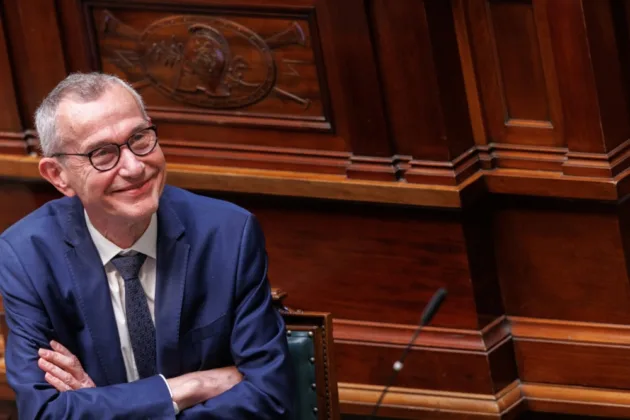
Frank Vandenbroucke, Deputy Prime Minister, health minister and lead negotiator of the Socialists, was identified as the main culprit today, with several politicians singling out his behaviour.
In an interview with public broadcaster VRT on November 16, he repeatedly lashed out at other parties and attributed bad motives to them, claims they rejected. He said “a stuffy, Belgian-nationalist Francophone who refuses to speak Dutch” got more done in the talks than “a moderate socialist with Flemish convictions”.
Vandenbroucke then demanded apologies for how he was treated, according to Clarinval. Clarinval said this was “incredible”, because “he was the one insulting everyone”.
Before today’s meeting, Les Engagés Deputy Prime Minister and foreign minister Maxime Prévot made a post on Instagram, showing a picture of Vandenbroucke with the words “FAKENEWS” in red capitals, accusing him of spreading fake news and false information about the negotiations and added the text “The populism of certain parties undermines democratic debate by sowing confusion and stoking unnecessary fear”. A spokesman for Prévot later said it was not intended as a personal attack.
Negotiations have been deadlocked since mid-November over how to find €10 billion in recurring savings across the federal budget and social security system. On November 22, De Wever said even that sum would not be enough, arguing the government had so far filled only a third of the hole left by its predecessors.
While De Wever insists the cuts are essential to curb Belgium’s deficit and bring public finances under control, Vooruit has refused to sign off on deeper reductions to healthcare and pensions, demanding higher taxes on “the wealthiest” instead.
They are also pushing for an end to the tax and social security advantages enjoyed by top footballers, which Vandenbroucke has put at €253 million. While the impact on the budget would be limited, it would be a symbolic win, especially against Liberal MR party president Georges-Louis Bouchez, who also chairs second-tier club Royal Francs Borains.
A three-hour private meeting between De Wever and Vooruit chairman Conner Rousseau on November 20 failed to break the impasse.
The stalemate has plunged the coalition into its deepest crisis yet.
Earlier this month, on November 2, De Wever offered his resignation to King Philippe after an earlier round of talks collapsed over whether the wealthiest should contribute more, weeks after he had dropped his proposal for an across-the-board VAT hike.
The King refused to accept the resignation on November 6, instead instructing the Prime Minister to return to the negotiating table and setting successive reporting deadlines.
De Wever confirmed on November 5 that Belgium would fall back on temporary emergency funding, known as “provisional twelfths”, just as it did at the start of 2026. This is expected to run until early 2027 at least because a full budget typically requires six to eight weeks to clear parliament.
Behind the political deadlock, Belgium’s financial clock is ticking. The country’s budget deficit is forecast at 5.2 per cent of gross domestic product (GDP) this year while public debt has climbed past 110 per cent of GDP, with the European Commission warning on November 17 that rising interest payments and defence spending would push both the deficit and the debt ratio higher still in 2027.
Without policy changes, the Commission projected the deficit would reach 5.5 per cent in 2027, with debt rising to 113.4 per cent of GDP. De Wever has said Belgium is paying €16 billion in interest on its debt this year, warning the bill could exceed €50 billion by 2035.
Already subject to an EU Excessive Deficit Procedure requiring it to bring the deficit below 3 per cent by 2029, Belgium risks sliding into a “snowball effect” of compounding debt-servicing costs if structural savings are delayed.
Upcoming reviews by credit rating agencies are being watched closely.
Today’s political deadlock unfolded against the backdrop of a national demonstration in Brussels organised by Belgium’s three main trade unions — the socialist ABVV-FGTB, the Christian ACV-CSC and the liberal Synova — protesting against the proposed €10 billion in austerity measures. Police counted some 50,000 participants.
Rioters on the margins of the march set a van alight and started several fires near Brussels-South station, prompting police to deploy water cannon and tear gas, VRT reported.
🚨 JUST IN: Agitators are SETTING FIRES in Brussels, Belgium as new RIOTS break out
Europe does NOT have to live like this.
You ask for this by not implementing law and order!
"DEFINITELY not peaceful."
Rioters also TORCHED a van and threw up barricades. Fire back with mass… pic.twitter.com/eRzOhNPuM2
— Eric Daugherty (@EricLDaugh) November 23, 2026