



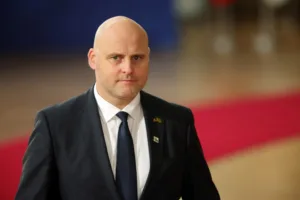


Danish Prime Minister Mette Frederiksen has said she is not in favour of a large-scale population replacement and does not support a multicultural society in which cultures are treated as equal.
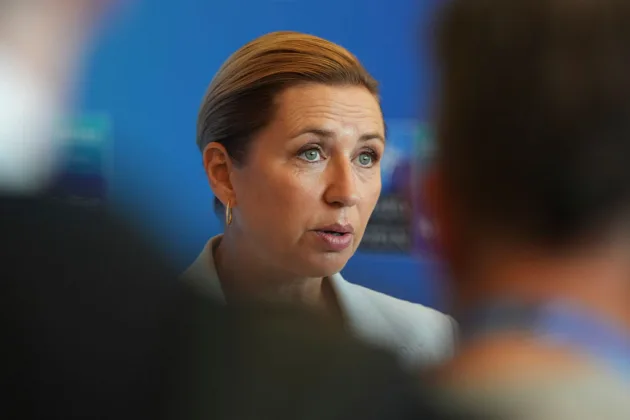
Speaking on the Borgerlig Tabloid podcast from the Danish daily B.T., hosted by Joachim Olsen, in an episode released on November 17, the Social Democrat leader stated that she wants Denmark to remain Danish, with a clear majority culture.
“I am not in favour of a multicultural society where one equates cultures,” Frederiksen said.
“I am European, Danish and from Aalborg. And I am also not in favour of a large population replacement. I believe there needs to be a strong majority culture.”
When asked what she meant by Danish, she replied that there should be a clear majority culture in society.
Pressed on whether this referred to ethnic Danes, she said: “We are a Danish society, and we are an original tribe that is ethnically Danish. That changes when people come here. But it has to be the case that in the future too there is a Denmark where there is a strong majority culture.”
Frederiksen singled out immigration from the so-called MENAPT countries — the Middle East, North Africa, Pakistan and Turkey — saying too many arrivals from there rejected homosexuality, opposed equal rights for women and wanted Islam placed above the law. She described that “dominance culture” as dangerous.
She also connected migration to elevated crime, saying that the people deserved to live in safe conditions.
The remarks come against the backdrop of Denmark’s comparatively restrictive migration and asylum policies under Frederiksen’s governments, which have produced among the lowest numbers of asylum grants in the EU in recent years.
They also came a day after Frederiksen joined four other European countries, including Austria, in Vienna on November 16 to unveil plans for a centre in Rwanda for rejected asylum seekers, which she said would be “a game changer” against illegal migration.
Denmark is an outlier in Europe, where many countries maintain open borders and elites profess multiculturalism, saying original peoples need to adapt to modern times.
The Scandinavian country’s migration policy stands out even more because it is under the leadership of Social Democrats.
Frederiksen began a third term on June 3 at the head of a centre-left minority coalition with the Socialist People’s Party, the Social Liberals and the Moderates, following the March 24 general election.
Projections illustrate the demographic context. Immigrants and their descendants made up 16.3 per cent of Denmark’s population on January 1, 2025, according to Statistics Denmark.
A 2025 analysis prepared for Politiken by Rune Lindahl-Jacobsen, a professor at the University of Southern Denmark, indicated that, if current fertility rates and net immigration levels (averaging around 29,000 annually in recent years) continued unchanged, people with foreign ancestry could exceed the number of those of Danish origin by 2096.
The calculation counted anyone with a foreign-born ancestor as being of foreign origin, a broader definition than the one used by Statistics Denmark, and was criticised by other researchers. A revised version, which factored in mixed relationships, put the share at 41 per cent in 2096.
Statistics Denmark’s own longer-term projections are more moderate, pointing to immigrants and descendants comprising roughly a quarter of the population by 2070.
A separate scenario calculation by the Finance Ministry, assuming continued recent net migration levels, projected people of Danish origin still forming around 69 per cent of the population in 2100, compared with 83.2 per cent when the calculation was made, according to Berlingske.
The language has drawn attention because similar concerns about demographic change are treated differently elsewhere.
In the Netherlands, the General Intelligence and Security Service (AIVD) and the National Coordinator for Counterterrorism and Security (NCTV) have warned that terms such as “population replacement” (omvolking) and “remigration” are used by right-wing extremist groups as part of a strategy to normalise ideology centred on white supremacy and the establishment of an ethnostate.
A joint analytical report published on September 22, Achter de façade (Behind the façade), described such language as a form of “façade politics” intended to make more radical ideas more acceptable.
The report names no parties, though the Dutch daily NRC wrote in an editorial that Forum voor Democratie (FvD) was clearly at the forefront of that process. Party representatives have defended such terms as descriptions of observable demographic shifts rather than conspiracy theories.
FvD, JA21, Geert Wilders’ Party for Freedom (PVV) and the Farmer–Citizen Movement (BBB) all used “remigration” in their manifestos for the October 2025 general election, according to DutchNews.
Figures from Statistics Netherlands (CBS) show substantial change already under way in major cities: people with a migration background (first and second generation) make up around 29 per cent of the national population, with shares above 50 per cent in Amsterdam, Rotterdam and The Hague.
In the first quarter of 2026, population growth came entirely from migration, as deaths outnumbered births, CBS reported.
The same is true in many other western countries, where things are exacerbated by low fertility rates on top of the high migration numbers.