
Between 10 and 30 per cent of livestock farmers in the Netherlands have been projected to shut down operations under new government nitrogen-reduction proposals, according to research conducted by Wageningen Social and Economic Research (WSER), published on November 4.
Commissioned by the Dutch agriculture ministry to assess the socio-economic fallout of the cabinet’s updated agricultural and nitrogen framework, the Wageningen study concludes that stringent emission mandates will trigger a significant contraction of the national livestock sector.
The projected closures come on top of the roughly 10 per cent of livestock farmers the researchers expect to stop regardless of the plans, meaning the sector could shrink by between 20 and 40 per cent by 2035 — around 3,000 holdings, according to Dutch farming press.
“Society is asking farmers through this policy: reduce your emissions,” said Petra Berkhout, project leader at WSER.
“That demands substantial modifications and investments on farms. Not every farmer can or wants to do that, even with support from the nitrogen fund, for instance due to where their holding is located.”
They found that mid-sized family farms face the steepest pressure, as many lack the capital or acreage to absorb expensive low-emission barn modifications, while larger industrial operations can leverage economies of scale to recoup investments. Smaller holdings, the researchers expect, will be the most likely to take up the voluntary exit scheme.
The findings follow the Government’s formal presentation on November 3 of its Programme for Agriculture, Nature and Nitrogen, overseen by agriculture minister Jaimi van Essen, who said: “In June we chose the direction. Today we set the route.”
The cabinet has presented the package as a way to create “space once again for farmers, nature and construction” through nature restoration.
Under the revised strategy, The Hague aims to cut agricultural ammonia emissions by 42 to 46 per cent by 2035 compared to 2019 levels.
In an effort to break years of regulatory gridlock that halted construction and infrastructure permits, the cabinet is replacing legal Critical Deposition Values (KDW) with binding, sector-specific emission ceilings measured in kilotonnes for agriculture, industry and transport. A first measurement is due in early 2028.
To cushion the blow, ministers have earmarked a €20 billion transition fund offering compensation, technical subsidies and voluntary buyout schemes for producers opting to exit the sector or relocate away from sensitive Natura 2000 nature reserves. More than €9 billion is reserved for the zones around vulnerable nature areas, including €2.75 billion for the buyout scheme. Even so, WSER calculates that at a 60 per cent subsidy rate the fund could support fewer than half of dairy farms with the required investments.
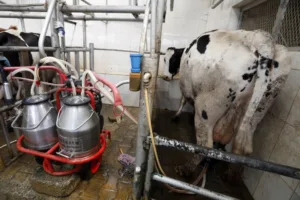
A survey of dairy farmers shows that currently fewer than 5 per cent of farms already meet the Government’s future requirements. The remaining farms will need to make adjustments. Nearly a quarter of dairy farms — more than 3,300 — currently exceed the proposed limit of 2.6 livestock units per hectare.
Despite the projected farm closures, the Wageningen assessment noted that national food security would not be compromised, estimating that the broader Dutch agri-food economy would see gross value-added fall by up to 4 per cent and sector employment by up to 5 per cent.
The Netherlands produces between one and a half and nine times more than it consumes of every animal product except beef, so a decline in production would mainly lead to lower exports.
Though environmental think tank PBL cautioned that even under full implementation, over half of vulnerable habitats will still exceed nitrogen thresholds by 2035. It projects that only 43 per cent of nitrogen-sensitive nature will be below the critical deposition value by then, with the number of protected areas free of exceedance rising only from 10 to 14 out of 120. The package, PBL said, “demands an effort that borders on what is feasible by 2035”.
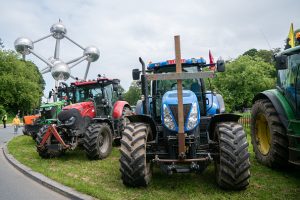
Farming interest groups have expressed renewed frustration over the projections, warning that the measures risk hollowing out rural communities while driving forced agricultural consolidation rather than sustainable farming.
European Commissioner for Agriculture and Food Christophe Hansen has told Dutch farmers that Brussels would no longer “just focus” on reducing livestock to cut emissions, indicating more co-operation with farmers. https://t.co/gdS73QbFzy
— Brussels Signal (@brusselssignal) March 21, 2025