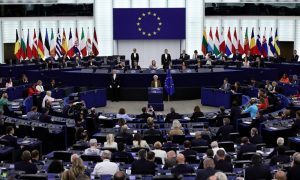









Patience with China is beginning to wear thin in the European Parliament. The piecemeal trade agreements reached by the European Commission with Beijing have failed to convince a growing number of MEPs, who are calling for a tougher response to the Asian giant’s trade practices and their impact on Europe’s industrial base.
Slovak MEP Miriam Lexmann, a member of the European People’s Party (EPP) and co-chair of the Inter-Parliamentary Alliance on China (IPAC), is leading an initiative urging Brussels to abandon its sector-by-sector negotiating strategy.
In a letter dated November 16 and addressed to European Commission President Ursula von der Leyen and Trade Commissioner Maroš Šefčovič, lawmakers are calling for structural measures to protect European industry. The initiative has received support from members of the European Conservatives and Reformists (ECR), as well as liberals, social democrats and greens.
The economic analysis underpinning the proposal is difficult to ignore. According to the European Commission’s own figures, the EU’s trade deficit in goods with China reached €359.9 billion in 2025, equivalent to nearly €1 billion a day.
The industrial outlook is equally discouraging. In September, the European steel distribution association Eurometal warned that 300,000 manufacturing jobs could be lost before the end of 2026. The signatories of the letter put the number of jobs potentially at risk in the longer term at more than one million.
The initiative follows negotiations held in Beijing on October 8–9, during which Šefčovič secured a commitment to “moderate” Chinese hybrid vehicle exports and further ease export licensing for rare earths and permanent magnets.
On November 24, the Commission announced the introduction of provisional quotas on hybrid vehicle imports, setting China’s allocation at 191,780 units for the 200 days starting on December 1 — equivalent to 350,000 units a year. The quotas apply to hybrid imports from all origins, including Japan, Turkey and the UK.
Beijing maintains, though, that the agreement will allow its exports to continue growing. Chinese authorities have also warned of possible retaliation should Brussels adopt unilateral trade restrictions.
The trade war is escalating, and there is growing suspicion that Washington may be exerting pressure behind the scenes.
MEPs argue that these agreements offer temporary relief but fail to address the underlying problems: Chinese state subsidies, industrial overcapacity and the lack of reciprocity in access to their respective markets.
Added to this is a familiar contradiction within the European Union. While China subsidises strategic industrial sectors, European companies face a regulatory burden whose impact on competitiveness former Italian prime minister Mario Draghi already highlighted in his 2024 report. It is difficult to compete with your hands tied.
The signatories are calling for faster regulatory simplification, stricter customs controls, European content requirements across supply chains, more rapid trade defence mechanisms and “horizontal” quotas and tariffs applied across sectors. Anti-dumping investigations can currently take up to 14 months.
The political pressure is beginning to coincide with moves within the Commission itself. Brussels is considering changes to its procedures to respond more swiftly to trade retaliation. Among the options under consideration is the possibility of implementing certain countermeasures unless a qualified majority of member states opposes them.
The Commission is expected to present its new trade defence instrument before the end of the year.
Meanwhile, Beijing is also stepping up its demands. Chinese authorities handed a delegation of MEPs visiting China in October a list of 19 European regulations they consider detrimental to their commercial interests, including the EU’s ban on products made with forced labour and its carbon border tax.
The current discussion has moved beyond the tariffs that dominated much of the debate in 2025. What is at stake is Europe’s ability to preserve its own industrial base without relying on periodic concessions from a foreign power, but also without imposing conditions on its own manufacturers that make their survival increasingly difficult.