

King Felipe VI of Spain has urged the 22 countries of the Ibero-American Community to keep supporting their system of summits, arguing the forum offers an “example of understanding and co-operation” and a “counterpoint to tensions and rivalries” as the world moves towards a multipolar order.
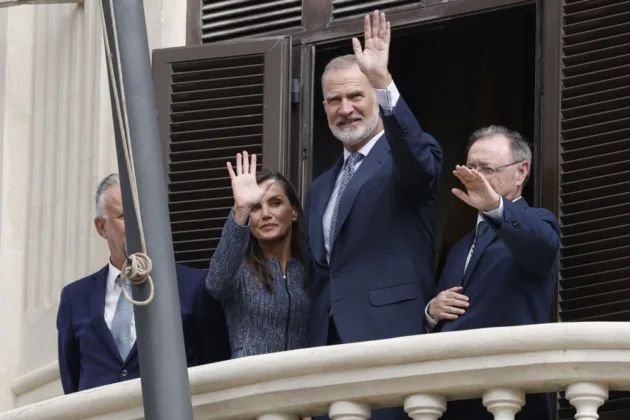
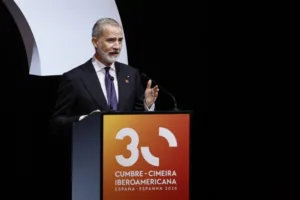
The monarch made the appeal to heads of State and government on November 4 at the opening ceremony of the XXX Ibero-American Summit, held at Madrid’s Teatro Real. The ceremony preceded a dinner the King and Queen hosted for delegates at the nearby Royal Palace.
The Madrid gathering, which runs until November 5, marks the 35th anniversary of the first summit, held in Guadalajara, Mexico, in 1991. Spain, which holds the pro tempore secretariat, is hosting the event for the first time since the Cádiz summit of 2012.
Felipe VI, who said he “proudly recognised himself in the mirror of Ibero-America”, called on leaders to back the community and its summits “with renewed strength”.
“Not only for its positive impact in so many areas,” he said, “but also as an example of understanding and co-operation, as a counterpoint to tensions and rivalries, as living proof that processes of political concertation are not empty rhetoric but benefit the daily lives of our citizens.”
The appeal comes after the previous summit, held in Cuenca, Ecuador, in November 2024, drew only three heads of State, all of them European: Felipe VI himself, Portuguese President Marcelo Rebelo de Sousa and Andorran head of government Xavier Espot.
Madrid has sought to reverse that trend. Ten heads of State and three vice-presidents are expected in the Spanish capital, with the remaining countries represented by their foreign ministers. Argentine President Javier Milei was due to arrive on November 5, while UN Secretary-General António Guterres was also expected to take part.
In his speech, the King said the Madrid summit was “a great occasion” to “vindicate our community with facts, with tangible achievements”. It was also a chance, he added, to “keep proclaiming to the world our clear and sustained commitment, as Ibero-Americans, to the word, to dialogue, to equality, to respect for the rules, to listening to minorities, to science, to entrepreneurship and innovation”.
“So let us make the most of it,” he told delegates. “Let us be the protagonists of our future. Let us keep tracing the path that led us from Guadalajara to Madrid and which, in two years’ time, will take us” to Honduras, which is due to host its first Ibero-American Summit in 2028.
That path, he said, “obliges us to keep working towards a fairer, more prosperous and more inclusive society”, before calling on leaders to continue “making Ibero-America” together.
Felipe VI set out what he said the countries on both sides of the Atlantic share, beginning with “two powerful common languages”, Spanish and Portuguese, “a culture of inexhaustible richness” and “our hospitable, associative and entrepreneurial spirit”. He also cited “a shared ethic, a set of principles and values, whose ultimate basis was, and remains, respect for the dignity of the person”.
The King praised the “intuition” of the leaders of 1991 who turned that common heritage into the Ibero-American Community of Nations. Quoting the Guadalajara declaration, he called it “an instrument of unity and development based on dialogue, co-operation and solidarity” that, “well used, opens access to a space of greater freedom and prosperity for some 700 million people”.
In the 35 years since, he said, “everything or almost everything has changed”, although both eras were “times of accelerated change”. In 1991 the world was waking up from a bipolar order and moving “not without uncertainty, towards what appeared to be a new world order”.
“Today we also perceive the imminence of a historic watershed, a paradigm shift, the progressive configuration of a multipolar order with contours still imprecise but different from those the world has known since 1945,” he said.
The King conceded that “nobody knows precisely what the world will look like in a few years” but said it “will continue to demand responses and solutions to challenges greater than any of our countries taken individually”.
Ibero-American countries, he added, could choose to respond “with one harmonious voice or 22 dissonant voices; with a shared hope or with 22 formulas to reflect uncertainty”. Choosing the right path, he said, “will be the historic responsibility of the 22 Ibero-American nations”.
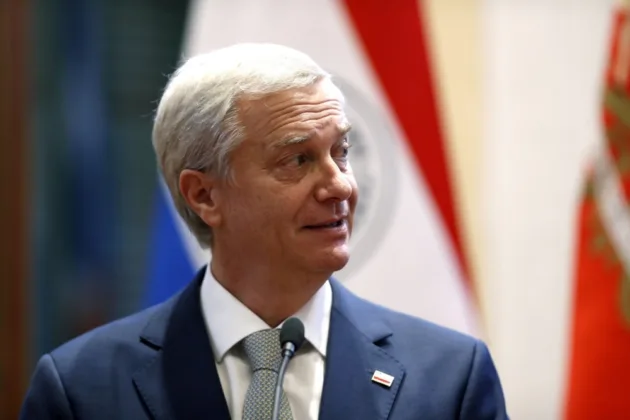
Ibero-American secretary-general Andrés Allamand, a former Chilean foreign minister, used his own address to praise Felipe VI, who he said had shown “an iron commitment to Ibero-America” since before his accession to the throne. The King, as Prince of Asturias, long represented Spain at the inaugurations of Latin American leaders.
“Far from all stridency, he is a leading actor in the Community, since when necessary he smooths rough edges, convenes not only governments but the full range of organisations that are our great social capital, contributes far-reaching ideas and injects the enthusiasm that must feed any organisation,” Allamand said.
The summit is expected to approve the Madrid Declaration and the Ibero-American co-operation action plan for 2026-2029, according to the Spanish Government.