










Italy has approved an anti-Semitism bill, turning a divisive political battle into law and reigniting the debate over the boundaries between fighting anti-Jewish hatred and protecting freedom of political expression.
The legislation, backed by Prime Minister Giorgia Meloni’s centre-right coalition, formally adopts the International Holocaust Remembrance Alliance (IHRA) working definition of anti-Semitism — a move welcomed by Jewish organisations but opposed by critics who fear it could blur the line between anti-Semitism and legitimate criticism of Israel.
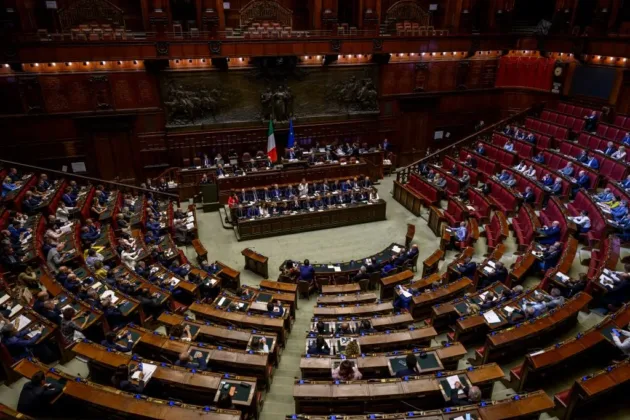
The Chamber of Deputies in Rome gave the legislation final approval on November 17, with 147 votes in favour, 93 against and five abstentions. The Senate had passed it on March 4 by 105 votes to 24, with 21 abstentions.
The bill was originally introduced in the Senate in January 2024 by Massimiliano Romeo, leader of the League (Lega) group in the upper house, together with fellow League senators Daisy Pirovano and Giorgio Maria Bergesio.
At the final vote in the lower house, the centre-right coalition was joined by lawmakers from opposition parties Italia Viva and Azione, as well as Benedetto Della Vedova of +Europa (More Europe). The main left-wing opposition parties — the Democratic Party (PD), the Five Star Movement (M5S) and the Green-Left Alliance (AVS) — opposed the legislation.
Futuro Nazionale (National Future), the movement led by Roberto Vannacci, also voted against. Speaking for the party, Rossano Sasso said the text “undoubtedly opens the way to a crime of opinion”.
Five PD lawmakers abstained, though, breaking with the party’s official position and exposing divisions within its ranks. Among them was former Turin mayor Piero Fassino, who said: “Anti-Zionism is nothing other than a form of anti-Semitism.”
The legislation adopts the working definition developed by the IHRA. Founded in 1998, the intergovernmental organisation brings together 35 member countries, including Italy, to promote Holocaust education, remembrance and research.
Its working definition was adopted at a plenary meeting in Bucharest in May 2016 and is intended to provide governments and institutions with a common framework for identifying anti-Semitism.
The definition describes anti-Semitism as “a certain perception of Jews, which may be expressed as hatred toward Jews”. It is accompanied by 11 illustrative examples, several of which refer specifically to Israel.
One of the most controversial examples concerns “denying the Jewish people their right to self-determination”, including by claiming that the existence of the State of Israel is a racist endeavour. Other examples include applying double standards to Israel or comparing contemporary Israeli policies to those of the Nazis.
Opponents argue that incorporating the definition into national legislation could create uncertainty over where legitimate political criticism ends and anti-Semitism begins.
The main critics are the PD, M5S and AVS, which warn that the law could expose pro-Palestinian activism, calls for boycotts and criticism of Israeli military operations to increased scrutiny, potentially encouraging self-censorship in universities and public debate. AVS co-leader Angelo Bonelli called it a “gag law”.
Amnesty International Italy has also raised concerns about the potential impact on freedom of expression.
The government has rejected these accusations, insisting that the legislation targets anti-Jewish hatred rather than political dissent. “The measure contains no system of sanctions and does not prevent any criticism of Israel,” said the bill’s rapporteur in the Chamber, Paolo Emilio Russo of Forza Italia.
The final text does not introduce new criminal offences or financial penalties. An earlier proposal concerning the possible prohibition of demonstrations was removed during the Senate examination of the bill, amid concerns over freedom of assembly and political expression.
From a legal standpoint, the law does not make criticism of Israel a criminal offence, nor does it introduce new criminal penalties or fines for expressing pro-Palestinian views. It explicitly safeguards freedom of political criticism and expression.
By incorporating the IHRA definition and its illustrative examples into the legal framework, though, it provides public authorities with a reference for identifying anti-Semitism, potentially influencing how existing hate-speech legislation is interpreted and enforced.
In practice, criticism of Israeli government policies remains lawful, while incitement to hatred or violence against Jews, or anti-Semitic discrimination, can already be prosecuted under existing Italian criminal law, notably the 1993 Mancino law.
The main concern raised by opponents is therefore not an automatic criminal ban, but the possibility of a broader interpretation of what constitutes anti-Semitic speech.
The law also provides for a National Strategy against Anti-Semitism, to be adopted by the Council of Ministers every three years, and institutionalises the role of a national coordinator within the Prime Minister’s office, tasked with overseeing efforts across public institutions.
Measures include education, teacher training, monitoring online hate speech and improving the collection of data on anti-Semitic incidents. The law also requires universities to adopt internal measures to prevent, monitor and respond to anti-Semitism, and provides for training in the armed forces, police and judiciary.
Livia Ottolenghi of the Union of Italian Jewish Communities (UCEI) welcomed the law, saying it would strengthen the “democratic antibodies” of Italian civil society.