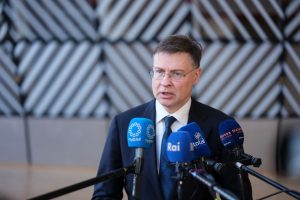


The European Union’s chief trade negotiator warned China on Monday during his trip to the nation that the bloc will be more forceful in upholding fair competition and defending its interests.
“The lack of reciprocity and level playing field from China, coupled with wider geopolitical shifts, has forced Europe to become more assertive,” said Valdis Dombrovskis, an executive vice president at the European Commission, during a keynote address at Tsinghua University.
“The EU welcomes competition. It makes our companies stronger and more innovative. However, competition must be fair, and we will be more assertive in tackling unfairness.”
Dombrovskis’ trip coincides with efforts by the EU to strengthen the defensive trade measures at its disposal. The bloc earlier this month launched an anti-subsidy probe into Chinese electric vehicles, which it said was needed to protect jobs and supply chains at home as it claims China is unfairly flooding the market with cheap vehicles.
China’s commerce ministry has criticized that investigation as “a naked act of protectionism.” The EV issue is expected to feature on Dombrovskis’ agenda during his China trip.
Asked later Monday about claims the country had created a non-level playing field, Chinese foreign ministry spokesman Wang Wenbin called China a “law-based country.”
“China is not a source of risk, but a staunch force for preventing and diffusing risks,” Wang told reporters at a regular press briefing. “China is an important cooperation partner for the EU. To shut out China in the name of de-risking is to throw away opportunities for cooperation, stability and development.”
In addition to a Monday event with Premier He Lifeng, the EU trade chief is also holding bilateral meetings with counterparts, and meeting European business representatives both in Shanghai and Beijing.
Dombrovskis is expected to tell Beijing that concrete agreements are needed in an effort to reset the relationship, according to people familiar with the EU’s plans.
During his speech, Dombrovskis argued that the EU’s de-risking strategy is not protectionist. He added that the EU’s plans are country-agnostic.
“Our approach to economic security is proportionate and precise, and our action will be purely risk-based,” he said. “De-risking is therefore a strategy to maintain our openness, but not undermine it.”
The current talks may also be a stepping stone for a summit between President Xi Jinping and the EU’s Ursula von der Leyen later this year.
“We can choose a path toward mutually beneficial relations. One which is based on open, fair trade and investment, and working hand in hand on the great challenges of our time,” Dombrovskis said Monday.
“Or, we can choose a path that slowly moves us apart. Where the shared benefits we enjoyed in recent decades weaken, and fade. And as a result, where our people and economies face reduced opportunities.”
Dombrovskis also cited challenges related to Russia’s war in Ukraine, saying that differences over the conflict could cause a rift between Brussels and Beijing.
“It’s very difficult for us to understand China’s stance on Russia’s war against Ukraine, as it breaches China’s own fundamental principles,” he said Monday, citing territorial integrity as a “key principle for China in international diplomacy.”
“Russia’s war is a blatant breach of this principle,” Dombrovskis added.
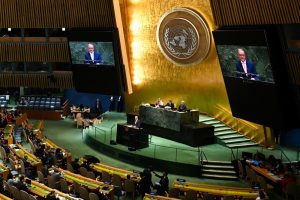
The EU has pressed Beijing to use its leverage to convince Moscow to end its aggression in Ukraine. European Council President Charles Michel called on China at this month’s United Nations Security Council gathering in New York to “join forces to persuade Russia to end this criminal war that is hurting so many.”
Dombrovskis on Monday noted other concerns for China because of the war, including those related to food safety and reputational risks.
“By increasing energy prices and driving inflation, the war is weakening the global economy,” he said, adding that it “directly affects China” because of its role as a manufacturing powerhouse.
Beijing’s position on the war is also “affecting the country’s image, not only with European consumers but also businesses,” Dombrovskis said.