



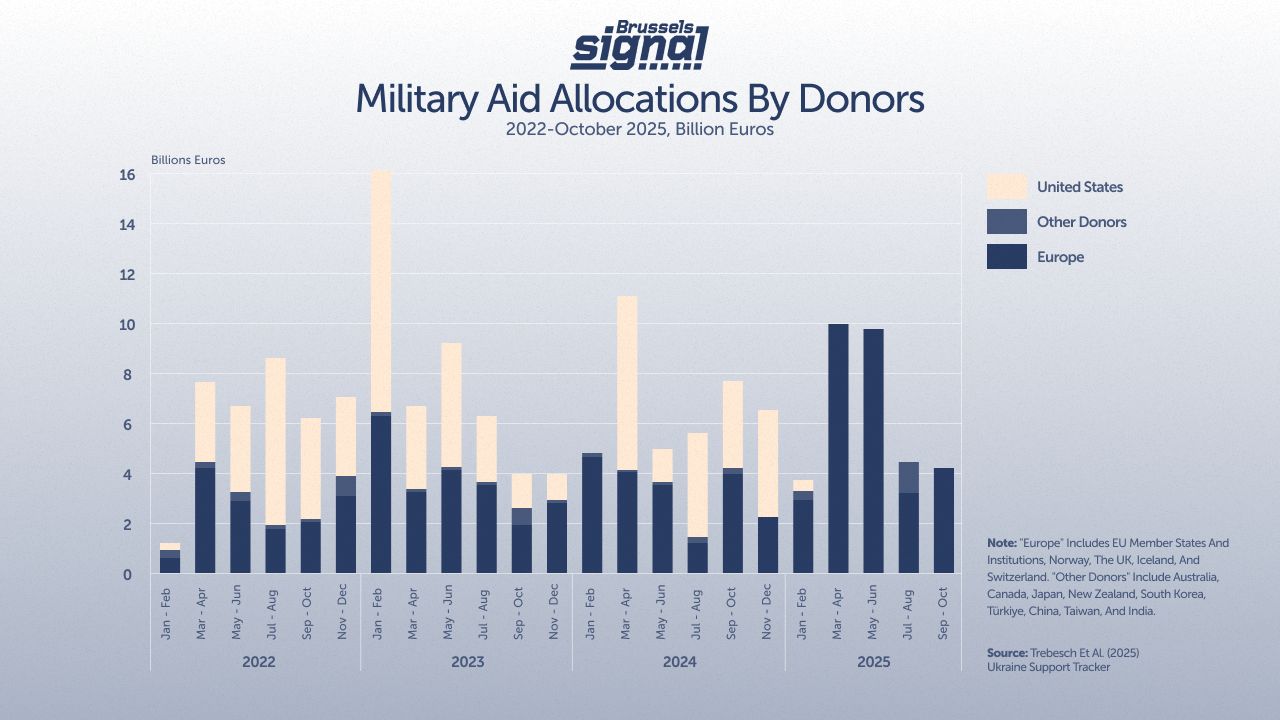
Europe’s military assistance to Ukraine is losing momentum, with new allocations in 2025 on track to fall to their lowest level since Russia’s full-scale invasion began in 2022.
That is according to the Kiel Institute’s latest Ukraine Support Tracker, released today.
Despite a strong start to the year, European commitments slowed sharply over the summer and continued to decline through September and October, leaving a widening shortfall as US support remains frozen, the data show.
Europe has allocated about €4.2 billion in new military aid to Ukraine so far in 2025, far below what would be required to compensate for the absence of fresh US assistance.
In previous years, global military aid from Europe, the US and other partners averaged around €41.6 billion annually. Yet by October 2025, only €32.5 billion had been committed worldwide.
To match earlier levels, donors would need to pledge an additional €9.1 billion before year-end, requiring a pace of support more than double that of recent months, the tracker disclosed.
“Based on the data available through October, Europe has not been able to sustain the momentum of the first half of 2025,” said Professor Christoph Trebesch, head of the Ukraine Support Tracker.
“The recent slowdown makes it difficult for Europe to fully offset the absence of US military aid in 2025. If this slower pace continues, 2025 will become the year with the lowest level of new aid allocations since the outbreak of the invasion.”
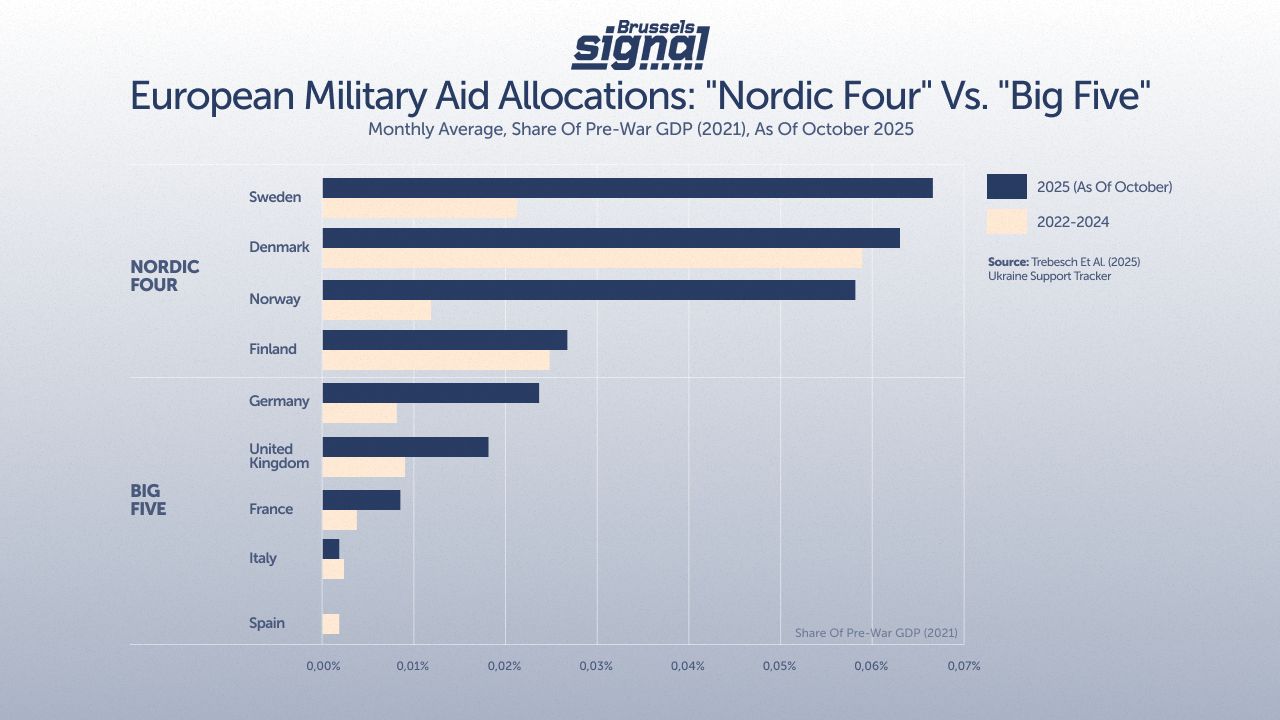
While Europe as a whole is falling short, the picture among individual countries is increasingly uneven. France, Germany and the UK sharply increased their military commitments compared with their average monthly allocations from 2022 to 2024.
Germany almost tripled its previous levels, while France and the UK more than doubled theirs.
When measured relative to national economic size, though, the major western European economies still trail far behind their Nordic counterparts.
Denmark, Finland, Norway and Sweden remain Europe’s leaders in relative terms, contributing significantly more compared with their GDP, according to the tracker.
The situation in southern Europe is even more stark. Italy and Spain delivered some of the weakest performances across the continent.
Italy reduced its already modest military aid levels by around 15 per cent compared with previous years, while Spain has not recorded any new military assistance for Ukraine in 2025.
“The higher allocations from France, Germany, and the UK are significant,” said Taro Nishikawa, project lead of the Ukraine Support Tracker.
“But even these three still trail the Nordic countries in relative terms. Meanwhile, the decline of support from Spain and Italy is a notable setback, reinforcing the importance of more balanced burden-sharing across Europe.”
Europe’s low support for Ukraine adds to the difficulties the country is facing at the front, with record numbers of deserters and very limited but constant Russian gains, keeping the pressure high on Kyiv.
Belgian Prime Minister Bart De Wever has issued a scathing letter to European Commission President Ursula von der Leyen, urging her to abandon plans to tap into €140 billion in frozen Russian assets to fund Ukraine’s war efforts. https://t.co/ZCX6B9NZCO
— Brussels Signal (@brusselssignal) November 28, 2025