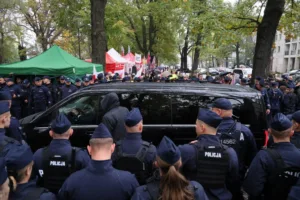

Emergency services have stormed the Gdańsk family home of Polish President Karol Nawrocki on May 23, 2026, after answering two hoax alarm calls — one claiming there was a fire at the property and the other citing a life-threatening medical emergency.
According to the President’s spokesman, Rafał Leśkiewicz, “officers forced the door open and entered the apartment while no one was at home”. There was no one inside and no fire.
Leśkiewicz noted that for several days there had been a series of similar incidents targeting journalists and public figures linked to the right-wing, including over a dozen journalists working for Poland’s most popular news broadcaster TV Republika, and Jarosław Kaczyński, the leader of the opposition Law and Justice party (PiS) — the party with which Nawrocki, who won the presidential run-off in June 2025, is aligned.
Kaczyński’s home was raided the previous week after a hoax report of explosives in the PiS leader’s garden. He suggested the ruling coalition could be behind the incidents.
“Whenever the ground starts slipping from under their feet, they resort to the same old tactics: provocations and insinuations aimed at intimidating their political opponents and their families,” he posted on social media. “They’re constantly testing how far they can go.”
Commenting on the incident at the President’s family home, Leśkiewicz complained that “for several days the authorities have been unable to respond appropriately”, adding that though the current targets were public figures, such threats “could affect anyone”.
The State Fire Service reported that it had received text messages on Saturday evening about a fire at the premises as well as reports of a cardiac arrest at the same address.
There appears to have been no contact with the State Protection Service (SOP), which is responsible for the security of the head of state and his family, as well as of government officials. The SOP could have contacted the President’s mother, who actually resides in the property.
The security services have been criticised for failing to identify the culprits behind the hoax calls and allowing emergency services to continue entering properties based on them. The authorities, though, insist that officers are obliged to treat such calls as if they were genuine.
Prime Minister Donald Tusk, who leads the current centre-left coalition which has repeatedly clashed with the opposition PiS-aligned Nawrocki, held a meeting of the security services at the weekend and expressed solidarity with the President, promising action to apprehend the culprits.
“We will use all available means to identify and apprehend the saboteurs, wherever they are from and whoever is behind them,” Tusk wrote on platform X.
But by Sunday night he was, in a political sense, facing a much bigger fire when citizens of the Polish city of Kraków voted in a referendum to recall the city’s pro-Tusk Mayor**, Aleksander Miszalski. That means the party now faces a tricky election in southern Poland’s second-largest city later in the summer and has to find a candidate capable of holding the seat.
PiS has pointed to the fact that so far the hoax calls leading to actions against victims’ homes have only affected journalists and figures from the Polish right-wing. According to former PiS candidate for Prime Minister Przemysław Czarnek, the incidents bore the mark of a “provocation” and “harassment of the homes of conservative figures”.
Earlier this month, police arrived at the home of Republika’s editor-in-chief Tomasz Sakiewicz after receiving a report about an alleged threat to the life of a minor. During the intervention officers briefly handcuffed Sakiewicz’s assistant, claiming she had refused to identify herself.
Media outlets sympathetic to the Tusk government sought to make light of the incident, with snide remarks about Sakiewicz being in a state of undress at the time.
Police later detained a 53-year-old man in connection with the incident but released him after their investigations suggested he himself had likely fallen victim to “unauthorised use of his personal data and access to the email he uses”.
The spate of hoax calls, whoever the culprit, fits into a pattern of actions against opposition politicians and conservative media in Poland.
Since coming to office in late 2023, the Tusk government has issued a long list of indictments against former PiS officials and politicians, drawing concerns over the rule of law from conservative observers across Europe.
Former Prime Minister Mateusz Morawiecki has been indicted for allegedly abusing power in 2020 when he sought to facilitate a postal ballot in the presidential election during the Covid pandemic without legal basis. Money was spent on preparations but the legislative changes could not be made in time and the election was eventually delayed.
Ex-interior minister Mariusz Kamiński and his deputy Maciej Wąsik were apprehended by security forces at the presidential palace, due to a legal wrangle over a presidential pardon for offences they were alleged to have committed during a previous PiS government (2005-2007) involving a sting operation against suspected corruption. They spent days in prison before the then-President issued another pardon which the Tusk government could not ignore.
The government has also indicted former PiS justice minister Zbigniew Ziobro and one of his deputies, Marcin Romanowski, for alleged abuse of power. Both have sought refuge in Hungary and then the US, fearing a long spell in detention without trial.
They are alleged to have conspired with others to siphon off funds from the Justice Fund for “political gain”. The funds reportedly went to conservative media and civil society organisations, the purchase of spyware allegedly used against the liberal opposition of the day, and to fund safety equipment such as fire engines in municipalities where support for PiS and politicians aligned with Ziobro was highest.
Defence lawyers maintain the prosecutors’ case is based on the testimony of one former civil servant who is himself under indictment for other offences. They also stress that neither defendant profited financially, and that money spent was strictly in line with the aims of the fund.
While the European Commission has remained silent on these cases, maintaining they are the business of the member state concerned, the US administration of President Donald Trump has taken a different line. Republican Congressmen and Senators have also written to the EC asking about the Tusk government’s actions with regard to the opposition and the maintenance of the rule of law.