


Former UK prime minister Tony Blair has launched a scathing attack on the leadership of his Labour Party, saying there is “no plan” for the future.
In a 5,600-word essay published by the Tony Blair Institute for Global Change, Blair has said the Starmer-led administration lacks a clear strategy for governing Britain amid rapid global change and warned that the party risks losing the next election without a fundamental policy reset.
The former Labour leader argued that the government is operating from a “traditional Labour ‘soft left’ position, parked firmly in the party’s comfort zone”.
He highlighted policies such as new workers’ rights laws, the push towards net zero, and certain tax changes as having held back business and growth.
“It is because we don’t have a worked-out, coherent plan for the country in a fast-changing world and are in the wrong political position from which we can devise one and win a second term,” he said.
“These measures have given headwinds not tailwinds to British business,” Blair added.
Blair emphasised that the party’s 2024 election victory stemmed more from public rejection of the Conservatives than from enthusiasm for Labour’s own platform. Labour increased its vote share by just 1.6 percentage points at that election, with its commanding parliamentary majority owed largely to the collapse of Tory support.
He called for Labour to reclaim the “Radical Centre”, prioritising “policy first and politics last”, and warned against leadership changes driven by personality rather than ideas.
“Whether there is a leadership change or not is irrelevant if it doesn’t start with a policy debate,” he said.
The intervention comes as Labour faces compounding challenges, including recent local election setbacks, declining polls and speculation about potential leadership contenders such as Greater Manchester mayor Andy Burnham and former health secretary Wes Streeting, who resigned from cabinet on May 14, citing a loss of confidence in the prime minister.
Blair cautioned the party against “playing with fire” by pursuing internal upheaval without a substantive policy agenda in place.
He said that plans to force Starmer out without knowing the future policy direction “is not a serious way of conducting ourselves”.
“It is one thing when in opposition to indulge this perennial delusion that when we lose seats to the right the country is really signalling it wants Labour to move left; it is dangerous to do it in government,” Blair wrote.
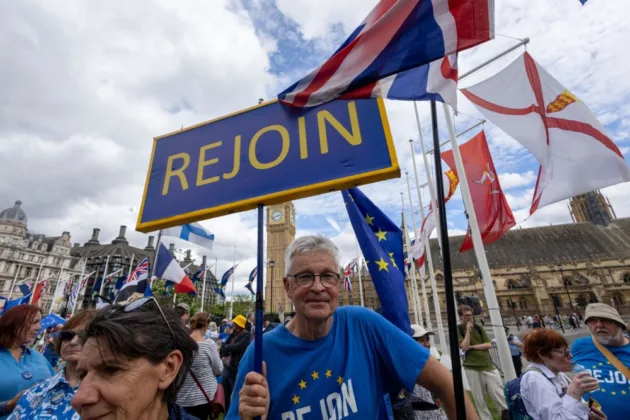
Blair further noted that the relationship between Europe and the UK needs to be handled with care and strategy.
“Just as Brexit was never the answer to Britain’s challenges back in 2016, reversing it isn’t the answer to the country’s far worse situation in 2026,” he wrote.
Blair argued against “personality contests” and said that politics requires “an idea, a project, a governing purpose, an analysis of what is wrong and a plan to put it right”.
He accused his party of having, “like many progressive parties, … an almost infinite capacity for self-delusion”.
“Without an agenda of this nature, radical but sensible, Britain will continue its long slide towards relegation from the Premier League of Nations,” Blair said.
He pointed to two “epochal changes happening in the world today – one geopolitical, the other technological – and Britain is not prepared for either”.
Blair warned of a technology revolution driven by artificial intelligence (AI) that would change everything, suggesting it was futile even to debate it because the transformation would happen regardless.
“Companies and countries will rise or fall on the back of it. It will revolutionise the private sector and should in time revolutionise public services and government. Yet people in most countries, including Britain, have no idea what is about to hit them,” he wrote.
On the US, Blair said that there was not a real rupture, but “a reckoning”. “This side of the water, we’re being told some home truths which, if wise, we will wake up to.”
He said the US does not want to dissolve NATO but demands European countries become bigger and better partners.
“So where does this leave Britain? Caught between the isolationist tendency of parts of the right and misguided progressivism of parts of the left which combined are in danger of leaving Britain marooned on an island of irrelevance,” Blair wrote.
Britain, he said, had “forgotten an essential lesson not just of diplomacy but of power politics: if you want to play you have to be sat at the table. And bring something to the table”.
He also stressed the rise of the Gulf states, “wealthy, modernising fast, and with huge investment in the West which they’re increasing”.
He issued a 10-point policy agenda, including support for private-sector adaptation to AI, planning reform and deregulation, cheaper energy and electrification, training youth in the technology economy, reindustrialising the Northof England, fundamental welfare reform, health-care reform, decisive action on illegal immigration, government reform on technology and a “Reimagined State”.
Blair’s comments, unusual for a former prime minister criticising a sitting Labour government he helped shape ideologically, have drawn significant media attention amid ongoing questions about the government’s direction nearly two years after taking power.
Treasury minister Dan Tomlinson directly disagreed with Blair’s assessment, defending the government’s record on growth and business measures on the BBC.