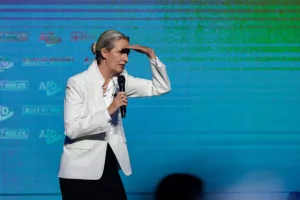

When Italian Minister of Culture Alessandro Giuli declared on May 8, 2026 that “Putin has won in Venice”, referring to the return of the Russian Pavilion at the 2026 Venice Biennale, he argued that the decision to include Russia represented a symbolic political victory for Vladimir Putin. The remark, though, was not merely about geopolitics.
Behind it lies a deeper conflict that has long been unfolding within Italy’s right-wing cultural sphere, revealing a growing divide. On one side stand journalists and intellectuals broadly aligned with Italian Prime Minister Giorgia Meloni’s government and her Fratelli d’Italia (FdI) party.
On the other side stands a group of right-leaning commentators and thinkers who, despite their conservative background, openly criticise the government’s actions. Their critique combines accusations that Meloni’s government has become too aligned with mainstream power structures and European Union institutional agendas, while also failing to develop a strong cultural strategy, thereby leaving cultural hegemony to the Left.
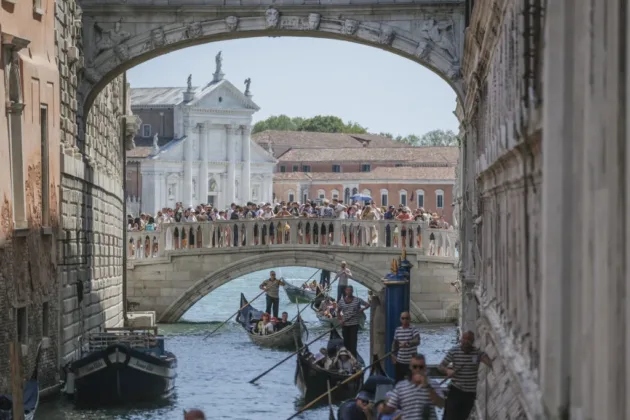
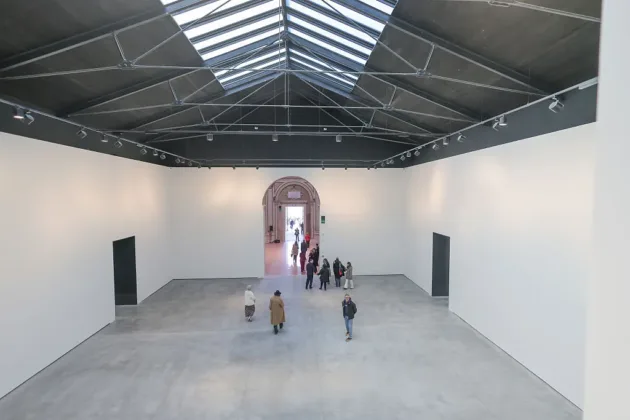
This divide became particularly evident in the controversy over the Russian Pavilion at the Venice Biennale, which opened on May 9, 2026 and will run until November 22. Giuli, a journalist and intellectual widely regarded as one of the most prominent figures aligned with the government, having been appointed Minister of Culture in September 2024, was widely interpreted as issuing a pointed critique of Pietrangelo Buttafuoco, a prominent right-wing intellectual and the Biennale Foundation’s president, who refused to exclude Russia despite mounting pressure from several sides, including the European Commission and government circles. Giuli ultimately boycotted the opening ceremony, a notable first in the Biennale’s recent history.
The Biennale is one of the world’s most important contemporary art exhibitions, held every two years in Venice and bringing together national pavilions from dozens of countries. Russia’s participation had been suspended following the Russian invasion of Ukraine in February 2022, in line with broader cultural and diplomatic isolation measures. Its last pavilion in Venice was held in 2019; in 2024 the country lent its space to Bolivia.
Its return, though, was defended by organisers as necessary to preserve cultural dialogue and protect the autonomy of artistic institutions. Buttafuoco argued that excluding an entire country from artistic representation would risk transforming cultural platforms into instruments of political censorship rather than spaces for exchange and dialogue.
The European Commission has warned that, in retaliation, funding for the Venice Biennale could be affected, noting that EU support, amounting to approximately €2 million under the Creative Europe programme, may be suspended or withdrawn if project conditions requiring the exclusion of Russia are not met. Fourteen of the 27 EU member states have backed the call for a funding suspension during a meeting of culture ministers in Brussels.
At the same time, pressure on the Biennale has also taken institutional forms within Italy, with the Italian Government aligning itself with the European Commission’s position. The Ministry of Culture reportedly supported the EU’s stance calling for the exclusion of Russia and sent inspectors to the Venice Biennale to conduct an administrative review of the organisation’s handling of Russia’s participation. The Biennale’s entire international jury also resigned in protest nine days before the opening.
Despite this, the Russian Pavilion was ultimately confirmed, but the confrontation between Giuli’s position and Buttafuoco’s approach has highlighted a deeper fracture within Italy’s right-wing cultural world, between those who broadly follow the government’s line and those who increasingly criticise it or openly distance themselves from it, as in Buttafuoco’s case. This latter current has become more vocal in recent months, gaining visibility and influence within conservative intellectual circles.
The criticism coming from this camp is not merely cultural in nature, but concerns the political trajectory of the Italian Government itself. Critics argue that the government should complement its electoral strength with a robust cultural strategy which, in their view, it has so far failed to develop, leaving cultural hegemony to the Left and maintaining an international posture seen as excessively aligned with EU and transatlantic institutional frameworks.
In recent months, several prominent conservative intellectuals have voiced concerns about what they describe as the government’s lack of a coherent long-term cultural strategy. Marcello Veneziani, a writer and essayist and one of the most influential voices of Italy’s conservative cultural tradition, has warned of a “right in power without cultural hegemony”, arguing that governing without a deeper intellectual project leaves political action exposed and reactive.
Historian Franco Cardini, a medievalist who in his youth was active in the post-fascist right and close to the political milieu from which Meloni’s party later emerged, has criticised what he sees as excessive subordination to external geopolitical pressures, suggesting that Italy’s cultural autonomy is being weakened in the name of international alignment.
Political theorist Marco Tarchi, a political scientist and one of the leading scholars of European populism, has long maintained that the Italian right continues to struggle to transform electoral success into a stable and enduring cultural identity, pointing to a persistent gap between political power and intellectual elaboration, famously describing it as a “political victory without cultural consolidation”.
These criticisms do not come from a cohesive or organised intellectual movement, but rather from a series of largely independent figures who nonetheless express a growing dissatisfaction with a government they accuse of not doing enough.
Across these different perspectives, a common concern emerges: that the right, now in government, has yet to develop a durable cultural hegemony capable of shaping institutions independently of short-term political pressures or external constraints, and thereby maintaining its political competitiveness even in the event of an electoral defeat.
Recent polling trends in Italy, including surveys from institutions such as Ipsos Italia (May 2026) and SWG (May 2026), generally place the governing centre-right coalition in a range of roughly 45 to 48 per cent of voting intentions nationally, maintaining a relative lead but showing a gradual decline compared to the stronger peaks of 2024-25, when it at times exceeded 50 per cent in aggregate support. At the same time, the centre-left opposition is typically estimated in the range of 42 to 45 per cent, despite remaining highly fragmented internally. While still slightly behind, a more unified opposition front ahead of the next general election, expected in 2027, could potentially render the balance of power less stable than in previous cycles.
In this reading, the controversy over the Venice Biennale is not an isolated case, but feeds into an internal debate within the right ahead of the next election. It is rather a revealing symptom of a broader uncertainty about the identity, direction, and intellectual foundation of Italy’s conservative culture in power, an uncertainty that some on the right fear could prove politically costly within an already fragile and uncertain Italian and European landscape.