
Belfast has become the latest flashpoint in a recurring cycle binding Ireland and Britain, in which violent attacks act as catalysts for an anti-immigration movement that, amplified online, has grown increasingly organised.
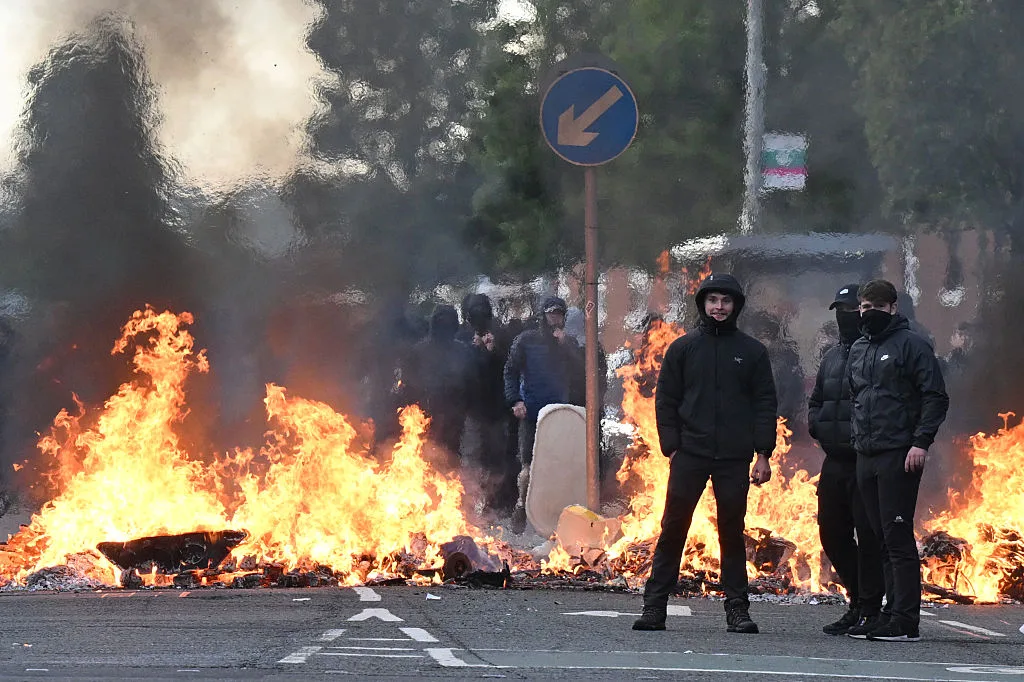
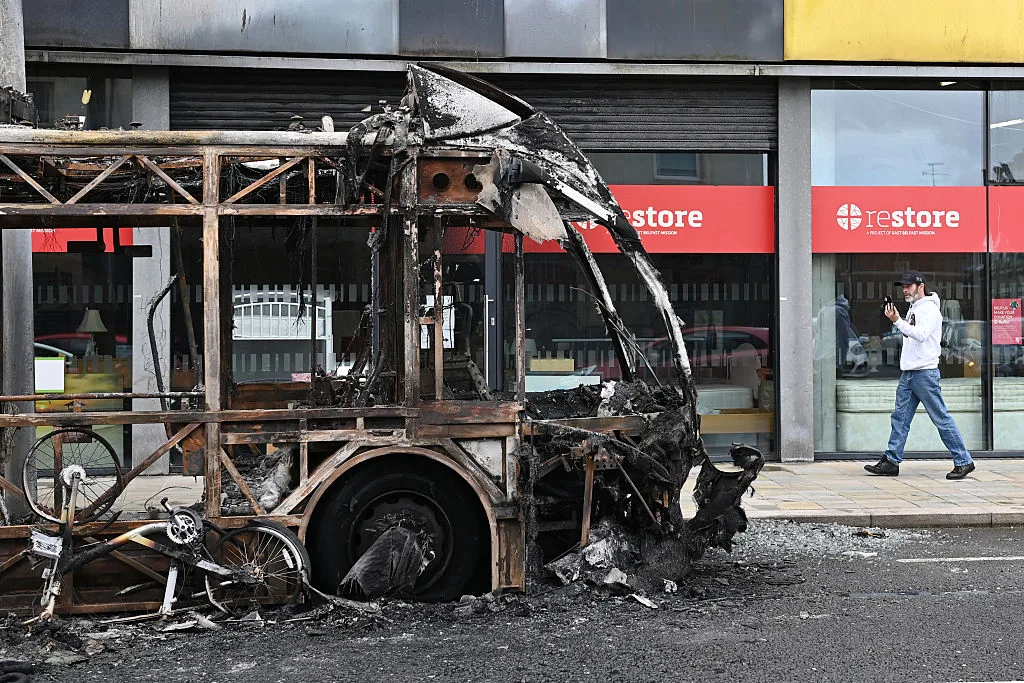
Hundreds of demonstrators took to the streets of the Northern Irish capital on June 9, setting cars, a bus and houses alight as police deployed armoured vehicles, after officers charged a Sudanese man over a knife attack.
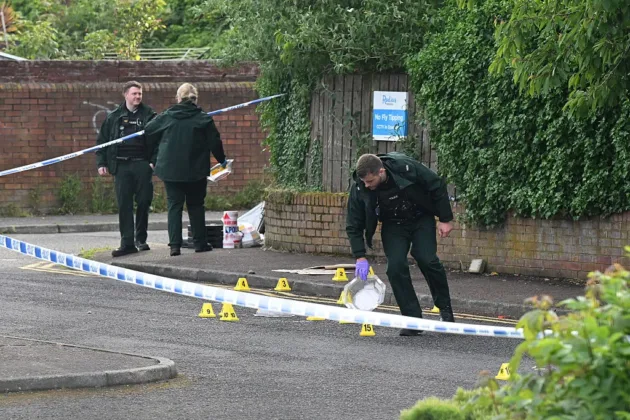
The unrest followed an attack late on June 8, when a man in his forties was stabbed in the Kinnaird Avenue area of north Belfast at about 10.30pm.
The Police Service of Northern Ireland (PSNI) said the victim had suffered serious injuries to his eyes, face and back, and remained in a serious condition in hospital. A kitchen knife was recovered from the scene.
A 30-year-old man was charged with attempted murder, possession of a bladed article in a public place and threats to kill. The PSNI said he was Sudanese, correcting an earlier statement that had described him as Somalian.
THE SAME SCRIPT
The mechanics were by now familiar: another violent attack acting as a catalyst, graphic footage shared widely, and a call to protest amplified by right-wing accounts, with US billionaire Elon Musk among those reposting appeals on X for rallies.
Established political figures moved quickly to the same ground. Democratic Unionist Party (DUP) leader Gavin Robinson urged authorities to curb “uncontrolled immigration”, while Reform UK leader Nigel Farage called the attack “barbaric” and questioned whether the suspect should have been in the country.
Restore Britain leader Rupert Lowe demanded mass deportations, and anti-immigration activist Stephen Yaxley-Lennon, known as Tommy Robinson, shared details of planned demonstrations on X.
PSNI Chief Constable Jon Boutcher said there was no indication the attack was terror-related and that the suspect was not known to police.
A SHARED CURRENT
The same script has played out repeatedly across both jurisdictions. In November 2023, the stabbing of three children and a care assistant in Dublin’s Parnell Square triggered the worst rioting the Irish capital had seen in years, with buses, a tram and Garda vehicles burned.
Around 60 members of An Garda Síochána were assaulted that night, according to Garda figures, after misinformation about the suspect’s nationality spread online. Irish mixed martial arts fighter Conor McGregor was among those who fuelled anger over immigration on X.
Many described those scenes under the banner “Irish Lives Matter“, a slogan — a deliberate echo of Black Lives Matter — that has become a rallying cry for an anti-immigration movement across Ireland and Northern Ireland alike.
It has appeared on placards at Dublin rallies and was daubed at the Kennedy Centre on the Falls Road in west Belfast, where the PSNI recorded it as a hate incident and nationalist politicians condemned it as racist.
The Republic has since seen a sustained protest movement against the housing of asylum seekers, with disorder in Dublin suburbs including Coolock in 2024.
The Belfast suspect’s route fed directly into that wider anxiety. Boutcher said the man was an asylum seeker believed to have travelled from Sudan to Paris, then flown to Dublin, before reaching Belfast by bus and claiming asylum in February 2023.
He had been granted leave to remain in 2023 and held refugee status with permission to stay until 2028, the Home Office said, according to the PA news agency. His arrival from the Republic of Ireland has renewed scrutiny of the Common Travel Area, the passport-free zone between the United Kingdom and Ireland that critics say complicates immigration enforcement.
FROM SOUTHPORT TO SOUTHAMPTON
In Britain, false claims that the killer of three girls in Southport was an asylum seeker helped ignite the country’s worst disorder in years in the summer of 2024, spreading to some 27 towns and cities and leading to around 1,280 arrests.
Northern Ireland was drawn in a year later, when 107 officers were injured over two weeks of rioting in June 2025, sparked by an alleged sexual assault in Ballymena, County Antrim, according to police.
The movement has also taken organised, set-piece form. A “Unite the Kingdom” march in London in September 2025, fronted by Yaxley-Lennon and addressed by Musk via video link, drew vast crowds and left 26 officers injured.
Most recently, protests flared in Southampton, southern England, over the police handling of the murder of Henry Nowak, an 18-year-old student fatally stabbed by a Sikh man who had falsely claimed to be the victim of a racist attack, as Brussels Signal has reported.
A HARDENING DEBATE
British Prime Minister Keir Starmer condemned the Belfast stabbing as “horrific” and “sickening”, while First Minister Michelle O’Neill appealed for calm and several Northern Irish politicians branded the rioting racially motivated.
The response has split along the same lines each time. Anti-immigration parties argue that repeated attacks expose the failures of Britain’s and Ireland’s asylum systems, while ministers and senior officers warn against exploiting individual crimes, often pointing to online misinformation.
Each episode has also drawn a counter-mobilisation, with large anti-racism rallies following the 2024 unrest in cities including Belfast.
The cumulative effect of these successive attacks has been to harden the migration debate across both islands and much of Europe. The immediate question in Belfast is whether the unrest subsides or, as in Ballymena and Dublin before it, hardens into successive nights of disorder.