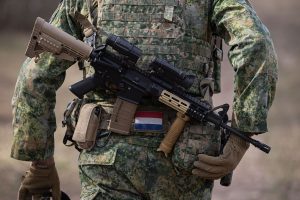







The Dutch armed forces are “stuck between the rules”, Dutch defence minister Dilan Yeşilgöz has warned, as the Dutch Government pushes a new law granting the military temporary powers to sidestep local restrictions and environmental constraints on existing training grounds.
Speaking to the NOS current affairs programme Nieuwsuur on August 12, Yeşilgöz said the proposed Defence Readiness Act (Wet op de defensiegereedheid, or Wodg) is essential to prepare Dutch troops for a possible conflict.
The five-year measure would make it easier to conduct night-time live-fire exercises, dig trenches, train with drones and accelerate or deviate from certain permit procedures.
“Defence is really stuck between the rules,” Yeşilgöz told the programme.
She pointed to several practical constraints.
Drones currently cannot film car licence plates during counter-drone drills, forcing months-long waits for permits in one of the most densely populated countries in Europe.
“In a country as small as the Netherlands there is almost nowhere to go,” she said. “If you want to run counter-drone exercises, you sometimes have to wait months for a permit. We simply do not have that time.”
Digging trenches, a staple of the war in Ukraine, is heavily restricted on many ranges because it permanently alters the terrain and triggers extra approvals.
“We all thought trenches belonged to the past. Suddenly we see them used extensively in Ukraine. That means we should also be able to practise them on our own training grounds. But we’re not even allowed to dig,” she said.
“The hard truth is also: Putin is not impressed by a nature park. We see what is happening in Ukraine and we want our people to be ready for your safety and mine.”
Without lighter regulation, she added, the Netherlands would keep sending personnel abroad, for example to Germany, where there is more space to train.
At Gilze-Rijen air base in the southern province of North Brabant residents already face growing noise and vibration from low-flying Chinook helicopters, with mitigation measures required for 275 homes.
Mayor Derk Alssema said he understood the military case but that a limit had been reached for residents living near the base.
He also warned that more helicopter movements could hold back housebuilding, because local authorities cannot demonstrate that a new district is fit to live in if aircraft pass over it every day.
Nature groups are pushing back. Jeroen de Koe, director of the conservation association Natuurmonumenten, said nature was treated as a dumping ground and told Nieuwsuur he feared the five-year relaxation would prove permanent.
Intensified exercises during the breeding season risk scaring birds off their nests and damaging biodiversity, he said.
Kars de Graaf, professor of public law and sustainability at the University of Groningen, said existing law already allowed defence interests to be weighted heavily and that the bill went further than necessary, at the expense of nature, housebuilding and energy infrastructure.
The defence ministry has said it is still examining compensation for those affected, though Yeşilgöz said the form it would take could not be set out in advance because the impact varies by site and by exercise.
The proposal comes amid long-running friction between Dutch nature and nitrogen rules. Many military sites sit in or near Natura 2000 areas.
Research by TNO, the Netherlands Organisation for Applied Scientific Research, has shown nitrogen permitting alone can delay or block training, construction and equipment use at multiple bases, potentially undermining NATO commitments, even though defence accounts for between 0.01 and 0.05 per cent of national nitrogen deposition.
The bill was laid before the House of Representatives on June 23, after the Council of State backed the approach in an opinion published on March 23 while calling for tighter limits on the powers and more work to build public support.
Prime Minister Rob Jetten’s three-party coalition, sworn in on February 23, lacks a parliamentary majority and will need opposition votes to carry the measure.
Belgian's former Vice-Chief of Defence @general_marcT has claimed Belgium is not at all ready for armed conflict, saying that within hours of an attack its troops would be rendered unable to shoot back and would have to rely on “throwing stones”. https://t.co/jN0oj6U3oU
— Brussels Signal (@brusselssignal) December 6, 2023