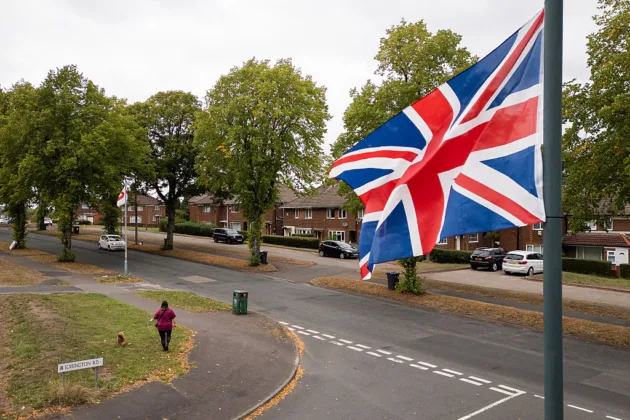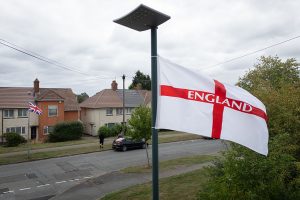






A number of local authorities across England have warned residents not to display England flags on public property during the World Cup, prompting criticism from those who see the measures as an attack on expressions of national pride.
Councils including Bristol, South Gloucestershire and Wiltshire have reminded residents that flags and banners should not be attached to lampposts, railings, road signs or other publicly owned infrastructure without permission.
South Gloucestershire Council told residents in a recent newsletter that while many people would want to support teams competing in the tournament, any decorations should only be displayed on private property.
“We know many residents will want to show their support for teams and countries competing in the World Cup,” the council said.
“To make sure this is done safely and lawfully, any items, including flags, should only be displayed on your own private property and must not cause obstruction, damage, or concern to others.”
Residents were directed to guidance on the council’s website stating that the rules are intended to protect public safety, prevent damage to public assets and maintain community cohesion, rather than limit free speech.
A similar message was issued in Bristol by the city’s Green Party council leader, Tony Dyer, who urged residents to restrict displays to their own homes.
“What people cannot do is fly flags on lampposts or railings or any public property,” Dyer said.
“Please do not attach anything to lampposts – it causes health and safety issues.”
Bristol City Council has said it will prioritise the removal of flags in what it describes as “sensitive locations”.
The issue has attracted particular attention in Bristol, home to Torrington Avenue, a street that has repeatedly been described as one of England’s most patriotic.
Yet the issue was not contentious during previous tournaments, where residents decorated the road with dozens of St George’s flags to show support for the England team.

Wiltshire Council has also warned residents that flags attached to road furniture may be removed.
Councillor Martin Smith, the authority’s Cabinet Member for Highways and Streetscene, said: “With major sporting events such as the World Cup bringing communities together, many residents will want to show their support by displaying England flags and decorations.
“We are all willing the England team on to end 60 years of hurt and bring the trophy home.”
“However, we would like to remind residents that placing items such as banners, bunting or flags on or near the public highway – including lampposts, road signs and roundabouts – without permission can pose safety risks to road users and pedestrians. It can also obstruct visibility.”
The debate touches on wider questions about the meaning of England’s national flag and how it is perceived in Britain today.
For many people, the St George’s Cross remains a straightforward symbol of national identity and support for England’s sporting teams. Others argue that the flag has been appropriated by anti-immigration and far-right groups.
The issue spilled into public debate during demonstrations organised by far-right activist Tommy Robinson, where St George’s flags were displayed.
In a blog post published last year, Bristol City Council leader Tony Dyer addressed the controversy surrounding the St George’s flag.
“We know that right now our St George’s flag, which should be a symbol of pride, is being used by some to represent anti-migrant campaigns of misinformation and hate,” he wrote.
“The irony of this becomes clear when we realise that St George himself was a migrant from what is now Turkey to Palestine,” he added.