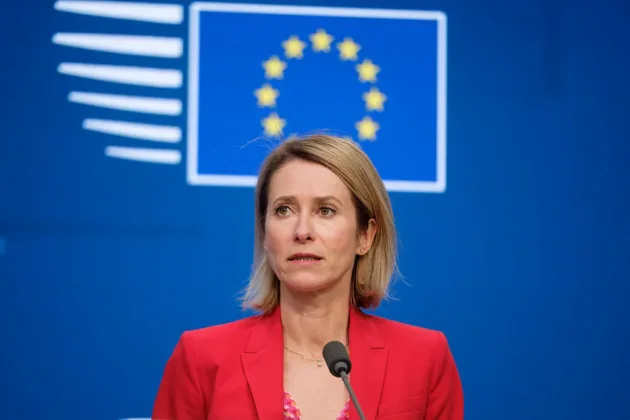

The European Union’s foreign policy chief has said Russia is not yet ready to enter serious negotiations with Ukraine, urging greater pressure on Moscow and stronger support for Kyiv to bring the war closer to an end.
Kaja Kallas made the remarks on June 8 as she arrived for an informal meeting of EU defence ministers in Nicosia, Cyprus. She said the bloc needed “strategic patience” and stressed it was not the EU that was seeking talks.
It was “Russia who has to talk to us if it wants to end this war,” Kallas said.
She argued that both sides would eventually have to reach an agreement, but said continued Russian strikes made it difficult to speak of any real negotiating scenario for now.
Kallas called for the European Union to step up pressure on the Kremlin while reinforcing its backing for Kyiv. She also pointed to signs of unease inside Russia over the war dragging on.
Any eventual settlement, she added, would have to take account of European security interests, particularly on questions such as a possible easing of sanctions or the unblocking of frozen Russian assets. EU foreign ministers had already debated what the bloc’s demands should be ahead of any future talks with Moscow.
European defence commissioner Andrius Kubilius struck a more upbeat note, suggesting recent developments on the battlefield could help bring a negotiating scenario closer.
The Lithuanian politician said Ukraine appeared to be gaining the upper hand on several fronts, both on the ground near Donetsk and Pokrovsk and through deep strikes inside Russia. That shift in momentum, he argued, “could push Putin to negotiate.”
Kubilius said member states still had room to maintain a high level of military assistance to Kyiv, arguing that a stronger Ukrainian position was the surest route to a lasting peace.
The comments came after British Prime Minister Keir Starmer, French President Emmanuel Macron, German Chancellor Friedrich Merz and Ukrainian President Volodymyr Zelensky met in London on June 7. The four leaders backed a ceasefire with Russia accompanied by security guarantees for Ukraine.
In a joint statement, they set out conditions for a “just and lasting peace”, starting with an immediate and complete ceasefire and using the current line of contact as a starting point for negotiations. Russian President Vladimir Putin has so far rebuffed Zelensky’s call for direct talks.