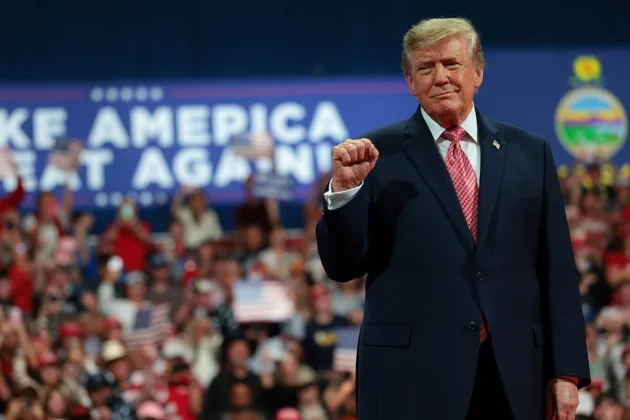











US President Donald Trump has warned that Republican supporters may stay at home at November’s midterm elections because his own name will not appear on the ballot.
In an interview published by Punchbowl News, a Washington outlet covering Congress, the President said he still expected his party to hold both chambers. He acknowledged that he could not guarantee his voters would follow him.
Trump said the anger among that electorate was directed at congressional Republicans and not at the White House. “They’re angry at Republicans, but they’re not angry at me,” he said.
The President has spent recent weeks pressing Senate Republicans to abolish the filibuster and pass the Safeguard American Voter Eligibility (SAVE America) Act, a proof-of-citizenship voting measure.
In a Truth Social post on August 6 he said failure to do so would leave him “the last Republican president”, a warning he returned to in the interview.
Trump said his super political action committee, MAGA Inc, which he put at $400 million (€345 million), would spend on behalf of Republican candidates.
Republicans hold 53 of the Senate’s 100 seats, meaning Democrats would need a net gain of four to take the chamber.
Trump declined to say whether Senate Majority Leader John Thune should serve another term as Republican leader, saying only that Thune was trying hard on the voting bill.
He added that he believed he could do business with House Minority Leader Hakeem Jeffries, the New York Democrat who would be in line to become speaker if his party won the lower house.
Relations with parts of his own bench have soured. Senators John Cornyn and Bill Cassidy lost their primaries this year after Trump endorsed their challengers, an outcome Brussels Signal has argued leaves European hopes of a restraining Congress badly misplaced.
That friction is complicating the confirmation of acting attorney general Todd Blanche, Trump’s former defence lawyer. Senator Susan Collins has said she will oppose him, while Lisa Murkowski and Cassidy have not said how they will vote.
Thune said he hoped to hold a first floor vote on the nomination before the Senate began a five-week recess.
The chamber was also due to vote on a long-delayed Russia sanctions package, one of the few measures tied to the Ukraine War that European governments have followed closely this summer.
Transatlantic strains have continued in the meantime, with several US states suing the administration over tariffs that also fall on EU exporters.