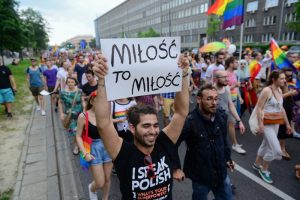





On May 22, Polish Interior Minister Marcin Kierwiński and Digitalization Minister Krzysztof Gawkowski signed a regulation imposing new official forms on Polish civil registry offices — forms specifically designed to facilitate the transcription of foreign same-sex “marriage” certificates into the Polish civil registry. The move was quiet, technical in appearance, and presented as a mere administrative update. It is nothing of the kind.
A government regulation cannot amend the law. It certainly cannot amend the Constitution. Yet this is precisely what the Tusk government is attempting. Article 18 of the Polish Constitution is unambiguous: Marriage is a union of a man and a woman. The Civil Registry Act and the Family and Guardianship Code give the same answer. No ministerial signature — however confident — can alter that. What has been signed into force is not a reform. It is a violation of the constitutional order, dressed in bureaucratic clothing.
The response from local authorities has been immediate and revealing. The cities of Warsaw and Wrocław, which have long positioned themselves as progressive standard-bearers in the culture war which the Tusk coalition has chosen to wage, have announced compliance. Others have not. The municipality of Zakopane, for one, has made clear it will refuse to transcribe same-sex “marriages” — because they are not marriages under Polish law. This is not defiance for its own sake. It is the correct legal position.
At Ordo Iuris, we have no intention of leaving those local governments and civil registry clerks to face the consequences alone. Attorney Magdalena Majkowska, the director of our Litigation Centre, announced on May 22 that the Institute will provide free legal assistance to every official who faces negative repercussions for refusing to execute orders to transcribe foreign same-sex union certificates. We will also publish a dedicated legal guidance brochure and conduct a webinar for local government representatives and registry officials, so that those who wish to act lawfully have the tools to do so. The government may be willing to put its officials in an impossible position. We are not willing to abandon them there.
The Polish Episcopate has spoken with equal clarity. The Delegate of the Polish Bishops’ Conference for the Pastoral Care of Local Government Officials and Civil Servants has called on registrars and local authorities to refuse compliance with the regulation, affirming that what the government is demanding conflicts not only with the law and the Constitution, but with the moral duty of those entrusted with maintaining the integrity of civil records. That the voice of the Church and the voice of legal analysis point in the same direction should not surprise anyone. They are both reading the same document: The Polish Constitution.
How we arrived here
The regulation of May 22 did not emerge from nowhere. It is the latest and most brazen step in a sequence that began with judicial activism in Poland’s own courts and was amplified, predictably, by an ideologically compliant Court of Justice of the European Union.
The case at the origin of this chain involved two Polish male citizens who had contracted a “marriage” in Berlin under German law and sought to have that union entered into the Polish civil register. When the case eventually reached Poland’s Supreme Administrative Court (NSA), a panel of three judges — rather than applying Polish constitutional law as their mandate required — took the remarkable step of submitting a preliminary reference to the CJEU, framing their questions in a way that effectively invited Luxembourg to impose a transcription obligation on Poland. This was not a good-faith request for legal clarification. It was a deliberate handoff: Activists in judicial robes asking activist judges in another jurisdiction to do what Polish law would not permit them to do directly.
The CJEU obliged. In its ruling of November 25, 2025, the Court declared that EU member states are obliged to recognise same-sex “marriages” contracted in other member states for the purposes of rights derived from EU law — specifically, free movement. The reasoning was characteristically creative. Family and matrimonial law are explicitly excluded from EU competence. The Treaties say so plainly. Confronted with this inconvenient jurisdictional reality, the CJEU did not dismiss the case as it should have. Instead, it reframed the issue as a matter of free movement rights, thereby arrogating to itself — and to the European Commission — a supervisory role over an area of law the member states never surrendered. The Commission, far from resisting this overreach, has been an enthusiastic participant in it.
Prime Minister Donald Tusk was quick to announce that the ruling had to be respected. This is a remarkable position from a man who, when it suited his political purposes, was perfectly content to disregard judicial decisions he found inconvenient. The selective reverence for court rulings in this government is not a matter of principle. It is a matter of politics.
The three-judge NSA panel that had originally made the preliminary reference then, on March 20 of this year, issued a ruling ordering the transcription of the Berlin “marriage” into the Polish civil registry. Ordo Iuris has described this ruling as an unconstitutional capitulation to EU ideologues. That description is precise. The ruling is grounded not in Polish constitutional law but in an external judgment which itself exceeded the competences of the court that issued it. The NSA panel did not apply Polish law. It deferred to a ruling that should never have addressed the matter in the first place.
The legal response
Ordo Iuris engaged at every stage. Prior to the adoption of the ministerial regulation, we submitted a formal legal opinion to the Ministry of Digital Affairs warning that the planned regulatory instrument would be unlawful. A government regulation, we explained, operates within the framework of existing statutes and the Constitution. It cannot override them. It cannot alter definitions established in the Family and Guardianship Code or the Civil Registry Act. And it certainly cannot undo the constitutional definition of marriage. The government received that opinion and proceeded regardless.
We have also submitted an amicus curiae brief to the Constitutional Tribunal concerning the NSA’s March 20 ruling. Our position is straightforward: The Polish Constitution does not permit the transcription of foreign same-sex “marriage” certificates into the Polish civil register. Article 18 establishes marriage as a union of a man and a woman. That provision is not a policy preference subject to reinterpretation through creative readings of EU free movement law. It is a constitutional norm, adopted by the Polish people and resistant to circumvention by either administrative regulation or judicial activism.
To address the systemic vulnerability exposed by this episode — namely, that activist judges can manufacture a pretext for CJEU intervention by asking the wrong questions — Ordo Iuris has also prepared a draft legislative amendment. The proposal would modify the existing statutory framework in a way that forecloses the interpretive manoeuvres that have been used to misread current law. Its purpose is not to introduce new restrictions but to ensure that the law is stated with sufficient precision that it cannot be distorted, and to prevent its exploitation by those who prefer to achieve through judicial channels what they cannot accomplish through democratic ones.
The civil partnerships flank
The transcription regulation is not the only front on which the Tusk coalition is advancing. Last Friday, the Sejm adopted a law introducing civil partnerships — including same-sex ones — into Polish law. The vote illustrates what has been apparent for some time: This government intends to use every available mechanism, regulatory, judicial, and legislative, to achieve an ideological transformation of Polish family law that lacks any democratic mandate.
There is, however, a safeguard in place. President Karol Nawrocki is expected to veto the civil partnerships law, and Ordo Iuris has been engaged in substantive dialogue with the presidential administration on exactly this question. A veto, if issued, will not be the end of the matter — the Tusk government has shown no reluctance to return to the same battles — but it will be a necessary and lawful exercise of the constitutional check on legislative excess.
The pattern is consistent and it must be named clearly. We see it in the SAFE loan affair, where the government seeks to bind the Polish state to a multi-decade financial obligation without parliamentary authorisation. We see it in the instrumentalisation of EU mechanisms against democratic decisions of member states. And we see it here: A government regulation signed on May 22 that attempts to do what only the Parliament and the Polish people could legitimately do — redefine the legal meaning of marriage in Poland.
Each instance, taken alone, might be dismissed as a technicality. Taken together, they form a deliberate pattern of constitutional circumvention. Those who hold office in Poland do so under the Constitution, not above it. That is not a partisan observation. It is the foundational premise of the rule of law — the same rule of law that this government, just like the European Commission itself in its dealings with Poland, which it miraculously stopped criticising on rule-of-law grounds as of December 23, 2023, invokes selectively, loudly, and without apparent awareness of the irony.
Jerzy Kwaśniewski is a Polish lawyer and the President of the Ordo Iuris Institute for Legal Culture, Warsaw