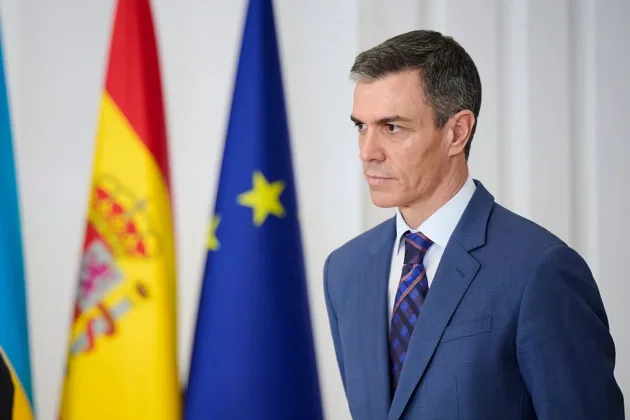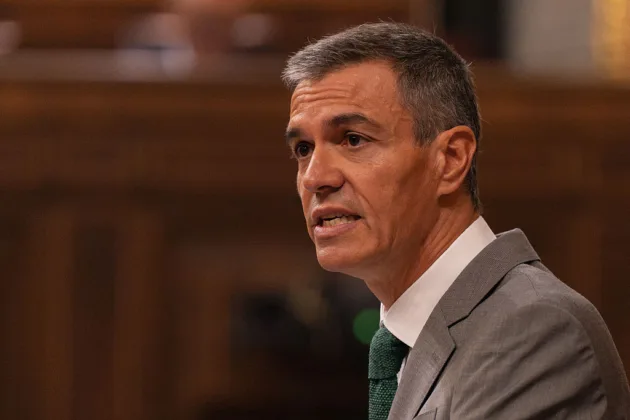







Spanish police investigators have concluded that Prime Minister Pedro Sánchez was aware of an alleged covert operation, run from within his own party, to obstruct court cases that reached into the Spanish Government.
The Guardia Civil’s Central Operational Unit (UCO) has said Sánchez had “knowledge of the activity” carried out by Leire Díez, a former Socialist member cast in the case as the group’s fontanera, or fixer, according to a judicial summary released this week.
The conclusions form part of what Spanish media call the Leire case, an investigation led by National Court judge Santiago Pedraz into the alleged cloacas — the “sewers”, or dirty-tricks unit — of the Spanish Socialist Workers’ Party (PSOE).
Pedraz holds that Díez and Santos Cerdán, the PSOE’s former organisation secretary, led a network whose purpose was to protect the interests at stake in court cases affecting the party and, directly or indirectly, members of the government and Sánchez himself, the summary said.
The UCO has reported that, in intercepted conversations, those under investigation referred to the “presi” — a familiar term for the president of the government — as someone aware of the network’s movements. The agency said the alleged plot worked in two ways.
First, by offering investigated individuals more favourable treatment, money or public-sector jobs in return for compromising material on judges, prosecutors and Guardia Civil officers. Second, by paying people to change their testimony in court.
A PARTY-FUNDED NETWORK
Investigators have alleged that the operation was paid for by the PSOE through false invoices and, in some cases, shell companies. Cerdán is said to have placed the party’s own structures at the network’s disposal to cover its costs.
The UCO named two party employees, Covadonga San Pedro and Celia Rodríguez, as having handled some of the group’s practical needs.
Gaspar Zarrías, a former vice-president of the regional government of Andalusia, southern Spain, allegedly took charge of legal matters. His consultancy was used as a front to pay Díez €16,000 across four instalments.
The party manager, Ana María Fuentes, is accused of falsifying two commission notes to disguise payments to two lawyers, Ismael Oliver and Jacobo Teijelo. Teijelo is reported to have received at least €125,000 from the PSOE.
He is alleged to have arranged meetings aimed at undermining fuel-fraud cases that investigators believed were linked to the party’s own legal troubles, and at gathering damaging material on UCO officers.
Oliver, for his part, was allegedly chosen to take over the defence of Koldo García, a figure in a separate graft case, and to channel complaints against the Guardia Civil that were later passed to the media. A businessman, Javier Pérez Dolset, is described as a direct source of information for Díez who accompanied her to several key meetings.
CONTACTS AT THE TOP
The summary alleges that Díez opened direct lines to the State Prosecutor’s Office (FGE) and even held face-to-face meetings at its Madrid headquarters during the tenure of the then attorney general, Álvaro García Ortiz.
Díez arranged the approach after repeated failed attempts by a lawyer for the former police commissioner José Manuel Villarejo to reach the anti-corruption prosecutor.
In one intercepted message, Díez assured Villarejo’s lawyer that “the FGE” would receive them directly. The UCO said her wording pointed to direct, top-level contact with the person she called the attorney general.
Investigators say at least two meetings took place at the prosecution service’s offices on Calle Fortuny in Madrid, on March 6 and April 4, 2025. Díez’s phone recorded a location at the building’s door on one of the agreed dates.
The UCO also believes that Juan Francisco Serrano, a former chief of staff to Sánchez, was aware of the network’s work and fielded queries from Díez.
Investigators say she repeatedly claimed she could secure a public-sector job for a woman who was preparing to report a prosecutor, though the woman’s employment never changed. The woman, who later testified before the Guardia Civil, was said to have met Socialist figures at the party’s headquarters.
A GOVERNMENT UNDER PRESSURE
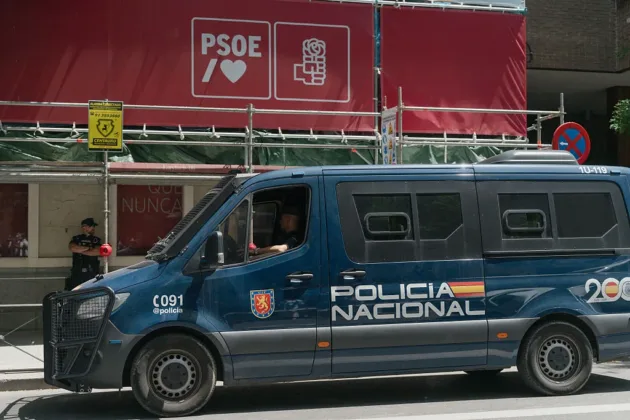
The summary deepens the legal jeopardy facing Sánchez’s administration. Pedraz has already named Cerdán, Fuentes and Zarrías as formal suspects, and the UCO searched the PSOE’s federal headquarters at Ferraz in Madrid on May 26 this year.
Investigators have also examined the network’s interest in cases touching the prime minister’s inner circle, including one involving his brother.
The PSOE has so far declined to bring its own complaint against Díez, saying the matter remains at the stage of preliminary indications. The opposition, including the right-wing Vox, has seized on the findings, arguing they point to an attempt to subvert the rule of law.
Sánchez, who leads a minority coalition, has repeatedly denied wrongdoing in the string of corruption cases that have reached his party and his family. The allegations set out in the summary remain unproven, and those named are entitled to the presumption of innocence as Pedraz’s inquiry continues.