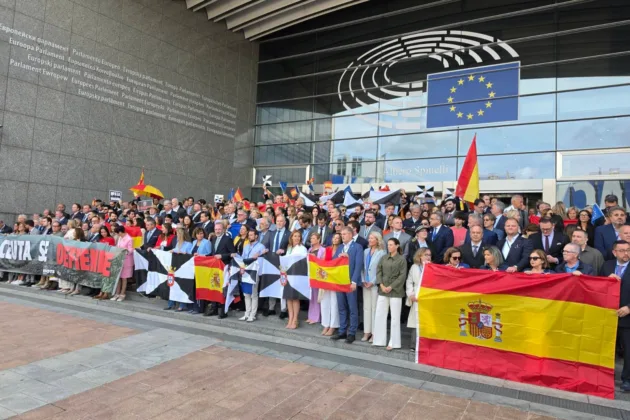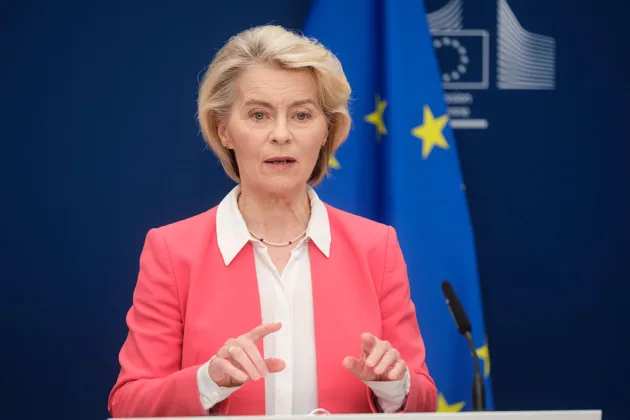




European Commission President Ursula von der Leyen has proposed that the European Union increase its technical and financial support to Morocco, days after tens of thousands of people crossed into the Spanish city of Ceuta.
In a written reply to Spanish Prime Minister Pedro Sánchez seen by Reuters on August 3, she described Morocco as an important strategic partner in the fight against migrant smuggling and illegal migration. She said the EU could work with Spain to strengthen border management early-warning systems and “improve our technical and financial support to Morocco”.
Sánchez had written to her on August 1 accusing some member states of a lack of solidarity over their reaction to the border breach.
The crossings began on July 30 at one of only two EU land borders with Africa. Spain’s Interior Ministry put the number of arrivals at about 50,000, while Ceuta mayor-president Juan Jesús Vivas gave a figure of around 60,000, in a city of some 84,000 people.
At least 72 people died. Some drowned and others were crushed at a breakwater near Tarajal beach, according to Spanish officials.
Most of those who entered went back to Morocco within 48 hours. Von der Leyen said on August 1 that nobody had reached mainland Spain or the rest of the EU, and thanked Spanish and Moroccan law enforcement for their work.
The reaction elsewhere in the bloc was sharper. Italy suspended passport-free Schengen arrangements with Spain for one month, applying targeted checks on non-EU nationals arriving from Spain by air and sea, while France ordered extra checks at its Spanish border.
Twenty-two of the 27 member states signed a letter demanding coordinated action to protect external borders. Several of them pointed to the Spanish Government’s mass regularisation scheme, for which 1.2 million people applied, as a pull factor.
Ireland, which holds the rotating presidency of the Council of the European Union, has convened an emergency video meeting of the Justice and Home Affairs Council for August 4. Irish Justice Minister Jim O’Callaghan will chair it.
Options under discussion include reintroducing internal border controls and an enhanced role for Frontex during emergencies. The proposals were examined by member state ambassadors on August 3.
The episode is the first significant test of the EU’s Migration Pact, which sets out how member states manage migration and share responsibility.
Rabat has denied responsibility, blaming social media misinformation and human trafficking networks. The Spanish Government has also pointed to smugglers exploiting a June 29 Supreme Court ruling that barred summary returns from Ceuta and Melilla without due process.