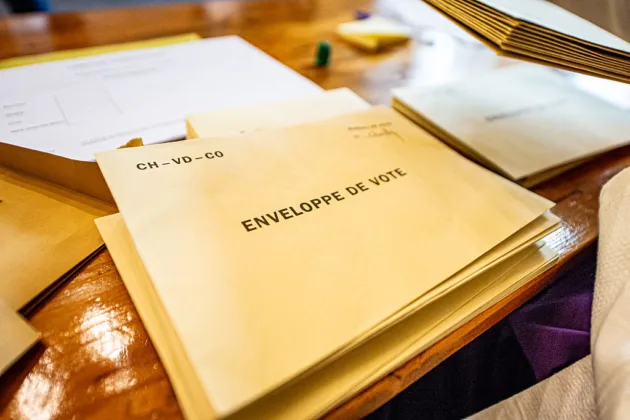






Swiss voters have rejected a proposal to cap the country’s population at 10 million by 2050, throwing out a plan that would have obliged the Swiss Government to impose sweeping restrictions on immigration and asylum.
The initiative, put forward by the right-wing Swiss People’s Party (SVP), was defeated in a national referendum on June 14.
Almost 55 per cent of voters opposed the measure and 45 per cent backed it. Turnout reached about 59 per cent, well above the average of roughly 48 per cent for recent Swiss votes.
The proposal would have required the federal government to curb asylum, family reunification and the issuing of residency permits once the population reached 9.5 million, a level expected to be passed in the 2030s. Switzerland is currently home to around 9.1 million people.
Had those steps proved insufficient, the country would have been obliged to end its free movement agreement with the European Union, which grants reciprocal rights to live and work across borders even though Switzerland is not a member of the bloc.
Approval would have made Switzerland the only country in the world to set a legal ceiling on its own population.
SVP VOWS TO FIGHT ON
Marcel Dettling, president of the SVP, said the initiative had proved popular in rural areas but had been defeated by urban voters. “Not a single problem has been solved,” he told reporters. “We will continue to push for sensible immigration.”
The vote again exposed the divide between Switzerland’s cities and its rural cantons. In Appenzell Innerrhoden, a north-eastern canton with few foreign residents, almost 66 per cent of voters backed the cap, according to the result.
Stephanie Gartenmann, an SVP member of the cantonal parliament in Bern, sought to present the 45 per cent approval as a success. “This is a clear signal that we must act,” she told SRF.
She urged the country to pursue what she called “qualitative immigration” to “keep Switzerland as it is: a place worth living in, with prosperity and a high quality of life”.
The SVP, the largest party in Switzerland, has opposed immigration and closer ties with Brussels for decades, repeatedly putting its concerns to voters through the country’s system of direct democracy.
Most of its initiatives have failed, although some have succeeded, including a 2009 ban on minarets and a 2021 ban on face coverings in public.
CONCERNS REMAIN
The party presented the population cap as a sustainability measure, arguing it would protect natural resources and ease overcrowded trains, urban sprawl and rising crime. It made clear throughout, though, that the central aim was to limit the number of foreigners in the country.
Those concerns have not gone away with the result. Switzerland’s population has risen by almost a quarter in a generation, growth driven largely by net migration under the bilateral free movement agreement signed with the EU in 2002.
The SVP argues that this expansion, rather than any rise in the birth rate, is reshaping the country. The Swiss fertility rate stands at about 1.4 children per woman, well below the level needed to maintain the population.
People born abroad account for almost a third of the population, the third-highest share among industrialised nations after Luxembourg and Australia, according to the Organisation for Economic Co-operation and Development.
BUSINESS AND BRUSSELS RELIEVED
Business groups welcomed the outcome after warning that a cap would restrict access to foreign workers and damage the economy. Monika Rühl, president of the employers’ association Economiesuisse, said the country still needed skilled labour and pointed to the risks of an ageing population.
“We need easy access through the free movement of people with the EU,” she said in comments reported by the German news agency DPA.
Economiesuisse urged the government to use the result to ratify a deal struck with Brussels in late 2024 to deepen bilateral economic ties.
European Commission President Ursula von der Leyen said Brussels and Bern would keep working together. Justice Minister Beat Jans welcomed the result, saying voters had sent “a message of stability, openness and reliability”.
Some opponents had likened the initiative to Britain’s 2016 Brexit vote, warning that ending free movement would jeopardise the more than 120 bilateral agreements that bind Switzerland to the EU single market.
The defeat removes, for now, the prospect of a fresh clash between the two over free movement. A 2014 initiative against “mass immigration” had narrowly passed, while a 2020 bid to scrap free movement was rejected by almost 62 per cent.
The referendum is the latest test of immigration sentiment in Europe, where the issue continues to dominate national politics and where the EU’s own Migration and Asylum Pact took effect this month. Although voters rejected the cap, the SVP signalled it would keep the debate alive in the months ahead.