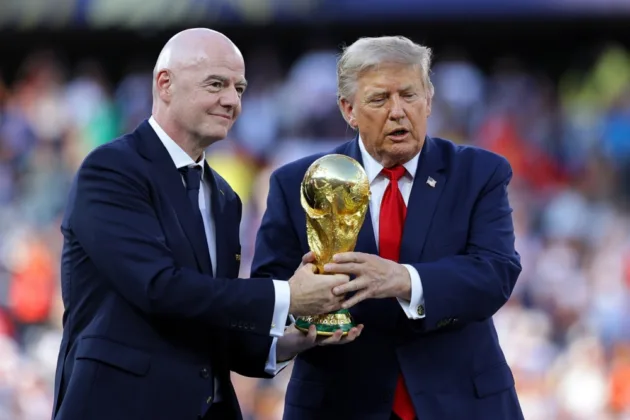




America’s hosting of the World Cup was clearly good for FIFA and the cause of promoting football (soccer) to Americans. The fact that hundreds of thousands of European fans also come home with a wider personal view of America may also prove to be good over the long term for conservative populists, too.
Europeans who travelled to watch their home countries’ squads had to go to parts of America few often visit. Games in Dallas, Houston, Atlanta and Kansas City brought fans to some of America’s largest and growing metropolitan areas, places with no traditional downtowns and utterly dependent upon automobiles. Even stadia in places like Boston, Philadelphia and New York are either in suburban locations like the cities mentioned above or are surrounded by massive parking lots to accommodate tens of thousands of cars.
Fans often were awed by the sheer size of these places. Every one of the 11 stadia which hosted matches could seat 64,000 or more fans. Only 24 stadia in all of Europe could accommodate that many, and many of those are not often used for club football. The American stadiums were also on average newer and had many more food and souvenir concession stands than their European cousins.
In short, simply attending the games themselves gave Europeans a glimpse of the massive wealth average Americans possess.
That impression would be cemented by any degree of travel outside of the areas around the venues. American houses are larger, with much more land surrounding them, than even nicer suburban areas. Cars are massive in the United States, with most people driving large trucks or sport utility vehicles that would be well beyond the capacity of middle-class Europeans to buy and operate. Shopping malls have a mixture of selection and consumer choice that few places in Europe can match.
The German traveller known by his X handle, @FreddyLA7, became an American sensation as he travelled throughout the country. He marvelled at the size of a Buc-ee’s gas station (they often have as many as 100 gas pumps along with a store that serves as a supermarket) along with the fact one could easily purchase rifles in many large stores. While he never mentioned it, he and other drivers surely noticed that petrol prices in the United States are between 50 and 66 per cent cheaper than in most of the European Union, too.
Tourists also noted how friendly many Americans were. Europeans who experience Americans abroad find them when many are uncertain and insecure, often not knowing their host country’s language or history. In their home milieu, though, Americans were open and accommodating to their guests. Those who expected snobbishness or impolite behaviour were surprised to find exactly the opposite.
These folks will now go home with a much clearer sense of what life in America is really like than any quick trip to a major tourist area or large American city can ever provide. They will know that Americans are nice, rich and free.
Conservative populist parties rarely say they want Europe to be more like America. But their platforms often call for lower taxes, freer economies and a devolution of power away from the stodgy bureaucracies that too often strangle European life in a maze of rules and papers. If these people liked what they saw in America, and the general reaction is that most did, they will have to ask themselves why they can’t have that life themselves.
Try as they might, the European establishment parties cannot satisfy that desire. Whether they are nominally left, centre or right, none embrace the emphasis on the consumer and the freedom of the average person that can ever approximate what the average American has. If the football tourists want what they experienced, they, and any of their friends and family they speak with, will have to look elsewhere when they vote.
That desire may not emerge overnight. But the more they compare the open, comfortable life they saw with the closed, stagnant lives too many have in Europe, they will likely want to see their homes look more like the US rather than humbly submit to the Eurocrats’ decrees.
A popular song in the US after the First World War asked, “How can you keep them down on the farm after they’ve seen Par-ee?” In a few years, wise Europeans will realise that they cannot keep their fellow countrymen down in the dumps after they’ve seen Buc-ee’s.