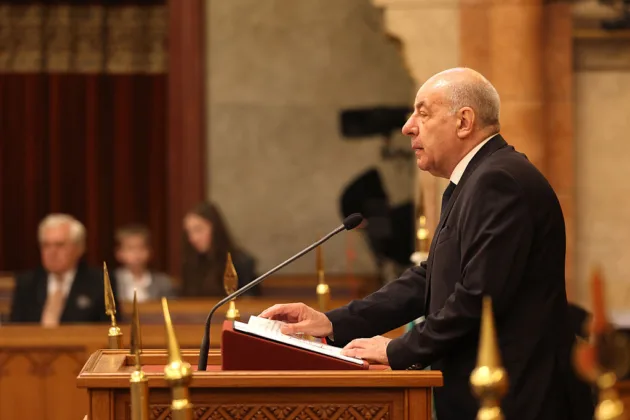












A minister in Péter Magyar’s Government has defended rewriting Hungary’s constitution to strip senior officeholders of their mandates, arguing that a new parliamentary majority may lawfully end the terms of those who refuse to resign.
Health minister Zsolt Hegedűs made the case in a Facebook post on the eve of the vote. He wrote that 16 years of Fidesz rule had produced not just a system of government but a “deep state” of entrenched officeholders built to survive an electoral defeat.
Parliament adopted the seventeenth amendment to the Basic Law, Hungary’s constitution, on July 13 by 139 votes to six. Fidesz and its Christian Democrat allies boycotted the session and President Tamás Sulyok did not attend.
Hegedűs argued that legality was not the same as morality and that acting within the law was not enough for a head of state. He said Pál Schmitt had fallen over plagiarism, Katalin Novák over a clemency decision, and Sulyok over his silence.
The amendment ends the President’s mandate the day after it enters into force. He has five days to sign it, after which parliament would elect a successor for a term of up to five years or until a new constitution is adopted.
Magyar said the National Assembly had carried out the will of voters and that a wider constitutional process would begin in September.
Viktor Orbán has rejected the move. Writing on Facebook after the vote, the former prime minister said a president installed unlawfully could not be lawful, adding that Hungary had the right to resist and would do so.
Fidesz has called the amendment an “unprecedented” assault on the country’s democratic order. The right-wing party’s parliamentary group leader, Gergely Gulyás, resigned hours before the vote.
The package also cuts Constitutional Court judges’ terms from 12 to nine years and restores a retirement age of 70, forcing out four judges including the court’s president, Péter Polt. It gives constitutional status to a new asset recovery office with prosecutorial powers.
A retrospective limit of 12 years, or three terms, on parliamentary mandates applies in practice only to opposition politicians, as every Tisza MP took a seat for the first time in May. János Áder, a former president, has described the overhaul as unconstitutional.
Amnesty International Hungary and Human Rights Watch have both criticised the method, arguing that impeachment would have been the proper route. Sulyok, who asked the Venice Commission of the Council of Europe to review his removal, said it would amount to a constitutional crisis.