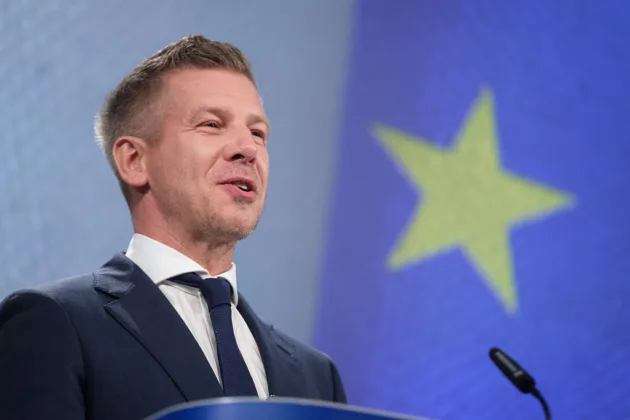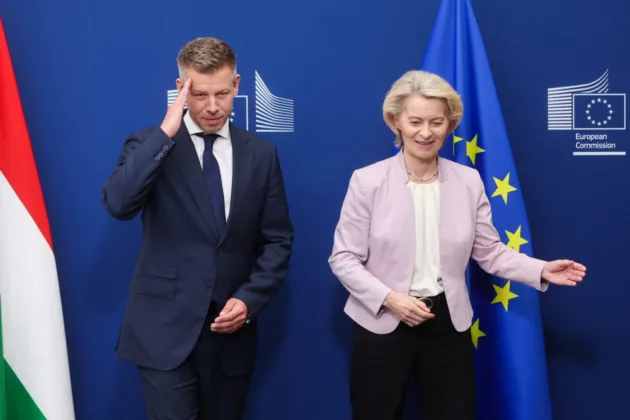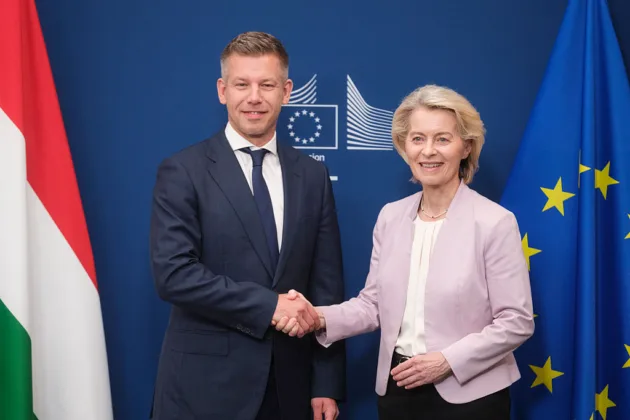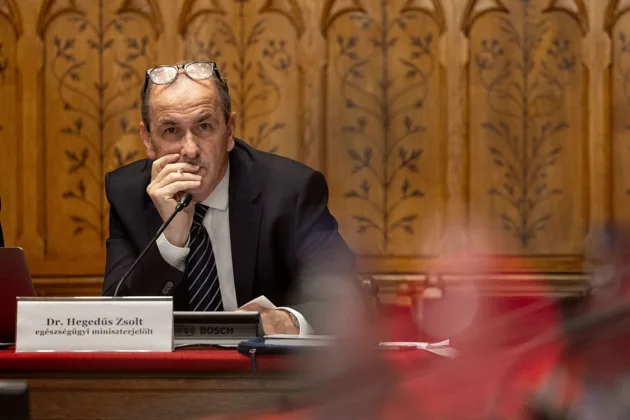










Hungary’s new government is focusing on eliminating its political opponents rather than governing the country, while the European Union has fallen conspicuously silent on constitutional changes it would previously have denounced as violations of the rule of law, according to Fidesz MEP Csaba Dömötör.
In an interview with Brussels Signal, Dömötör said the constitutional reforms adopted by Prime Minister Péter Magyar’s parliamentary majority amounted to a dangerous and unprecedented attempt to reshape Hungary’s political system by retrospectively excluding experienced politicians from public office.
“The government is not really focusing on governing,” Dömötör said. “Its main activity is a political witch hunt and curbing the political rights of the opposition.”
He said that the constitutional package includes a series of retrospective measures that would fundamentally alter Hungary’s political landscape.
“They removed the president without any justification, although he had been democratically elected.”
“They want to introduce a term limit for the prime minister in a retroactive way. They also removed the head of the Constitutional Court and introduced a retrospective 12-year limit for Members of Parliament.”
“A great number of opposition MPs have a long track record and many years of experience. Many of them would effectively be expelled from political life.”
He added that discussions had even included limiting parliamentary service to eight years.
“That would be unprecedented in any European country.”
According to Dömötör, the reforms would barely affect the governing Tisza Party because its MPs are largely political newcomers. It affects politicians from every other party who have experience.
RULE OF LAW WAS NEVER ABOUT DEMOCRACY
For Dömötör, the most striking aspect is not only the reforms themselves but the lack of reaction from Brussels.
“For years the European institutions talked about Hungarian democracy at every corner.”
“Now they are silent,” he said.
“It shows that the rule of law was never really about democracy. It was a tool of political blackmail.
“Now that they have a prime minister who is willing to accept the plans of the left-wing mainstream in Brussels, they let everything go. Anything goes.”
He said the Commission had effectively given Magyar political cover.
“The new Prime Minister has received a blank cheque.”
“We don’t know what Brussels expects in return, especially on economic issues.”
According to Dömötör, the Commission’s approach demonstrates that governments adopting Brussels’ positions on issues such as migration, Ukraine and EU enlargement are treated differently from those that challenge the bloc’s left-leaning mainstream.
The Hungarian MEP stressed that the changes pushed forward by Magyar, retroactive and targeting the opposition were a much bigger threat against the country’s democracy than everything Brussels claimed it feared in the past, though now it remained silent.
Dömötör pointed to the years of criticism that Orbán would refuse to relinquish office if defeated.
“Fidesz accepted the election result and allowed a peaceful transfer of power, he did it faster than is the norm in many European countries.”
“That demonstrated that all the claims portraying Viktor Orbán as a strongman who would refuse to hand over power were false.”
“Hungarian democracy was stable until now,” he added. “The new government’s measures could change that.”
NEW ANTI-CORRUPTION AUTHORITY
Magyar’s government also submitted a bill on July 10 to create the National Asset Protection and Recovery Office, which is to serve as an independent anti-corruption body.
However, this new office seems to be tailor-made to target figures of the opposition, with the current government claiming it will “investigate graft from the Orbán era and recover stolen assets”.
The proposed body would have jurisdiction over cases involving state assets, public property, government contracts and public subsidies, while enjoying “unprecedented powers” and offering little or no possibility of appeal against its decisions.
“This is not about improving governance,” Dömötör said. “It is about continuing the political witch hunt through new institutions with extraordinary powers.”
The Magyar government has defended the constitutional package as part of a broader effort to strengthen democratic institutions and prevent the long-term entrenchment of political officeholders.
Supporters argue that term limits encourage political renewal, while changes to judicial appointments and oversight bodies are intended to improve institutional independence and accountability.
Government officials have rejected accusations that the reforms target specific opposition figures, insisting the measures are designed to modernise Hungary’s constitutional framework rather than disadvantage particular parties.
They have also dismissed claims of political interference in the planned anti-corruption authority, arguing it will enhance oversight of public finances and strengthen transparency.