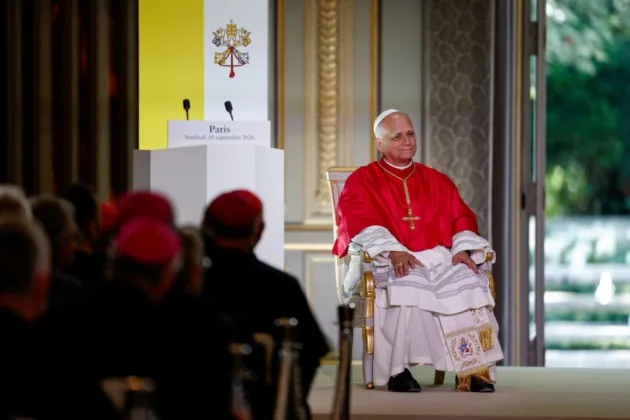
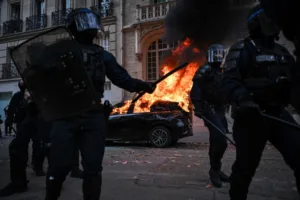





On June 30, 2026, French President Emmanuel Macron opened the ninth World Congress Against the Death Penalty in Paris with the observation that capital punishment “has never made a society safer because it does not deter”. Although he might be right about deterrence, he also picked a remarkable moment for his speech, as the world seems to be rediscovering the application of capital punishment: weeks earlier, in a report published on May 17, 2026, Amnesty International had counted 2,707 executions worldwide for 2025, the highest figure it has recorded in 44 years, and France’s own debate has been reignited by two murders that shocked the public and a general sense of deteriorating safety in the streets of France.
Contrary to the claims of President Macron, the death penalty is less relevant as a deterrent than it is as a fundamental element of the contract between the people and the government. In one of his tragedies written around 458 BC, the Greek playwright Aeschylus staged and described the founding transaction of every legal order we possess, and how the death penalty is in fact a cornerstone of civilisation, as it plays a key role in the legitimacy of the state as the neutral arbiter in conflicts and disputes. Aeschylus takes us through the drama of one of Greek mythology’s most important families: The house of Atreus, which had been slaughtering itself for generations. Agamemnon sacrifices his daughter for a fair wind to Troy, his wife Clytemnestra butchers him in the bath on his return, their son Orestes kills his mother to avenge his father, and the Furies, goddesses of blood vengeance, descend to claim Orestes in turn. Athena interrupts the cycle by convening what is probably the first murder trial in world literature, and the deal she brokers is the one we still live under: The family renounces revenge and hands it to the city, and the city promises in exchange that crime will actually be answered, in the last resort with death. Athena (with the help of Apollo) established a system that outlaws vigilante justice, but also guarantees that the state is, and in fact has to be, willing to also apply the hardest of punishments, no matter how rarely. Only via that promise could the state persuade the families to give up their claim to do justice of their own accord, and hand over the monopoly on violence to the state.
My argument, though, is not just built on myth, but there is also empirical data to back it up: Europe spent half a millennium enforcing Athena’s half of the bargain with a thoroughness we prefer to forget and instead tell ourselves that one day Western societies woke up and decided to become peaceful and civilised. But such a story would not be true, as it was via state-controlled violence that societal peace was established. Norbert Elias called it the civilising process, and Peter Frost and Henry Harpending assembled the numbers behind it in Evolutionary Psychology: At the height of the late medieval war on murder, courts condemned to death between 0.5 and 1 per cent of all men of every generation, and the homicide rate in England fell by a factor of 10 or more, a development Steven Pinker, a man not usually suspected of reactionary sympathies, calls the great pacification. Abolition, when it finally arrived, was the dividend of this success rather than its cause. Societies retired the gallows because they could afford to. Alas, dividends can be spent, and I fear this is where we are headed.
In some places you can already see the machinery run in reverse. In Sweden, 93 children under 15 were suspected of murder or attempted murder in the first half of 2024, three times the previous year’s figure. Stockholm’s answer is to lower the age of criminal responsibility to 13 for the gravest crimes, provisionally, for five years, and the objection raised against the law is the truly revealing detail: Critics warn that the gangs will simply recruit 11-year-olds. To be clear, I am not advocating the death penalty for children, but I most certainly am in favour of considering it for those who recruit children to carry out murder. A state negotiating with and surrendering to the recruitment logic of criminal networks has conceded the essential point already, which is that the monopoly on violence is no longer held by the public authorities, but the shadow state of criminals. This also means that people no longer fear the state, but those who call the shots in its place. In Germany, for example, investigators describe clan structures whose members fear the family considerably more than the courts. The contemporary meaning of no-go area, though, is no longer just a district the citizen avoids after dark. It is territory that ambulances and fire brigades enter under police protection or not at all, demonstrating that these are becoming territories under new management.
The standard reply is that the modern state lacks the means to reverse these developments, and that the needed force could infringe on certain rights. I am not buying that argument, as I have seen what the state was capable of doing during Covid. Governments that supposedly cannot bring the employer of a 14-year-old contract killer to trial proved perfectly capable of keeping unvaccinated teenagers out of football training. The capacity was never missing, only the will, and if current governments continue to remain unwilling to reestablish order, the people are going to turn to those who will. Incidents like the murder of Henry Nowak in the UK are making people suspicious of their current governments, and a sense of two-tier justice, where the native population is disadvantaged while newcomers are favoured, is growing. In his writings, the liberal thinker Francis Fukuyama reminds us that kings, long before parliaments, drew their legitimacy from one function above all, the dispensing of justice. A state that enforces its rules selectively is experienced by its citizens not as humane but as arbitrary, and arbitrariness is the one thing no legal order survives. That is also the mood in which Uwe Boll’s film Citizen Vigilante resonates throughout the West.
None of this is a case for mass executions, but a warning that if the state refuses to prosecute crimes, its legitimacy will begin to crumble, and certain acts might indeed deserve the death penalty. For two fortunate generations the European level of civilisation was at such heights that capital punishment could be retired in good conscience. Alas, as our civilisation is tested by criminal gangs and the recruitment of children for the most heinous crimes, we might have to reconsider this retirement. Citizens have not forgotten why the guillotine was retired (because they abandoned crime) but they have begun to notice that the other half of the old bargain, the promise that crime will be answered, is no longer being kept.