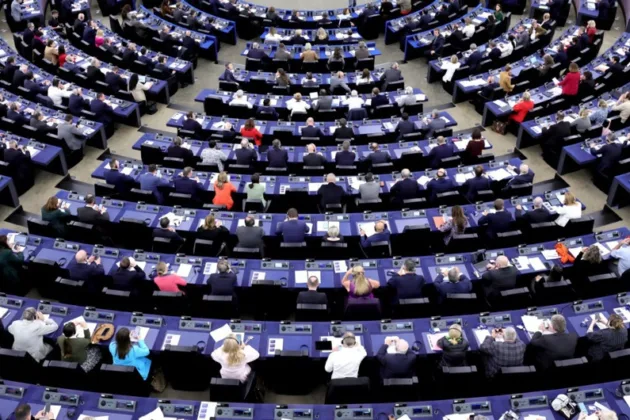






The European Parliament is set to vote this week on reviving expired EU rules in a highly controversial way, allowing online platforms to scan private messages for child sexual abuse material.
The interim measure, which lapsed in April after MEPs resoundingly rejected an extension, has been revived by the centre-right EPP through a rarely used fast-track procedure. If Parliament approves the urgent process, a final vote is expected on July 9.
The new vote will take place under different rules, favouring approval because its might be able to pass with minority support.
Critics, including some MEPs and digital rights groups, argue the move undermines democratic scrutiny and raises concerns over privacy and encrypted communications.
German MEP Martin Sonneborn said Metsola cut his microphone after 60 seconds at the opening session in Strasbourg on July 6, as he tried to challenge the fast-track. He and fellow MEP Sibylle Berg have argued that rushing the measure through breaches Parliament’s Rules of Procedure.
Asked why proponents are trying to push the matter again after recently having lost a key vote, Sonneborn told Brussels Signal that “attrition is the strategy”.
“The proponents of Chat Control have understood that they do not need to win the argument, they only need to pick the right week. This House has rejected mass scanning of private communications twice. So the third attempt is not being made on the merits, it is being made on the calendar: An urgency procedure squeezed in before the summer recess, when attention is low and attendance is lower.
“Our position is unambiguous: This request for urgency is inadmissible, and we have told the President so in writing. Urgency under the Rules presupposes unforeseen developments. Here, nothing unforeseen has happened; every deadline in this file has been known for years. A deadline you have known about since it was printed in the Official Journal is not an emergency, it is a plan.
Sonneborn stressed that there were no relevant changes between the plans on chat control that were voted away last time and the new effort.
“That is the point. The text is the same as that of Chat Control 1.0, which expired on 3 April. Nothing has been improved, nothing has been fixed, nothing has been learned.”
“The only innovation is procedural: Instead of trying to assemble a majority for the proposal, the strategy is now to make rejection arithmetically difficult, an urgency procedure, compressed deadlines, and a vote timed so that every absent Member effectively counts in favour.
“And it is worth saying clearly what this ‘temporary derogation’ actually does: It suspends a fundamental right, the confidentiality of telecommunications. Interferences with fundamental rights are only permissible on the basis of laws that define precisely what is allowed and what is not. A blanket ePrivacy derogation does no such thing, which makes it, in our assessment, illegal.
“The problem is that courts need years to establish that, and the proponents know it. By the time the Court of Justice gets around to this text, it will have been ‘temporarily’ in force for half a decade.
Sonneborn told Brussels Signal that procedurally speaking, the urgency request is even inadmissible.
“Rule 170 provides for the urgent procedure only for proposals at first reading. This dossier is at second reading, and Rule 80 states expressly that in the event of a conflict, the rules governing the second reading take precedence. There is no urgency procedure at second reading, for good reason: at that stage, silence already counts as consent.”
Asked if Metsola’s move regarding an absolute majority was precedented, Sonneborn highighted it was the combination of the unforseen urgency procedure used to compress a second reading vote in which every absent MEP automatically counts for the Council that was unprecedented.
He noted that their objections were sent to President Metsola in a letter on Saturday, but her office replied that everything is in accordance with the rules, citing the Ukraine assistance of 2022 as a precedent.
“That precedent does not carry the weight placed on it”, Sonneborn said. “In 2022, the Council had committed in writing to take over Parliament’s text; the urgent procedure executed the will of this House, in a wartime emergency. Here, it is being used to override the will of this House, expressed twice”.
“Invoking solidarity with Ukraine to justify that is, frankly, indecent.”
Sonneborn said they raised the matter in plenary as a point of order under Rule 202, which is the procedure the Rules provide for exactly this situation.
“The President’s response was to switch off the microphone. We now know how the presidency deals with objections to the admissibility of a procedure: Acoustically. Under Rule 22, the President is the guardian of the Rules of Procedure, not of the mute button.
“The inadmissibility objection remains on the table, unanswered, and we have asked her to do her job and declare the request for urgency inadmissible. We remain willing to hand her a current copy of the Rules, in person, and if necessary loudly enough to be heard without a microphone.
To the question if people should be more afraid of “tech bro’s” or “big government” Sonneborn replied to Brussels Signal that this was “a false choice”, because they are “business partners”.
He noted that in 2018, when Parliament and Council voted to extend the fundamental right to confidentiality of communications to messengers and email, it was big tech that started a campaign against protection because they “realised it interfered with their business model. Since then we have been told, at regular intervals, that privacy is an obstacle.”
“Big Tech has spent two decades monitoring every move we make online, and it fully intends to keep doing so, at all cost.
“And governments are not the victims of this arrangement, they are its customers. Already today, they buy movement profiles from data brokers, data they could lawfully obtain only under narrow conditions, on individual suspicion. They want to keep doing that, and they want more of it.
“Chat Control does not disrupt this cosy public-private surveillance partnership, it completes it: Private infrastructure scans our communications, and the state harvests the results without ever having to justify itself to a judge. As this week has shown, the same logic applies inside this Parliament: Whoever controls the microphone decides which objections exist.
Supporters, including child-protection groups and EU governments, counter that detection tools are needed to combat abuse and to avoid a legal gap.
On Monday, a sexual abuse survivor published a letter he had sent to 836 MEPs asking for them to vote against the latest attempt for chat control.
“Without privacy, without confidential communications and without encryption – I would not have told my story and those convictions would never have happened and those victims/survivors would never have seen justice”, he said.
#ChatControl 1.0 and 2.0 Explained: There is not one proposed “Chat Control” law — there are two, and they are moving through the EU institutions in parallel. This page untangles the two.https://t.co/afiaVlKSq1 pic.twitter.com/ZnFmerE71D
— Patrick Breyer #JoinMastodon (@echo_pbreyer) July 6, 2026