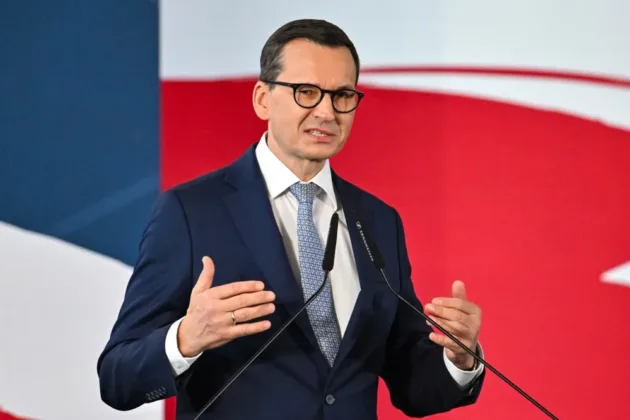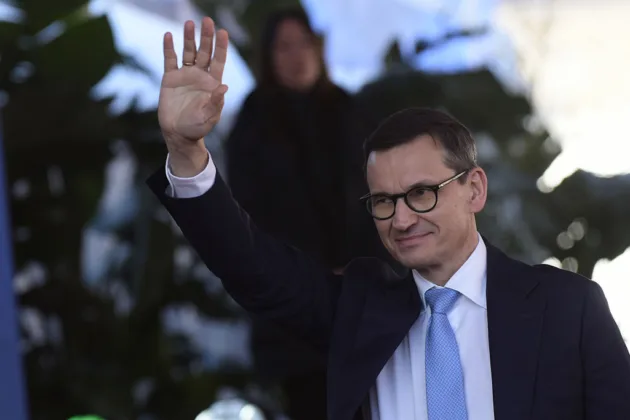




Former Polish prime minister Mateusz Morawiecki has resigned as president of the European Conservatives and Reformists (ECR) Party after being forced out of Poland’s main opposition Law and Justice (PiS) party.
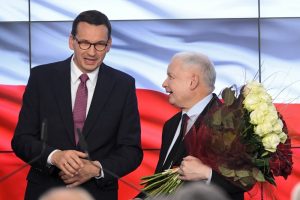
The resignation, announced on July 28, came hours after the PiS political committee referred the cases of 44 parliamentarians, among them Morawiecki, to the party’s disciplinary spokesman Karol Karski, following an escalating internal power struggle with party leader Jarosław Kaczyński.
The committee stopped short of the formal expulsions Kaczyński had signalled on July 24. Karski said afterwards that the 44 remained full members of PiS and had not been suspended, and that each case would be examined individually.
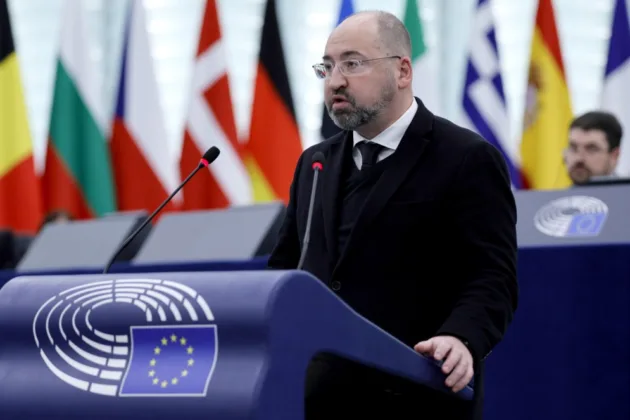
Morawiecki ally Piotr Müller, an MEP and press spokesman for the last PiS government, said the former prime minister had stepped down “in line with his earlier announcement” and tied the move directly to his exclusion from the party.
Morawiecki had told the broadcaster Kanał Zero that the ECR presidency was attached to the second-largest national delegation in the alliance, PiS, and that his own group of parliamentarians would not hold that place.
In a letter published by the ECR Party, Morawiecki said he had decided to devote his full attention to “the challenges facing my beloved Poland”.
“For this reason, I have decided to resign from the position of president of the ECR Party,” he wrote.
He stressed, though, that the move did not signal a break with Europe’s conservative movement.
“This decision does not change my attachment to our political family. I will always remain close to you and continue supporting our shared values and work on the European stage.”
In comments to Brussels Signal, Morawiecki said his resignation marked “the beginning of a new chapter” in his political career rather than a departure from the European conservative movement.
Morawiecki added that MEPs affiliated with his Rozwój Plus movement remained committed to their mandate and would continue working with like-minded partners, while any future decisions on parliamentary or organisational matters would be announced “through the appropriate channels and at the appropriate time”.
He also underlined that he still believed in the European conservative movement, without specifying which role he intended to play in it: “I remain convinced that the principles championed by the European conservative movement will continue to make an important contribution to the debate on Europe’s future,” he said.
The ECR Party said it had learned of the decision “with great regret” while thanking Morawiecki for his leadership and service.
“While fully respecting his decision, the Party expresses its sincere gratitude for his leadership, commitment and service to our political family,” the statement read.
The party confirmed that Italian MEP Carlo Fidanza of Brothers of Italy had assumed the role of acting president and had begun the steps required under its statute.
Morawiecki had led the ECR Party since January 14, 2025, succeeding Giorgia Meloni despite not being a member of the European Parliament. His candidacy was proposed by the Italian prime minister and carried by acclamation.
The ECR Party groups right-wing parties from across the bloc, among them the Czech Civic Democratic Party (ODS) and the Sweden Democrats, and counts the US Republican Party as a partner.
Its parliamentary counterpart, the ECR Group, has 84 MEPs from 18 member states, according to its own figures, with Brothers of Italy and PiS forming its two largest national delegations.
Morawiecki’s departure follows a split inside PiS that has seen more than 30 MPs effectively leave the party after refusing to renounce membership of Morawiecki’s political association, Rozwój Plus (Development Plus).
The dispute stems from a resolution introduced by PiS on July 15 requiring parliamentarians to withdraw from any outside political organisations, with a deadline of midnight on July 23.
Morawiecki and many of his allies refused to sign what they described as a loyalty pledge, arguing that Development Plus was intended to broaden the party’s appeal rather than undermine it.
On July 29 Morawiecki announced the creation of a Rozwój Plus parliamentary club made up of 40 MPs and one senator, and said an application would be lodged with the Speaker of the Sejm the same day.
That would make it the third-largest club in the lower house and leave PiS on 146 seats, behind the governing Civic Coalition on 156.
PiS spokesman Rafał Bochenek responded that Morawiecki and his allies were tripping over their own feet and did not know the basic rules of either the party or the Sejm, pointing to the chamber’s requirement that a deputy belong to only one club.
The rift appears to have weakened the Polish Right at a point when PiS is already losing ground.
A CBOS survey carried out in early July put PiS on 19.1 per cent, with Confederation on 15.2 per cent and the Confederation of the Polish Crown on 8.2 per cent, ahead of parliamentary elections due in 2027.
As PiS leader Jarosław Kaczyński announced Mateusz Morawiecki and his allies had left the party, TVP Info and Polsat News showed a split screen of Kaczyński alongside KO politicians Krzysztof Kwiatkowski and Adam Gomoła eating popcorn in parliament. https://t.co/jTVV4SoPLC
— Brussels Signal (@brusselssignal) July 27, 2026