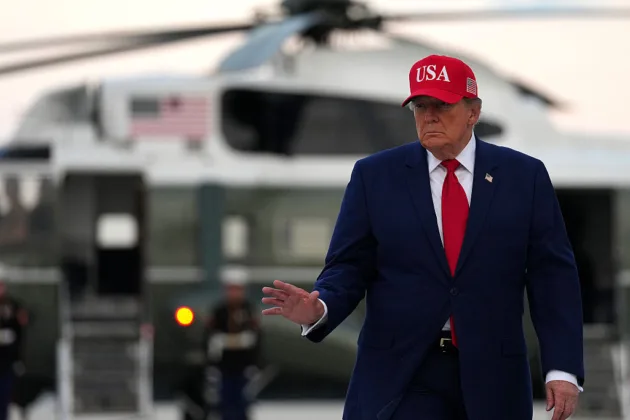







Meetings in Washington on July 28 between Ukrainian President Volodymyr Zelensky and US President Donald Trump, and between Israeli Prime Minister Benjamin Netanyahu and Trump, held before all of them attended the funeral of US Senator Lindsey Graham, as well as recent events in the Ukraine and Iran wars, indicate that Europe will soon be required to make important alliance decisions.
Petulance and pettifogging about the legal justification for American military action against Iran should never have occurred, but certainly it has to stop now.
The European NATO members cannot imply any moral equivalence between the United States, the chief liberator and guarantor of Western Europe from the invasions of Italy and France in 1943 and 1944 to the disintegration of the Soviet Union in 1991, and Iran, which has been the chief state sponsor of terrorism throughout the world since the establishment of the Islamic Republic in 1979.
There has been a general consensus that NATO has not only been the most successful alliance in history, but that the Americans are correct to require that all participants pull their weight, and that some sort of strategic reorientation should be collegially agreed to relaunch the alliance in a reinvigorated condition.
It is a splendid historical development that this association of countries, all of whose members except Sweden, Turkey and Portugal, have been in violent conflict within the lifetimes of many millions of their citizens, often with each other, have cooperated so well starting 77 years ago.
NATO was allowed to lapse into the so-called “alliance of the willing”, which in practice meant that the Europeans and Canadians would treat the United States like a great St Bernard dog, holding the leash and giving the instructions, while the Americans took the risks and did the work.
Abrasive though his methods sometimes are, the whole alliance can be grateful to President Trump for putting an end to that charade.
It is almost inconceivable that Iran could persuasively negotiate an acceptable end to this conflict, since it is comparatively philosophical about the death of large numbers of its own population, including the leadership of the Islamic Republic, yet construes the survival of its government, however battered and fragmented, as a victory, even over the United States which with Israel has done a trillion dollars damage to the Iranian military and economy at a cost of at least 20 American servicemen and 28 Israeli civilians.
The ceasefire agreement that was arrived at was immediately reinterpreted by Iran in a way that had little relation to the wording of it.
There appear to be only two alternative courses: either the United States takes down the entire Iranian electric grid and the bridges and highways connecting the various regions and puts maximum pressure on the whole country and possibly introduces some commandos on the ground (unlikely to be Americans) and begins helicoptering in armaments to dissident groups; or it largely confines itself to air attacks necessary to keep the Strait of Hormuz open to international navigation while rigorously imposing an air-tight land, sea and air blockade of Iran driving that country into utter penury within a few months.
Under either scenario, the oil price will settle at a reasonable level and Trump will not be overly preoccupied by the midterm elections in November, especially as his Democratic opponents seem so fixedly determined to commit electoral suicide by presenting bigoted, Islamist, Marxist candidates.
There is little chance that the Democrats can take the Senate and, in any case, no two-term president except Franklin D Roosevelt in nearly 120 years has not had an opposition Congress in his last two years.
All they can do is stall legislation: There is absolutely no chance of overriding a presidential veto, and the ability of the Congress to tamper in the president’s actions as commander-in-chief of the armed forces and architect of foreign policy is very limited.
The European NATO allies should chin themselves on collaborating with the United States in whichever policy it pursues. This also applies to Ukraine.
Russia has been as stubborn and almost as disingenuous as Iran and there is nothing for it but gradually to turn up the heat on the Kremlin.
The ability to do this is already being enhanced by the impending production of missile defence systems within Ukraine and the expansion of Ukraine’s ability to make drone attacks throughout European Russia, including on the Kremlin itself.
Russia has a GDP smaller than Canada’s and has already taken over a million casualties in Ukraine, a hundred thousand deserters and more than 300,000 draft evaders, and is unable to occupy more than 20 per cent of the country.
Although Russia is obviously more formidable an adversary than Iran, it is not as immune to public disaffection and can make no serious claim to defending its homeland, more than four years after it unleashed its aggressive war on Ukraine.
Here too, and it should be quite easy to do, the European and North American NATO allies should concert policy. Both these wars can be swiftly brought to a satisfactory conclusion, and NATO can emerge stronger than ever and with a renewed mystique of legitimacy and military and diplomatic success.