



The first parts of a report commissioned by the Polish government on wartime losses to the USSR during the second world war was published at the end of June and is expected to form part of a reparations claim against Russia which the present government led by Prime MInister Donald Tusk is gearing up to file.
Poland’s Jan Karski Institute of War Losses has released the first two volumes of a documentary series on Polish wartime losses, drawing on previously unpublished records of Soviet actions against Polish citizens.
The first volume compiles documents on wartime losses in the now Ukrainian city of Lviv and the surrounding region, based on reports from Soviet commissions investigating war losses during the German occupation from July 1941 to August 1944. The second volume documents losses to Polish forestry during World War II.
The Karski’s institute director Bartosz Gondek made clear that these were materials which will form a part of a larger “eastern report” and in any future reparations claim against Russia, but may also be used in evidence against Germany.
“These source materials don’t just contain information about wartime losses on the Soviet front,there’s also fairly significant material concerning the German side. We’re focusing on the Soviet side, which is the least studied and least known, but we’re not forgetting the western aggressor”, said Gondek.
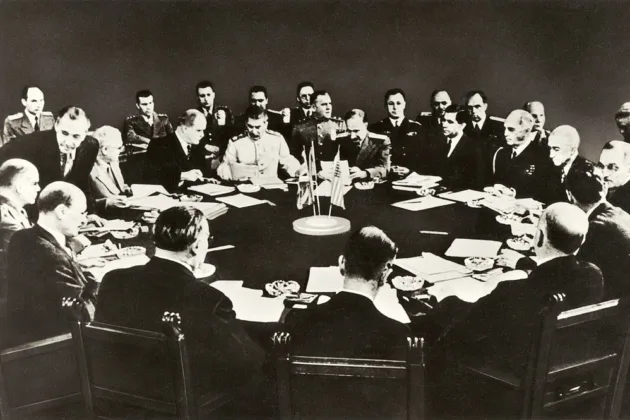
The “eastern report” refers to a comprehensive accounting of wartime losses suffered by the Polish state and its citizens in the country’s eastern provinces, which became part of the Soviet Union under the Tehran, Yalta and Potsdam conference agreements that created the framework for the new order after the second world war.
The Lviv volume contains documents produced by the Soviet Extraordinary Commission for Investigating Losses Caused by German-Fascist Occupiers and Their Collaborators, a body staffed by senior Communist Party officials, Red Army officers, lawyers, doctors and other experts and answerable directly to the Soviet government.
The Soviets counted the losses in Lviv which they occupied in September 1939 when Stalin ordered in the Red Army into Poland’s eastern territories on the basis of the Ribbentrop-Molotov Pact of August of that year which briefly allied the USSR to Nazi Germany, as their own rather than Polish losses.
The USSR benefitted from German reparations after the war whereas the puppet pro-Soviet government installed by the USSR in Poland signed off on an agreement by which Poland was going to be compensated for all its war time losses via the USSR.
The second volume of the report, relating to forestry shows the losses Poland suffered to the environment as well as economic losses of raw materials that come from the country’s substantial forestry resources.
Before the war, Poland was among Europe’s most forested countries, with 8.49 million hectares of forest in 1937 (22 percent of its territory) concentrated mostly in the eastern and southeastern provinces of the country.
Forests in the lost eastern territories yielded an average of 15-20 percent of premium-grade pine suitable for fine carpentry while forests in the territories gained from Germany in the west of the country yielded just 1-2 percent.
The lost resources in forestry could not be recovered quickly as forests regrow over generations whereas buildings can be reconstructed in a relatively short time.
The Polish government announced back in February of this year that it plans to demand reparations from Russia for the period when the country was under effective occupation by the USSR.
Polish PM Tusk who leads the present centre-left government said at the time that a large-scale investigation into the “historical crimes” of the Soviet regime had begun.
The Ministry of Foreign Affairs confirmed that Poland is exploring the feasibility of filing an international lawsuit for compensation, likely to be one of the largest in European history.
It was made clear at the time by the Karski institute which is in charge of the investigation that the report would be even more extensive than that which was prepared by the previous Conservative (P|iS) government on wartime losses caused by Germany, because the period of Soviet occupation was much longer (50 years) whereas the German occupation covered a period of just six years.
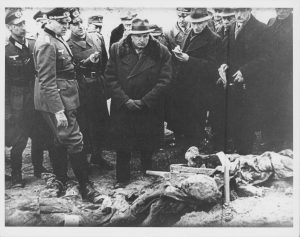
In addition to documented war crimes such as Katyn and the deportations to Siberia the Karski Institute is also assessing losses from population decline and the loss of eastern territories after 1945. The report is intended to reflect the long-term economic and social consequences of Soviet systemic domination during the Cold War.
But the institute admits that the research is challenging because Polish researchers lack access to classified Russian archives, which contain important documents from the Soviet period, making it difficult to fully assess the economic and human losses suffered during the period of Soviet control.
If Poland files an official lawsuit against Russia and achieves international consideration, this could set a precedent for other countries in Central and Eastern Europe that were also under Soviet influence.
Experts note that even the mere fact of launching an investigation could have serious political consequences, increasing pressure on Russia in the international arena.
Even before Poland signalled it was looking at making a reparations claim Russia was hostile to Polish interpretations of history.
The Kremlin, which previously acknowledged responsibility for the Katyn massacre after the USSR was wound up, has been promoting a different version of history since 2022 and has even made financial claims against Poland.
In 2023, the then-chairman of the State Duma, Vyacheslav Volodin, said that Poland should pay Russia 750 billion dollars for its “liberation” at the end of the second world war when the Red Army pushed the Germans out of Poland.
The head of the Russian Federal Archives, Andrei Artizov, has gone on record saying that research commissioned by Russian President Vladimir Putin allegedly showed that Poland undermined Soviet attempts to cooperate with Britain and France against Germany, a claim Warsaw categorically denies.
Russian Foreign Ministry spokeswoman Maria Zakharova in February suggested Warsaw could receive a link to a recording of the opera Ivan Susanin, which depicts a Russian peasant leading Polish soldiers to their deaths in a swamp, making it clear Russia dismisses Polish claims out of hand.
Poland’s first reparations demand was made against Germany in 2022 when Warsaw’s PiS officially demanded 1.3 trillion dollars in compensation for damages caused during World War II. The Karski Institute has not, thus far, produced any estimates on the damages which may be claimed from Russia, the country that is legally the successor to the U|SSR.
The claim against Germany was rejected out of hand by Germany which argued that the issue of reparations was legally closed after the war by the settlement reached with the USSR.
However the PiS government and the Presidents allied to the party, Andrzej Duda and Karol Nawrocki have continued to press for the reparations on the international stage and PiS supports making claims against Russia for the damages caused by the USSR.
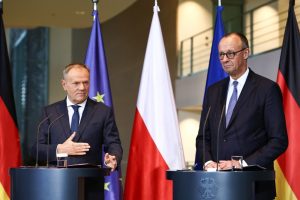
The Tusk government’s strategy however is different. It concentrates politically on claims against Russia rather than pursue them against Germany, a country the present administration sees as an ally.
It has simply put the ball in the court of Germany with regard to the issue of compensation given that Poland never received any during the communist period.
Poland’s thinking is that it needs Germany onside in NATO’s Eastern Flank. Berlin is contributing air defence systems, security cooperation and political weight to the coalition deterring Russia, therefore pressing on these issues is more important than the issue of reparations.
Chancellor Friedrich Merz has taken a number of symbolic steps: he promised to create a Polish memorial in Berlin and return stolen Polish artifacts, emphasizing awareness of historical responsibility, but his compensation offer of 200 million Euro for the still living victims of the war was considered derisory, even by the Berlin friendly Tusk administration.
Russia is legally speaking the successor to the USSR but parts of the territories on which the alleged damages took place are now Ukrainian territory, and there is no sign of Poland pressing any reparations claims against that country.
Legal experts in Poland are skeptical, arguing that there is no clear international legal basis to compel Russia to pay state-to-state reparations.
However, sources at the ministry of foreign affairs in Warsaw have said that the objective of the claim would be for Poland to have some stake in the international settlement that comes out of the conflict between Ukraine and Russia and some participation in any claims made against the Russians.
The conversation about post-war money is already happening. Since Russia invaded Ukraine in 2022, around €210 billion of Russian central bank assets have been frozen across the EU and G7 and western governments are arguing about how to use that cash to rebuild Ukraine and compensate for war damage.
Polish diplomats believe that the very existence of the reparations claim will give Poland some leverage, just as diplomats from the last PiS government felt that a reparations claim against Germany gave them leverage internationally against Germany.
The Tusk government knows that reparations claims are unlikely to be enforced by a court anytime soon,but the objective is to become a creditor in a future settlement of the Ukraine war rather than just a frontline state and logistics hub.
It is also admitted unofficially that the Tusk administration wants to show itself as being tough on Russia looking to right the wrongs of history, just as its PiS predecessor used the reparations claim against Germany in domestic politics.
The popular president Nawrocki has called Tusk’s approach on Germany weak, therefore by ordering a full audit of Soviet crimes allows the PM to claim patriotic ground without risking opposition, as no Polish politician can oppose attempts to hold Russia to account.