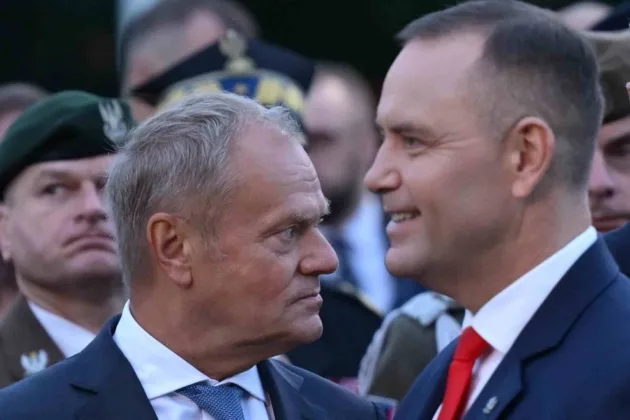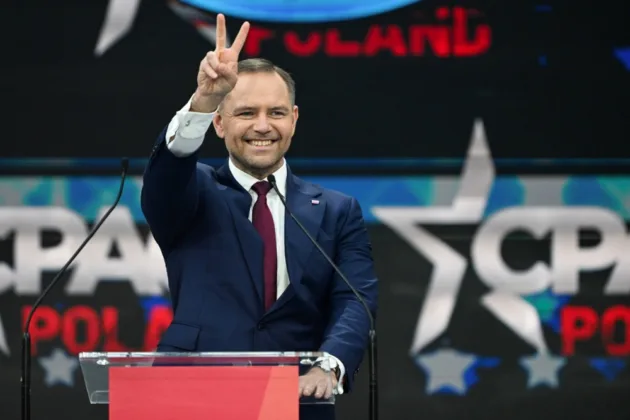


On a hot Warsaw evening on August 6 Polish President Karol Nawrocki held an event for thousands of his supporters to mark a year since he took office that showed his growing confidence and power in a country in which he was a relative unknown before the 2025 presidential election.
The same day, Law and Justice (PiS), the party that supported him in the presidential election, held a policy convention announcing new initiatives. The PiS event was overshadowed, though, not only by Nawrocki’s gathering but also by the fact that the party is involved in a bitter internal split that led former prime minister Mateusz Morawiecki, 40 MPs, one senator and three MEPs to leave it in July.
The contrast was palpable. On the one hand Nawrocki is riding high, with 56 per cent of Poles rating his presidency positively in a United Surveys poll for Wirtualna Polska taken on July 24-25, and is the man all the parties of the right are looking towards as a future broker of a new right-wing government after next year’s parliamentary election. On the other a party that has seen its poll ratings fall from about 27 per cent a year ago to 16.9 per cent in an IBRiS survey for Polsat News published on August 3, and now having to accept that it is no longer the dominant opposition party, but just one of four parties of the right who are jockeying for position ahead of the general election.
The Nawrocki event was a celebration of the fact that the President has had a very good year, which is acknowledged even by his most ardent enemies in the centre-left government led by Prime Minister Donald Tusk.
The event displayed Nawrocki’s common touch, ability to mobilise supporters, dominate the agenda and display the strong team he has gathered around him in the presidential palace.
The enthusiasm for Nawrocki and his messages looked genuine. Jan Rokita, a former Civic Platform MP and senior commentator for the popular internet broadcaster Kanał Zero, said that “Nawrocki really does have his fans” and he found the atmosphere around the celebration “a little reminiscent of Taylor Swift fans”.
On August 6, 2025, the former historian and head of Poland’s Institute of National Remembrance took the presidential oath before the National Assembly, completing an unlikely journey from relative political obscurity to the country’s highest elected office.
His unexpected election victory, by 50.89 per cent to 49.11 per cent, had dealt a bruising defeat to Tusk’s governing camp, ushering in yet another period of cohabitation between the government and a head of state backed by the opposition right and armed with a fresh mandate from the electorate.
During the election campaign Nawrocki had made clear he was going to oppose the Tusk government and that he wanted that administration to depart after the parliamentary elections at the latest.
Many Tusk supporters reacted with fury and denial. Claims were made of irregularities in the counting of the votes, followed by challenges to the legitimacy of the chamber of the Supreme Court that certified the election results and pressure on the Speaker of Parliament to delay Nawrocki taking his oath of office. The Supreme Court confirmed the validity of the election on July 1, 2025.
Tusk acknowledged the result in a televised address on June 2, 2025 but congratulated Nawrocki’s voters rather than the president-elect himself. In the closing weeks of the campaign he had also referred publicly to allegations, published by the news portal Onet on the basis of anonymous former colleagues, that Nawrocki had been involved in procuring prostitutes for guests while working as a security guard at the Grand Hotel in Sopot in his youth. Nawrocki denied the allegations and said he would sue in civil rather than electoral proceedings.
Nawrocki was unfazed by all the personal attacks and muckraking throughout the campaign. If the allegations were meant to provoke or distract him they miserably failed.
Nawrocki’s first year has shown him to be an ambitious and active President. He has not flinched from this course in his first 12 months in office and during his celebratory anniversary event he made clear that he wanted to see presidential powers and his own role in Polish politics expanded further still.
The Polish President has vetoed 41 government bills, more than any other head of state since the end of communism, has blocked the appointment of 44 ambassadors put forward by the government and refused to accept government proposed judicial nominations too. Over the same period he signed 255 bills into law.
But he has also been unusually active in proposing legislation of his own. In a year, he submitted 22 bills and a proposal to hold a referendum on the EU’s climate policies. His legislative proposals have been blocked by the pro-Tusk government parliamentary majority, with 21 of them stuck in the Sejm, but in doing so he has made it clear that he sees the presidency as being pro-active.
“I want, in fact, to change the model of the presidency,” Nawrocki told the crowd. “The president is not only there to review the law and deal with bills that come from parliament. The president is also there to come forward with legislative initiatives and carry your voice and your demands.”
He has appointed 17 presidential advisory councils involving around 700 experts, academics and activists, who work unpaid, to help him. One of them is working on proposals to change Poland’s constitution while several others are working on a development strategy for the country as a whole.
“I deeply believe that the presidential development strategy… will become, in the next parliamentary elections, a point of reference for all those who aspire to govern Poland,” Nawrocki said.
The government has done its best to resist the President’s attempts to increase his role in domestic and foreign affairs and has been persistently accusing Nawrocki of being obstructive and partisan.
These attacks have not hurt Nawrocki. While his ratings stand at 56 per cent, Tusk was trusted by 35.5 per cent of respondents in an IBRiS poll for Onet conducted on July 24-25.
With regard to foreign policy Nawrocki has played his trump card, good relations with the current President of the USA, very well. He has become Donald Trump’s closest ally in Europe and has made a permanent American military presence in Poland his declared strategic goal, though the decision rests with Washington and talks between the defence ministry and the Pentagon on converting the rotational deployment into a permanent one are still under way.
He has also succeeded in standing up to the Ukrainians over their honouring of nationalist leaders involved in the mass slaughter of Poles during the Second World War in Volhynia. On June 19, 2026 he stripped Ukrainian President Volodymyr Zelensky of the Order of the White Eagle, Poland’s highest decoration, after a Ukrainian army unit was named after the “Heroes of the UPA”, the Ukrainian Insurgent Army. Zelensky returned the order the following day. The move created waves on the international scene and drew renewed attention to the fact that Ukrainian nationalists during the Second World War cooperated with the Nazis, murdered Jews and committed what the Polish parliament in 2016 designated a genocide against Poles.
Nawrocki, unlike his also PiS supported predecessor, Andrzej Duda, has made it clear that while on his watch Poland would continue to support Ukraine against Russia he would not countenance turning a blind eye to past history and if the Ukrainians refused to budge on such matters was willing to oppose Ukraine’s bid for EU membership.
“You can help and you can demand”, Nawrocki told the crowd in Warsaw, encapsulating the change of course he has made from the Duda presidency which had been more accommodating and willing to cut Ukraine slack because of the war with Russia.
The political story of Karol Nawrocki started with PiS leader Jarosław Kaczyński’s gamble. PiS, having lost power in 2023 despite winning 35.38 per cent of the vote, and watched Confederation make inroads into its support on the harder right, in 2025 chose an outsider who could bridge the two electorates and help win those voters back while remaining acceptable to its own base.
This worked, but the presidential election proved that right-wing alternatives to PiS were growing rather than contracting. PiS hoped that after Nawrocki’s victory they would recede but in reality the process of PiS losing votes accelerated after the President’s triumph at PiS’s expense.
Nawrocki’s aides have been hinting that their boss will not hesitate about being pro-active on the domestic political front and that PiS’s internal problem and the fact that no party is likely to win a majority in parliament make that inevitable.
None can dominate the others, and Nawrocki can speak to them all. The presidency has become the stable centre of an unstable but expanding right from which Poland’s next governing coalition could emerge next year.
His popularity extends beyond that of any single right-wing force as he has cultivated good relations with all four parties of the right: PiS, whose candidate for prime minister is Przemysław Czarnek; the breakaway Rozwój Plus (Development Plus), which registered as a parliamentary club on July 30 with 40 MPs and one senator; Confederation Liberty and Independence, the libertarian nationalist grouping led by Sławomir Mentzen and Krzysztof Bosak; and the nationalist Catholic Confederation of the Polish Crown led by MEP Grzegorz Braun.
While Tusk’s Civic Coalition is currently Poland’s most popular political party, on 27.5 per cent in the same IBRiS survey, polls indicate that it would lose power because its coalition partners are doing badly and will not be able to repeat the 2023 situation in which they were able to help Tusk back into office.
If that scenario comes to pass Nawrocki will face the test of having to persuade the parties of the right who may have the majority to form a government that will be seen as very much his administration.
In that way he may achieve the executive presidency he seems to favour without actually changing the constitution.
That will be a much harder task than opposing the Tusk government as it will be dependent on the parties of the right while currently he can oppose the present administration without having to particularly coordinate or lead his allies.
This is why the strategy he says will be presented within a few months, ahead of the general election year, could prove an important moment in which he either grasps or fails to grasp the political initiative and leadership of the Polish right.