


Russia’s Supreme Court has barred the liberal Yabloko party from contesting September’s parliamentary elections, removing the only officially registered party that openly opposes Moscow’s war in Ukraine from the ballot.
The court ruled on August 10 in favour of a lawsuit filed on August 7 by the small pro-Kremlin nationalist party Rodina, whose leader Alexei Zhuravlyov, a sitting State Duma deputy, has called Yabloko’s members “national traitors”.
Supreme Court judge Vyacheslav Kirillov granted the claims seeking to annul the registration of Yabloko’s federal list of candidates for the State Duma, which carried 269 names.
Rodina alleged that Yabloko had received undeclared campaign support, including from Western sources, and had breached campaigning rules.
A Central Election Commission representative told the hearing that Rosfinmonitoring, the State financial monitoring service, had reported that people on the list took money from sources in the United States, Germany, the United Arab Emirates and other countries. The Prosecutor General’s office also asked the court to grant the suit.
Yabloko rejected the accusations. Party leader Nikolai Rybakov, who attended the hearing, said there was no evidence to support them and described the case as an unconstitutional attack on freedom of thought by political rivals seeking to clear the field.
The party was also found to have violated copyright in its campaign materials, which included the unapproved use of images of public persons and scenes from a feature film. Rodina’s filing cited photographs of former president Dmitry Medvedev and the blogger Victoria Bonya, footage from the film War and Peace, illustrations generated with ChatGPT and a line from the 1962 Soviet peace song May There Always Be Sunshine.
Both the commission and the prosecutor rested their support for the suit on the copyright findings rather than on the extremism allegations, Kommersant reported.
“Excluding Yabloko from the election means refusing dialogue with people who ask questions that are uncomfortable for the authorities,” Yabloko founder Grigory Yavlinsky said. Rybakov said the party would appeal within the five-day deadline.
The Central Election Commission had approved Yabloko’s candidate list in late July alongside those of 10 other parties.
The party had campaigned under the slogan “For peace and freedom”. The ruling annuls its federal list; Yabloko had also put forward 135 candidates in single-mandate constituencies.
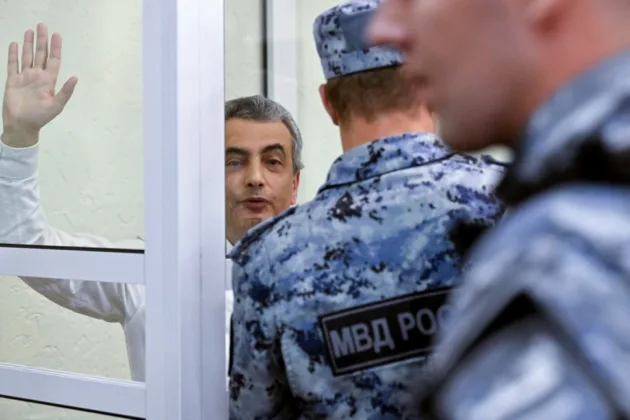
Several of its members had already been barred from running, including deputy leader Maxim Kruglov, who was sentenced on June 24 to seven years in prison over two social media posts published in 2022 about Bucha and Mariupol. Rybakov was himself fined for displaying “extremist” symbols, a penalty that disqualified him from standing.
Hundreds of mostly young supporters gathered outside the Moscow courthouse during the seven-hour hearing, which the court streamed online. When the verdict was announced many chanted “Shame! Shame!” Some carried apples, a reference to the party’s name, which means “apple” in Russian. The party’s press service put the crowd at about 500.
Kirillov was also the judge who declared the rights group Memorial “extremist” earlier in 2026.
Yabloko was registered in 2001 and is one of Russia’s oldest political parties, tracing its roots back to an electoral alliance established in 1993.
Once a leading liberal force in post-Soviet Russia, Yabloko now holds a handful of regional seats and has not won representation in the national parliament since 2003.
During the 2021 elections 1.34 per cent of the vote went to the party.
Recent polls by state pollster VTsIOM put its support at around 3 per cent, below the 5 per cent threshold required to enter the State Duma.
Ten parties will compete for the 450 seats in the lower chamber of the Russian parliament during the 2026 parliamentary elections, which are scheduled for September 18-20.
Pro-Kremlin parties, led by United Russia, are widely expected to dominate the September vote.
The ruling does not take legal effect until appeal proceedings are complete. Novaya Gazeta reported it was the first time in post-Soviet Russia that a registered federal list has been struck from a State Duma ballot.