





The Higher Administrative Court of Saxony-Anhalt has confirmed that membership of or support for the state’s right-wing Alternative for Germany (AfD) association can justify the revocation of weapons permits.
In three final decisions published on August 10 — case numbers 3 L 44/25, 3 L 45/25 and 3 L 51/25 — the court’s third senate rejected applications for leave to appeal against earlier rulings by the Magdeburg Administrative Court.
The cases involved current and former members or supporters of the AfD state association, which the state Office for the Protection of the Constitution has classified as confirmed right-wing extremist since November 2023, having listed it as a suspected case in January 2021.
The police authorities had revoked the individuals’ firearms licences.
The court held that the plaintiffs lack the “reliability under weapons law” required by section 5(2) no. 3 of the Weapons Act (Waffengesetz).
That provision states that a person is generally considered unreliable if they belong to or support an association that pursues aims directed against the constitutional order.
The judges made clear that the rule applies to ordinary party members as well as active supporters and does not require a formal ban on the party by the Federal Constitutional Court.
The claimants had argued the reverse. They invoked the “party privilege” set out in the Basic Law and said disadvantages under weapons law could follow only once the Federal Constitutional Court had banned the party outright.
They also disputed that the AfD in Saxony-Anhalt was directed against the constitution. The court rejected both arguments, stating that neither authorities nor administrative courts pronounce a party ban in weapons-law proceedings and that the legislation sets general reliability requirements applying to all citizens alike.
In its reasoning the court stated that the state need not wait until offences or harm have occurred before acting to protect the public from the extreme dangers of weapons. Risks, it said, may be minimised in advance.
It found that the AfD state association’s overall orientation is directed against human dignity, through the blanket devaluation and exclusion of people with a migration background or of Muslim faith, and against the principle of democracy, through systematic disparagement of state institutions and comparisons with the German Democratic Republic (GDR) or the Nazi regime. The judges based that assessment on speeches, publications and social media posts.
An “objectively combative-aggressive attitude” towards constitutional fundamentals does not require physical violence. Gradual undermining of the basic order, the deliberate stirring of fears or the systematic degradation of population groups is sufficient.
No special circumstances that would justify an exception, such as active distancing from the association’s stance, were established in the three cases.
The decisions give authorities in Saxony-Anhalt a secure legal basis for further action. A court spokesman said the only remaining route for those affected is a constitutional complaint in Karlsruhe.
The Magdeburg Administrative Court had already dismissed the claimants’ challenges in March 2025 after examining material collected by the state constitutional protection authority.
The same senate had reached the opposite conclusion in April 2023, ruling that classification of the state association as a suspected case did not on its own justify revoking a licence.
Similar classifications of AfD state associations exist in Saxony and Thuringia. Elsewhere the party is treated by the domestic intelligence service as a suspected case.
The decisions come against a backdrop of intensified political contest ahead of the state election in Saxony-Anhalt on September 6.
According to reporting by Die Welt, cited by Junge Freiheit, the Greens and the Left party are committing record sums to their campaigns in Saxony-Anhalt and neighbouring Mecklenburg-Vorpommern, which votes on September 20.
The Greens plan to spend €1.5 million in Saxony-Anhalt, more than double the previous record and the highest figure in the state’s history, and a further €800,000 in Mecklenburg-Vorpommern. The Saxony-Anhalt sum breaks down into about €1.2 million for the state association and €300,000 for district branches, out of €2.3 million committed across the two states. The Mecklenburg-Vorpommern budget was raised from €350,000 agreed at the end of 2025.
Greens lead candidate Susan Sziborra-Seidlitz said the anti-fascist strategy answered a need in civil society. Junge Freiheit reported that the two parties are campaigning less on their own policies than against the AfD.
The Left is allocating €562,000 and €600,000 respectively, both described as record amounts. The CDU and the AfD declined to give campaign figures.
An INSA poll for Bild, published on August 10, put the AfD on 42 per cent in Saxony-Anhalt, 20 points ahead of the CDU on 22 per cent.
The Greens’ campaign slogan there is: “Five per cent Greens in the state parliament means zero per cent AfD government.”
Several other parties are hovering at or below the 5 per cent threshold. INSA put the Greens on 4 per cent, the Free Democratic Party (FDP) on 4 per cent and the Sahra Wagenknecht Alliance (BSW) on 5 per cent.
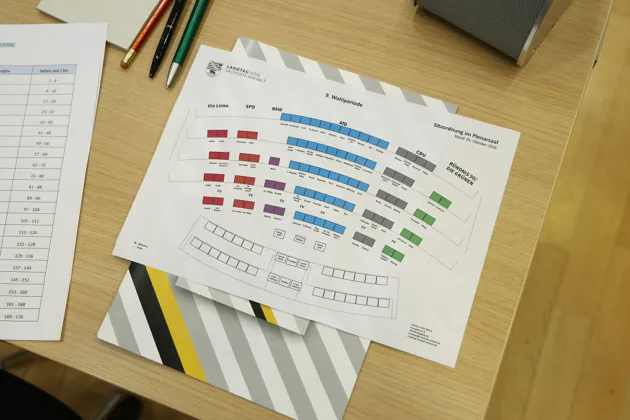
Under the state’s proportional system, votes for parties that fail to clear the threshold are discarded, so the remaining seats are redistributed among those that enter. The state parliament has at least 83 seats.
On those figures, and assuming the BSW clears the bar, the AfD would take roughly 47 to 48 per cent of the seats, short of an absolute majority, yet close enough that a further rise for the AfD or the failure of one more smaller party could tip it over the line. Were the BSW also to fall short, the AfD would hold an absolute majority on those numbers alone.
A new voter survey for the east German State of Saxony-Anhalt shows an option for the AfD to achieve a majority in the state’s parliament after elections in September this year. https://t.co/LXnfX47Jgj
— Brussels Signal (@brusselssignal) March 27, 2026